Golden Hill, San Diego
Updated · 6,729 residents
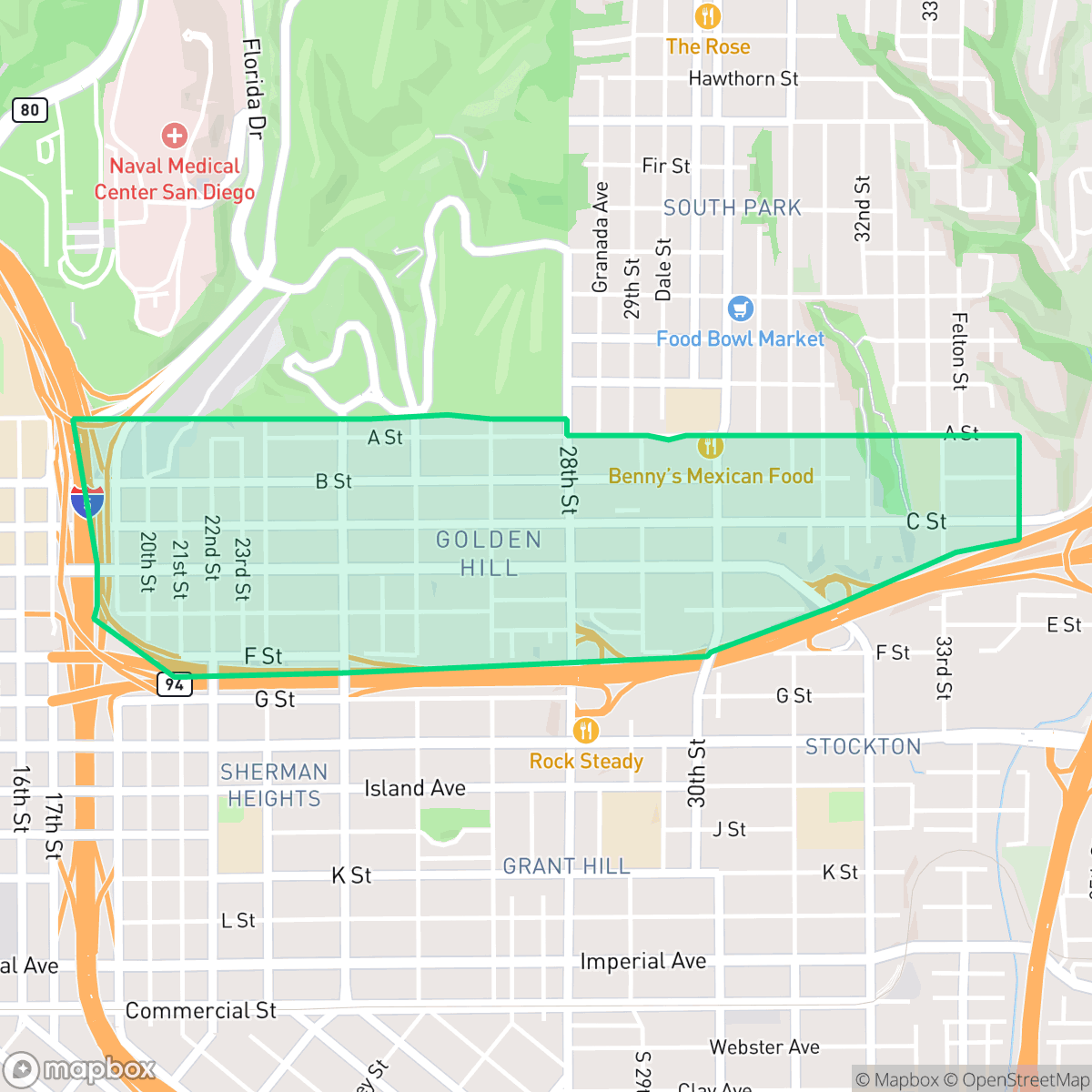
Golden Hill is a highly walkable urban neighborhood defined by its historic architecture and a vibrant local dining scene. While the area offers excellent access to parks and a dense, community-focused environment, residents should anticipate high noise levels from surrounding highway infrastructure.
Key Highlights
About Golden Hill
Initially subdivided in 1869, San Diego's Golden Hill neighborhood was named in 1887 by developers Daniel Schuyler and Erastus Bartlett, inspired by the sun glinting off the hills at dusk. It quickly became an elite residential enclave celebrated for its architectural diversity, ranging from grand Queen Anne and Classical Revival mansions—such as the 1896 Quartermass-Wilde House—to Craftsman bungalows. In 1978, the city established the six-block Golden Hill Historic District to preserve this heritage. The neighborhood is also culturally significant: in 1947, future city council member Leon Williams became its first Black resident by defying a local racial covenant, and the nation's second-ever LGBTQ+ community center opened on B Street in 1972. Today, Golden Hill Park, developed by grassroots community efforts around 1900, remains a vital local landmark.
The neighborhood stands out for its exceptional walkability and consistent street grid, which connects residents to a variety of local dining establishments such as Birria El Rey, Pizzeria Luigi, and the Golden Hill Cafe. Its central location provides convenient access to both urban amenities and green spaces, fostering a lively atmosphere that attracts a diverse group of residents. The built environment is characterized by tightly packed housing, which contributes to a dense, urban feel that prioritizes proximity over expansive private outdoor space.
Prospective residents should weigh the benefits of this central location against specific livability trade-offs. The area is notably loud due to its proximity to major highway infrastructure, and the high density of homes results in limited privacy between properties. Families should be aware that local schools, such as Golden Hill K-8, operate within the San Diego City Unified School District, which is currently navigating budget and operational challenges. Despite these factors, the area remains a popular choice for those who value a pedestrian-friendly lifestyle and a strong, established community identity.
Neighborhood Scores Across 15 Qualities
Residential structures are closely packed with narrow gaps between properties, resulting in lower privacy than the San Diego average. Many homes feature shared property lines or minimal separation between buildings.
Pedestrian access is excellent due to a consistent grid of sidewalks and numerous crossings, even though the neighborhood is bisected by a major freeway. According to iHuus data, this level of walkability is notably higher than the San Diego average.
Visual variety is limited by a prevalence of uniform tract housing and boxy apartment complexes. This neighborhood offers a more functional, dense urban landscape than the San Diego average.
Access to green space for pets varies significantly by street, as some areas feature expansive canyon trails while others consist of dense, concrete-heavy environments. According to iHuus data, overall dog friendliness in Golden Hill is below the San Diego average due to limited park access near certain residential pockets.
Residential streets and natural canyon spaces exist in equal measure, creating a suburban character that is less urbanized than the San Diego average. This area features a blend of multi-family housing and single-family lots interspersed with significant highway infrastructure and commercial zones.
Diverse dining and coffee shops create lively pockets that are more active than the San Diego average. These vibrant blocks sit alongside quieter, more suburban sections characterized by industrial units and residential greenery.
Frequent noise from nearby freeway and railroad corridors makes this a loud area. According to iHuus data, acoustic comfort here is significantly lower than the San Diego average.
Air quality in this area fluctuates between acceptable and unhealthy levels, sitting slightly below the San Diego city average. Sensitive groups may experience occasional concern during periods of poor air quality, according to iHuus data.
Residential and recreational spaces dominate the area, with only limited light commercial activity and no heavy industrial hazards. According to iHuus data, the neighborhood lacks the significant industrial presence found in some other parts of the city.
Health insurance access is below the San Diego city average. According to iHuus data, a significant portion of the resident population lacks coverage.
Voting patterns and census indicators reflect a political landscape that is significantly more liberal than the San Diego average. According to iHuus data, residents can expect a community with deeply established progressive leanings.
Residents live alongside a balanced mix of young adults, families, and seniors. According to iHuus data, this age distribution is very similar to the broader San Diego area.
Significant flood risk exists here because parts of the area fall within a designated floodplain. According to iHuus data, this level of risk is notably higher than the San Diego average and may necessitate flood insurance.
Address-Level Insights for Golden Hill


iHuus Neighborhood Intelligence Insights
Get address-level neighborhood insights for Golden Hill
- Street-level scores — see how individual blocks compare, not just neighborhood averages
- Micro-zone boundaries — identify quiet pockets, flood boundaries, and walkable clusters before you visit
- 15 dimensions in full — walkability, noise, air quality, school quality, insurance coverage, population age profile, urban/rural index, and more
- Boundary risk alerts — know if your address sits near a block boundary where scores drop, the kind of detail no listing will ever mention
- School insights — individual school ratings and insights, not just district-level data
- Compare before you commit — side-by-side data across neighborhoods, down to block precision
No credit card required
Compare with Any Neighborhood
| Dimension | Golden Hill | Adams North |
|---|---|---|
| 🚶 Walkabilityavg 8.58 | ||
| 🔊 Acoustic Comfortavg 3.33 | ||
| 🤫 Privacy Indexavg 4.87 | ||
| 🎨 Visual Appealavg 6.85 | ||
| 🐕 Dog Friendlinessavg 6.91 | ||
| 🗺️ Urban-Rural Indexavg 6.6 | ||
| ✨ Neighborhood Vibeavg 5.12 | ||
| 🏥 Health Insurance Coverageavg 7.53 | ||
| 🌿 Air Qualityavg 6.36 | ||
| 🏭 Industrial Proximityavg 9.12 | ||
| 🌊 Flood Safetyavg 4.2 | ||
| 🗳️ Ideological Leanavg 8.51 | ||
| 👥 Population Age Profileavg 4.8 | ||
| 🔥 Fire Safetyavg 0.61 | ||
| 🏫 School Quality |
Golden Hill Rankings
School Districts Serving Golden Hill
School Insights for Golden Hill
Below average outcomes; significant attendance and academic challenges.
School Insights
See what's really behind every school rating near Golden Hill
- Individual school ratings — each school's own score with outcome context, not just a district average
- Enrollment & class size data — student-to-teacher ratio and how it compares to the state average
- Full demographics breakdown — ethnicity and gender composition for every school in the enrollment zone
- Every school in the district — all schools within the enrollment boundary ranked by rating, not just the closest one
- Grade levels & benchmarks — elementary through high school, with below/above state-average flags
No credit card required