Gaslamp Quarter, San Diego
Updated · 1,007 residents
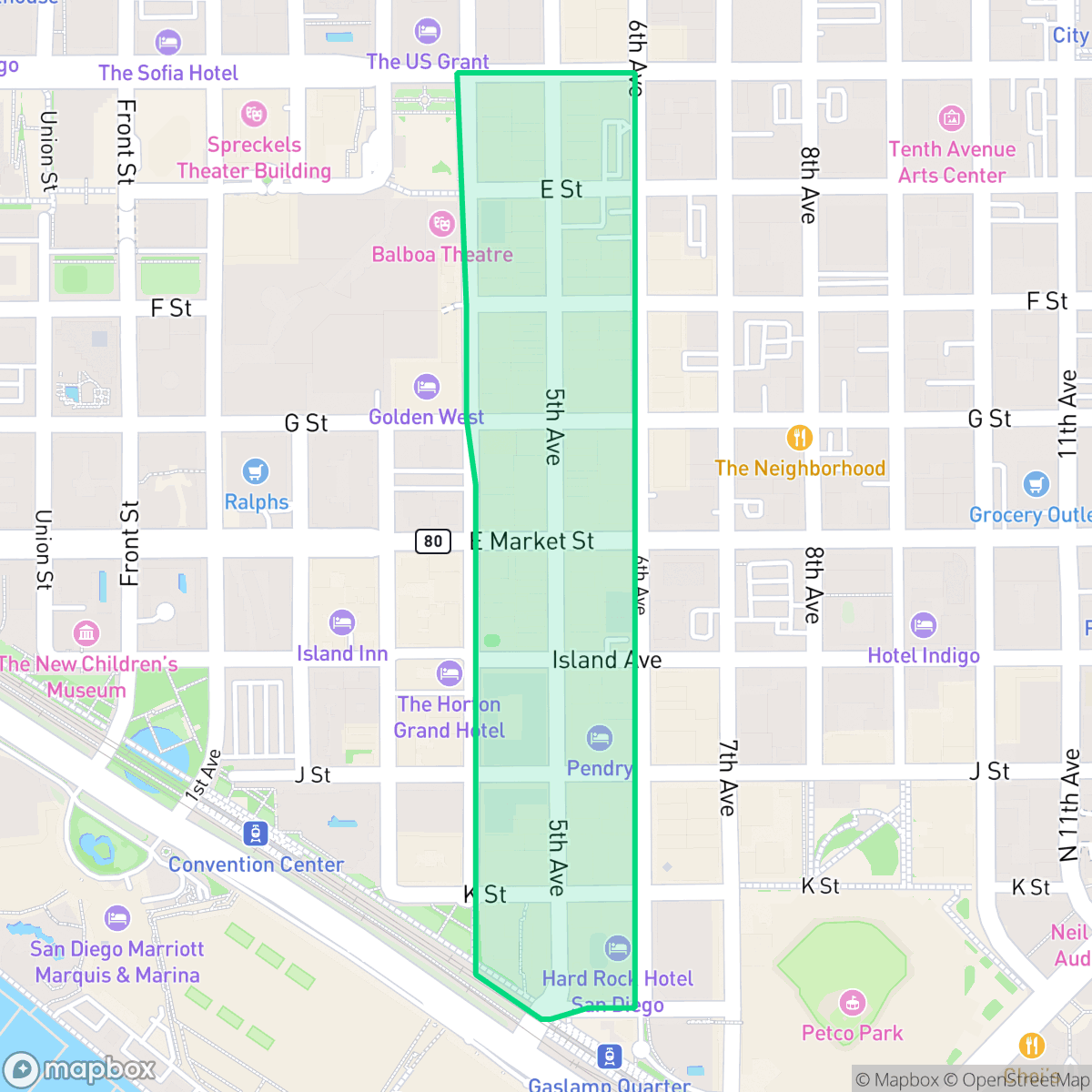
The Gaslamp Quarter serves as San Diego's primary high-energy entertainment hub, defined by its dense urban layout and exceptional walkability. While the neighborhood offers immediate access to diverse dining and nightlife, residents experience significant noise from road traffic and limited privacy due to its high-density residential towers.
Key Highlights
About Gaslamp Quarter
The Gaslamp Quarter in downtown San Diego originated in 1850 when William Heath Davis attempted to establish a waterfront town, erecting a prefabricated saltbox house shipped from Maine—now the historic Davis-Horton House. Though initially dubbed "Rabbitville" due to its sparse population, the area flourished after Alonzo Horton purchased the land in 1867. By the late 19th century, Fifth Avenue became the neighborhood's spine, lined with Victorian-era commercial buildings, Romanesque Revival structures like the Keating Building, and Baroque Revival landmarks like the Louis Bank of Commerce. Historically, the southern portion overlapped with Chinatown and the notorious "Stingaree" red-light district, which was raided and shut down in 1912. Following decades of decline, a major urban renewal movement in the 1970s preserved and restored its historic architecture, transforming the Gaslamp Quarter into a premier cultural and entertainment district.
The neighborhood functions as the central entertainment and dining core of downtown San Diego. It is defined by a high-energy atmosphere, featuring a mix of luxury high-rise apartments and historic commercial structures. According to iHuus data, the area boasts perfect walkability, allowing residents to easily access local landmarks like Petco Park and the nearby Embarcadero waterfront.
Living in this district involves specific trade-offs typical of a dense urban environment. The area is characterized by significant vertical density and shared-wall construction, which results in limited privacy and elevated noise levels from road traffic. While the neighborhood is ideal for professionals seeking immediate access to city amenities, those requiring extensive green space or absolute quiet may find the concrete-heavy environment challenging.
Neighborhood Scores Across 15 Qualities
High density urban living and shared walls in residential complexes result in significantly lower privacy than the San Diego average. According to iHuus data, buildings are often separated only by narrow alleys or streets.
Pedestrian infrastructure is exceptional here, featuring a dense grid of continuous sidewalks, marked crosswalks, and waterfront promenades. This level of accessibility for foot traffic is significantly higher than the San Diego average.
Dense urban structures and modern apartment complexes define the skyline; however, the area lacks the lush greenery and private estates found in more scenic parts of the city. According to iHuus data, the visual landscape is primarily composed of high-density residential and commercial buildings with shared amenities like rooftop pools.
Dense urban concrete grids and narrow sidewalks dominate the area, providing far fewer opportunities for pet exercise than the city average. Access to significant relief is primarily restricted to the nearby Embarcardero and Petco Park.
High-rise buildings and extensive pavement dominate the landscape, resulting in a much higher level of density than the San Diego average. According to iHuus data, the area features significant vertical building density with very little ground-level greenery.
Dense high-rise developments and a continuous concentration of dining and social hubs create a level of activity significantly higher than the San Diego average. This area functions as a primary regional epicenter for nightlife and social interaction, according to iHuus data.
Persistent sound from nearby transit corridors and heavy traffic makes this area slightly noisier than the San Diego average. According to iHuus data, residents may experience frequent disruptions from surrounding infrastructure.
Air quality in this area fluctuates between acceptable and unhealthy levels, appearing slightly lower than the San Diego average. Sensitive groups may experience occasional concern during periods of poor air circulation.
Large warehouses and heavy industrial facilities are absent from this urban center, making the area as free of industrial proximity as the rest of San Diego. However, a massive rail yard and storage facilities located to the south contribute to notable noise and traffic levels.
Health insurance access among residents is significantly lower than the San Diego average. According to iHuus data, a small proportion of the local population maintains active health coverage.
Voting patterns and census indicators show a distinctly progressive leaning that is more pronounced than the San Diego city average. Residents will find the community aligns with liberal political values according to iHuus data.
A diverse range of age groups resides here, including young professionals, families, and seniors. This demographic spread is slightly more balanced than the broader San Diego area, according to iHuus data.
Flood risk levels in this area are higher than the San Diego average. According to iHuus data, the specific risk level remains undetermined because detailed federal flood studies have not yet been completed for this district.
Address-Level Insights for Gaslamp Quarter


iHuus Neighborhood Intelligence Insights
Get address-level neighborhood insights for Gaslamp Quarter
- Street-level scores — see how individual blocks compare, not just neighborhood averages
- Micro-zone boundaries — identify quiet pockets, flood boundaries, and walkable clusters before you visit
- 15 dimensions in full — walkability, noise, air quality, school quality, insurance coverage, population age profile, urban/rural index, and more
- Boundary risk alerts — know if your address sits near a block boundary where scores drop, the kind of detail no listing will ever mention
- School insights — individual school ratings and insights, not just district-level data
- Compare before you commit — side-by-side data across neighborhoods, down to block precision
No credit card required
Compare with Any Neighborhood
| Dimension | Gaslamp Quarter | Adams North |
|---|---|---|
| 🚶 Walkabilityavg 8.58 | ||
| 🔊 Acoustic Comfortavg 3.33 | ||
| 🤫 Privacy Indexavg 4.87 | ||
| 🎨 Visual Appealavg 6.85 | ||
| 🐕 Dog Friendlinessavg 6.91 | ||
| 🗺️ Urban-Rural Indexavg 6.6 | ||
| ✨ Neighborhood Vibeavg 5.12 | ||
| 🏥 Health Insurance Coverageavg 7.53 | ||
| 🌿 Air Qualityavg 6.36 | ||
| 🏭 Industrial Proximityavg 9.12 | ||
| 🌊 Flood Safetyavg 4.2 | ||
| 🗳️ Ideological Leanavg 8.51 | ||
| 👥 Population Age Profileavg 4.8 | ||
| 🔥 Fire Safetyavg 0.61 | ||
| 🏫 School Quality |
Gaslamp Quarter Rankings
School Districts Serving Gaslamp Quarter
School Insights for Gaslamp Quarter
Below average outcomes; significant attendance and academic challenges.
School Insights
See what's really behind every school rating near Gaslamp Quarter
- Individual school ratings — each school's own score with outcome context, not just a district average
- Enrollment & class size data — student-to-teacher ratio and how it compares to the state average
- Full demographics breakdown — ethnicity and gender composition for every school in the enrollment zone
- Every school in the district — all schools within the enrollment boundary ranked by rating, not just the closest one
- Grade levels & benchmarks — elementary through high school, with below/above state-average flags
No credit card required