Fox Canyon, San Diego
Updated · 2,712 residents
Fox Canyon is a residential community in the City Heights area characterized by a dense suburban layout and a network of quiet, walkable streets. While the area offers consistent pedestrian access, residents should expect moderate noise levels primarily driven by local road traffic.
Key Highlights
About Fox Canyon
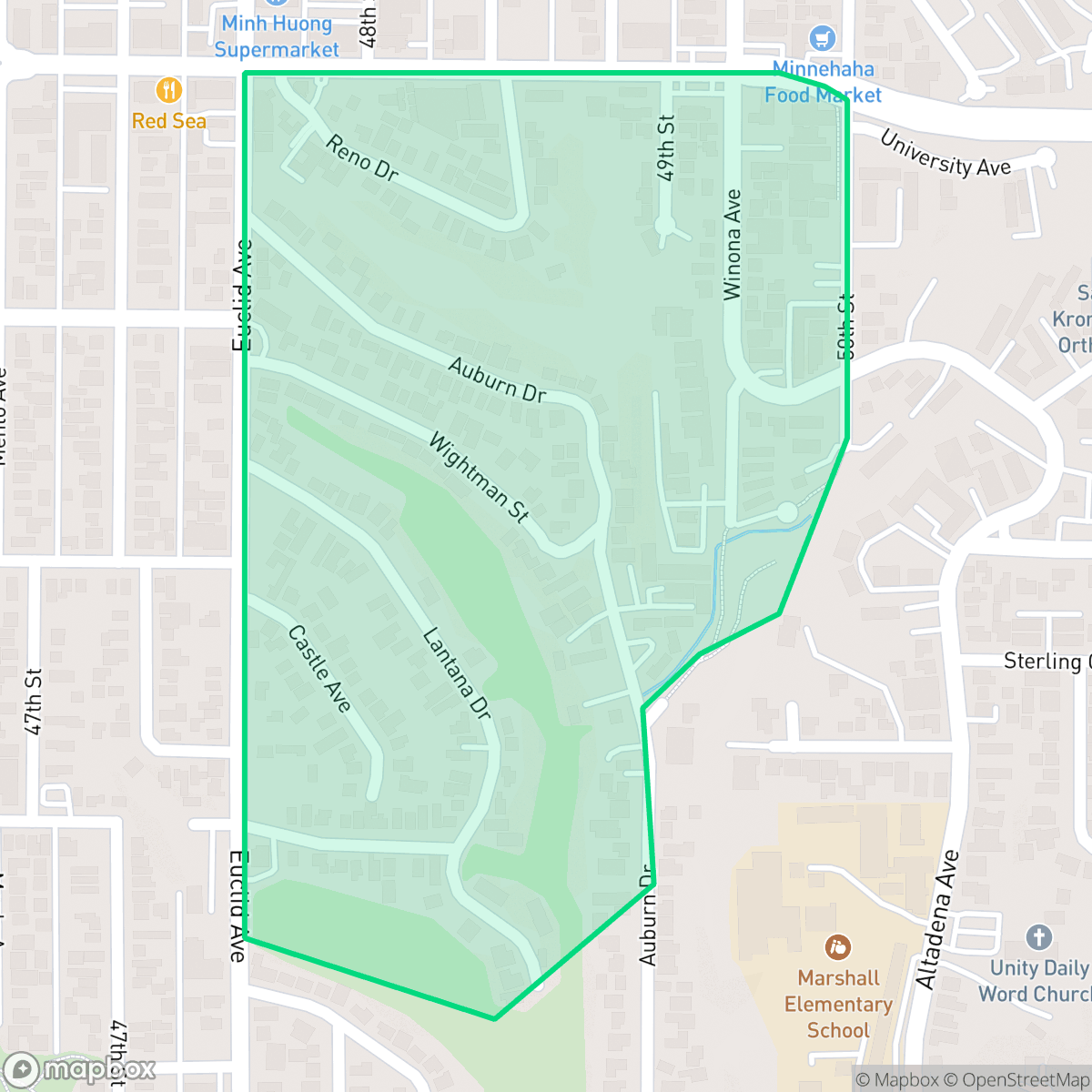
Fox Canyon is a neighborhood in San Diego’s City Heights area with residential roots dating back to 1921, though the majority of its housing stock was developed in the latter half of the 20th century. Historically challenged by blight and crime, the community underwent a major grassroots transformation beginning in 1997. Led by local residents Jose Lopez and Carol Sullinger, the newly formed Fox Canyon Neighborhood Association successfully mobilized to reclaim the area. The association spearheaded crucial local improvements, including the Auburn Drive one-way loop, community cleanups, and the establishment of neighborhood identification signs. Their advocacy also catalyzed municipal efforts to address the neighborhood's park deficit, leading to city planning and funding initiatives for local green spaces like Wightman Street Park.
The area maintains a consistent residential character defined by a mix of single-family homes and mid-sized apartment complexes. According to iHuus data, the neighborhood benefits from a reliable sidewalk network that supports daily pedestrian movement. The proximity to natural canyon spaces provides residents with accessible green areas for outdoor activities, balancing the dense built environment with pockets of nature. The community layout is primarily residential and light commercial, ensuring an environment free from heavy industrial or hazardous sites.
Prospective residents should consider that the neighborhood experiences moderate road traffic noise, which impacts overall acoustic comfort. While the area is largely free of industrial activity, it faces specific challenges regarding flood and fire safety, as well as a lower rate of health insurance coverage compared to the broader city. It is best suited for those seeking an established, community-focused environment within San Diego that prioritizes pedestrian connectivity and local accessibility over luxury amenities.
Neighborhood Scores Across 15 Qualities
Residential spacing is roughly in line with the San Diego average, offering a mix of closely packed homes and natural canyon buffers. Some areas feature higher density with shared walls or houses positioned near one another, according to iHuus data.
Pedestrian connectivity is excellent due to a dense grid of streets featuring consistent sidewalks on both sides and well-connected school zones. According to iHuus data, this level of accessibility is notably higher than the San Diego city average.
Uniform rooflines and small yards define this area, which features less visual variety than the San Diego average. Most properties consist of dense tract housing with limited private luxury amenities or large green spaces.
Local school grounds and natural canyon areas provide ample space for pet exercise. While many residents rely on private backyards, the presence of large park trails and wide paths makes this area slightly less dog-friendly than the San Diego average.
Open land and scattered homes amidst woodland define the area, providing a landscape that is very similar to the San Diego average. Residents will find a blend of low-density residential pockets and pockets of more structured suburban development according to iHuus data.
Suburban streets and green spaces feature a noticeable concentration of social hubs and dining options, making the area more active than the San Diego average. Local favorites like 777 Noodle House and various taco spots provide amenities, though many shops remain a short drive away according to iHuus data.
Steady traffic sounds from nearby busy streets are common here. According to iHuus data, acoustic levels are notably higher than the San Diego average.
Air quality fluctuates between acceptable and unhealthy levels, appearing slightly lower than the San Diego average according to iHuus data. Sensitive groups should be aware of occasional days with increased pollutants.
Industrial activity and heavy warehouses are entirely absent from this area. According to iHuus data, the neighborhood offers a cleaner environment than the San Diego average due to the lack of visible industrial hazards or large-scale manufacturing facilities.
Health insurance coverage among residents is significantly lower than the San Diego average, according to iHuus data. This indicates a high proportion of the local population lacks employer-sponsored or private medical coverage.
Voting patterns and census indicators reflect a notably liberal political leaning, which is more pronounced than the average found across San Diego.
Residents live alongside a balanced mix of young adults, families, and seniors. This demographic spread is slightly more concentrated toward older age groups than the San Diego average, according to iHuus data.
Significant flood hazards and wave action are present in this area, making it much more vulnerable than the San Diego average. Residents should anticipate elevated or potentially prohibitive flood insurance costs according to iHuus data.
Address-Level Insights for Fox Canyon


iHuus Neighborhood Intelligence Insights
Get address-level neighborhood insights for Fox Canyon
- Street-level scores — see how individual blocks compare, not just neighborhood averages
- Micro-zone boundaries — identify quiet pockets, flood boundaries, and walkable clusters before you visit
- 15 dimensions in full — walkability, noise, air quality, school quality, insurance coverage, population age profile, urban/rural index, and more
- Boundary risk alerts — know if your address sits near a block boundary where scores drop, the kind of detail no listing will ever mention
- School insights — individual school ratings and insights, not just district-level data
- Compare before you commit — side-by-side data across neighborhoods, down to block precision
No credit card required
Compare with Any Neighborhood
| Dimension | Fox Canyon | Adams North |
|---|---|---|
| 🚶 Walkabilityavg 8.58 | ||
| 🔊 Acoustic Comfortavg 3.33 | ||
| 🤫 Privacy Indexavg 4.87 | ||
| 🎨 Visual Appealavg 6.85 | ||
| 🐕 Dog Friendlinessavg 6.91 | ||
| 🗺️ Urban-Rural Indexavg 6.6 | ||
| ✨ Neighborhood Vibeavg 5.12 | ||
| 🏥 Health Insurance Coverageavg 7.53 | ||
| 🌿 Air Qualityavg 6.36 | ||
| 🏭 Industrial Proximityavg 9.12 | ||
| 🌊 Flood Safetyavg 4.2 | ||
| 🗳️ Ideological Leanavg 8.51 | ||
| 👥 Population Age Profileavg 4.8 | ||
| 🔥 Fire Safetyavg 0.61 | ||
| 🏫 School Quality |
Fox Canyon Rankings
School Districts Serving Fox Canyon
School Insights for Fox Canyon
Below average outcomes; significant attendance and academic challenges.
School Insights
See what's really behind every school rating near Fox Canyon
- Individual school ratings — each school's own score with outcome context, not just a district average
- Enrollment & class size data — student-to-teacher ratio and how it compares to the state average
- Full demographics breakdown — ethnicity and gender composition for every school in the enrollment zone
- Every school in the district — all schools within the enrollment boundary ranked by rating, not just the closest one
- Grade levels & benchmarks — elementary through high school, with below/above state-average flags
No credit card required