Fairmount Village, San Diego
Updated · 7,752 residents
Fairmount Village is a dense residential neighborhood in San Diego known for its highly walkable grid and diverse architectural landscape. Residents benefit from excellent pedestrian access to local school zones and nearby canyon trails, though the area features closely packed housing with limited private yard space.
Key Highlights
About Fairmount Village
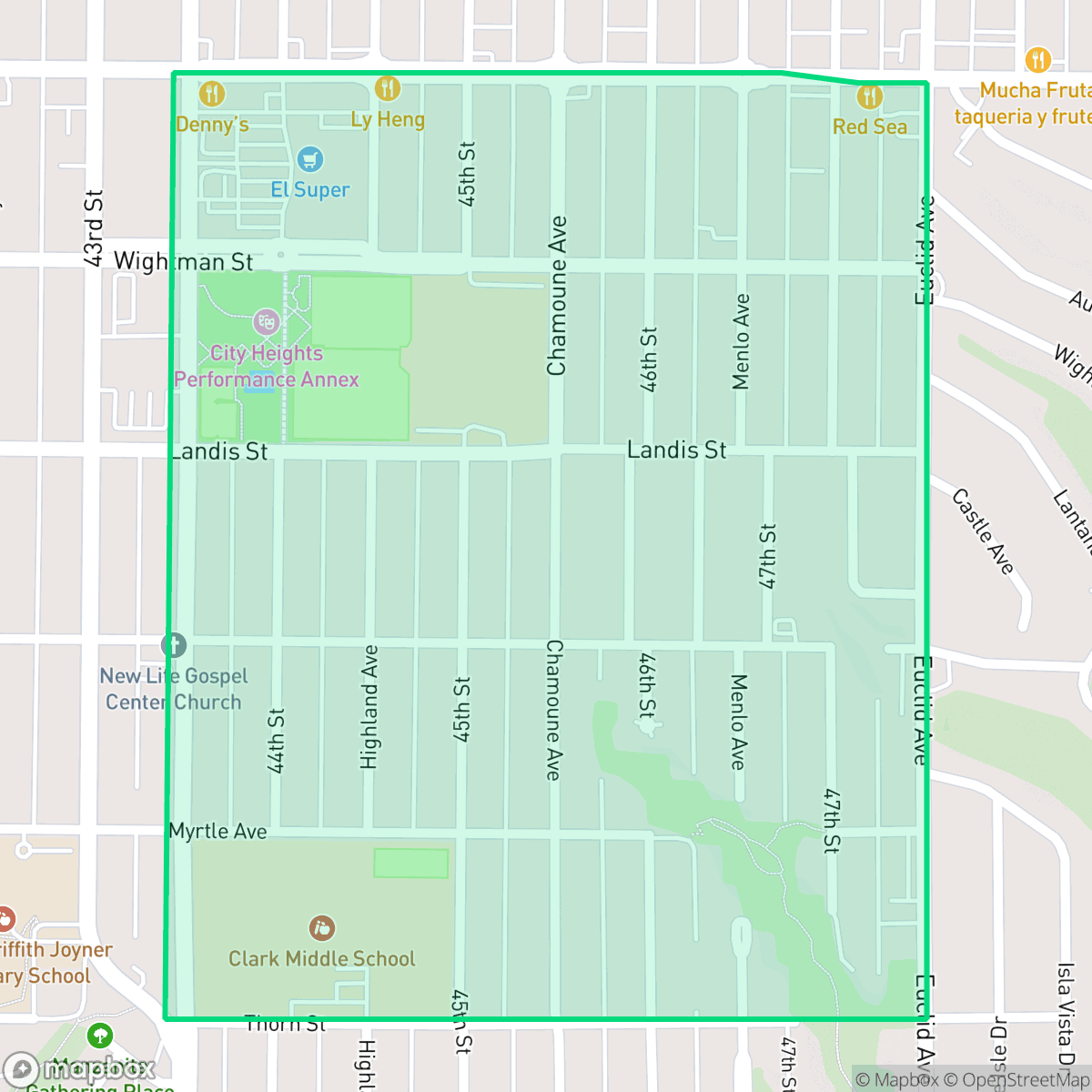
Fairmount Village, a residential neighborhood in San Diego’s City Heights community, is bounded by University Avenue, Thorn Street, Fairmount Avenue, and Euclid Avenue. Developed at the turn of the 20th century, the neighborhood was officially annexed by the City of San Diego in 1926. This history is reflected in its diverse architectural landscape, which features a blend of early Craftsman cottages, mid-century ranches, and multi-family apartment complexes. In the late 20th and early 21st centuries, the neighborhood underwent significant revitalization, highlighted by the City Links infrastructure project and the construction of Rosa Parks Elementary and Monroe-Clark Middle School. Culturally, Fairmount Village is known for its immense diversity, active community organizations, and natural spaces like the 47th Street canyon trail.
The area functions as a quiet residential enclave within the broader City Heights community. It maintains a calm atmosphere, with measured noise levels significantly lower than the city average. The urban layout prioritizes pedestrian movement, offering a high degree of walkability that connects residents to essential local institutions and public spaces. The neighborhood remains free from industrial activity, ensuring a focused, residential environment that benefits from consistent sidewalk infrastructure.
Prospective residents should consider the trade-offs inherent in this dense urban setting. While the lack of industrial hazards ensures a peaceful living environment, the area faces challenges regarding school performance ratings and limited private outdoor space. It is well-suited for those who value connectivity and a central location over expansive private property. According to iHuus data, the neighborhood provides a stable, purely residential environment, though potential residents should note the current educational landscape and local school district constraints.
Neighborhood Scores Across 15 Qualities
Houses are generally spaced with some buffer between neighbors, though certain areas feature closely packed structures. According to iHuus data, the density in Fairmount Village is slightly higher than the San Diego average.
Continuous sidewalks and dedicated pedestrian crossings make navigating the neighborhood on foot very easy. According to iHuus data, the sidewalk network and street connectivity are significantly better than the San Diego average.
Uniform rooflines and compact lots define this area, which offers a more functional and dense residential aesthetic than the San Diego average. Most properties feature small yards and minimal private luxury amenities, according to iHuus data.
Local school grounds and natural canyon areas provide useful walking routes, though public park access is below the San Diego average. Most greenery in the area consists of private backyards rather than expansive public green spaces.
Residential lots feature a dense low-rise mix of single-family homes and multi-unit apartments. This landscape remains largely consistent with the overall density seen across San Diego.
Diverse dining spots and local coffee shops create a social atmosphere that is more active than the San Diego average. While some blocks offer a calm suburban feel, several pockets feature a noticeable concentration of social hubs and eateries.
A consistent level of noise from nearby busy streets characterizes the area, though it remains slightly more peaceful than the city average. According to iHuus data, residents may notice regular ambient sound from local transit corridors.
Air quality in this area fluctuates between acceptable and unhealthy levels. According to iHuus data, these conditions are slightly lower than the average for San Diego.
Industrial activity is non-existent here, as the area consists entirely of residential and light commercial zones. This absence of warehouses or heavy industrial facilities is notably higher than the San Diego average according to iHuus data.
Health insurance access is significantly lower than the San Diego average. According to iHuus data, a small minority of residents in this area maintain active health coverage.
Voting patterns and census indicators show a predominantly liberal political leaning that is more pronounced than the San Diego average. According to iHuus data, this area reflects a much stronger liberal orientation than most other parts of the city.
Residents live alongside a varied mix of young adults, families, and seniors. This demographic spread is slightly more concentrated toward older age groups than the San Diego average, according to iHuus data.
Significant flood hazards exist here due to coastal wave action, which is much higher than the San Diego average. Residents should prepare for elevated or potentially prohibitive flood insurance costs.
Address-Level Insights for Fairmount Village


iHuus Neighborhood Intelligence Insights
Get address-level neighborhood insights for Fairmount Village
- Street-level scores — see how individual blocks compare, not just neighborhood averages
- Micro-zone boundaries — identify quiet pockets, flood boundaries, and walkable clusters before you visit
- 15 dimensions in full — walkability, noise, air quality, school quality, insurance coverage, population age profile, urban/rural index, and more
- Boundary risk alerts — know if your address sits near a block boundary where scores drop, the kind of detail no listing will ever mention
- School insights — individual school ratings and insights, not just district-level data
- Compare before you commit — side-by-side data across neighborhoods, down to block precision
No credit card required
Compare with Any Neighborhood
| Dimension | Fairmount Village | Adams North |
|---|---|---|
| 🚶 Walkabilityavg 8.58 | ||
| 🔊 Acoustic Comfortavg 3.33 | ||
| 🤫 Privacy Indexavg 4.87 | ||
| 🎨 Visual Appealavg 6.85 | ||
| 🐕 Dog Friendlinessavg 6.91 | ||
| 🗺️ Urban-Rural Indexavg 6.6 | ||
| ✨ Neighborhood Vibeavg 5.12 | ||
| 🏥 Health Insurance Coverageavg 7.53 | ||
| 🌿 Air Qualityavg 6.36 | ||
| 🏭 Industrial Proximityavg 9.12 | ||
| 🌊 Flood Safetyavg 4.2 | ||
| 🗳️ Ideological Leanavg 8.51 | ||
| 👥 Population Age Profileavg 4.8 | ||
| 🔥 Fire Safetyavg 0.61 | ||
| 🏫 School Quality |
Fairmount Village Rankings
School Districts Serving Fairmount Village
School Insights for Fairmount Village
Below average outcomes; significant attendance and academic challenges.
School Insights
See what's really behind every school rating near Fairmount Village
- Individual school ratings — each school's own score with outcome context, not just a district average
- Enrollment & class size data — student-to-teacher ratio and how it compares to the state average
- Full demographics breakdown — ethnicity and gender composition for every school in the enrollment zone
- Every school in the district — all schools within the enrollment boundary ranked by rating, not just the closest one
- Grade levels & benchmarks — elementary through high school, with below/above state-average flags
No credit card required