Fairmount Park, San Diego
Updated · 3,457 residents
Fairmount Park is a primarily residential neighborhood in San Diego, defined by its mid-century origins and a balanced, quiet suburban atmosphere. While the area offers residents a stable community feel and notable visual appeal, it is characterized by significant road traffic noise and limited local commercial amenities.
Key Highlights
About Fairmount Park
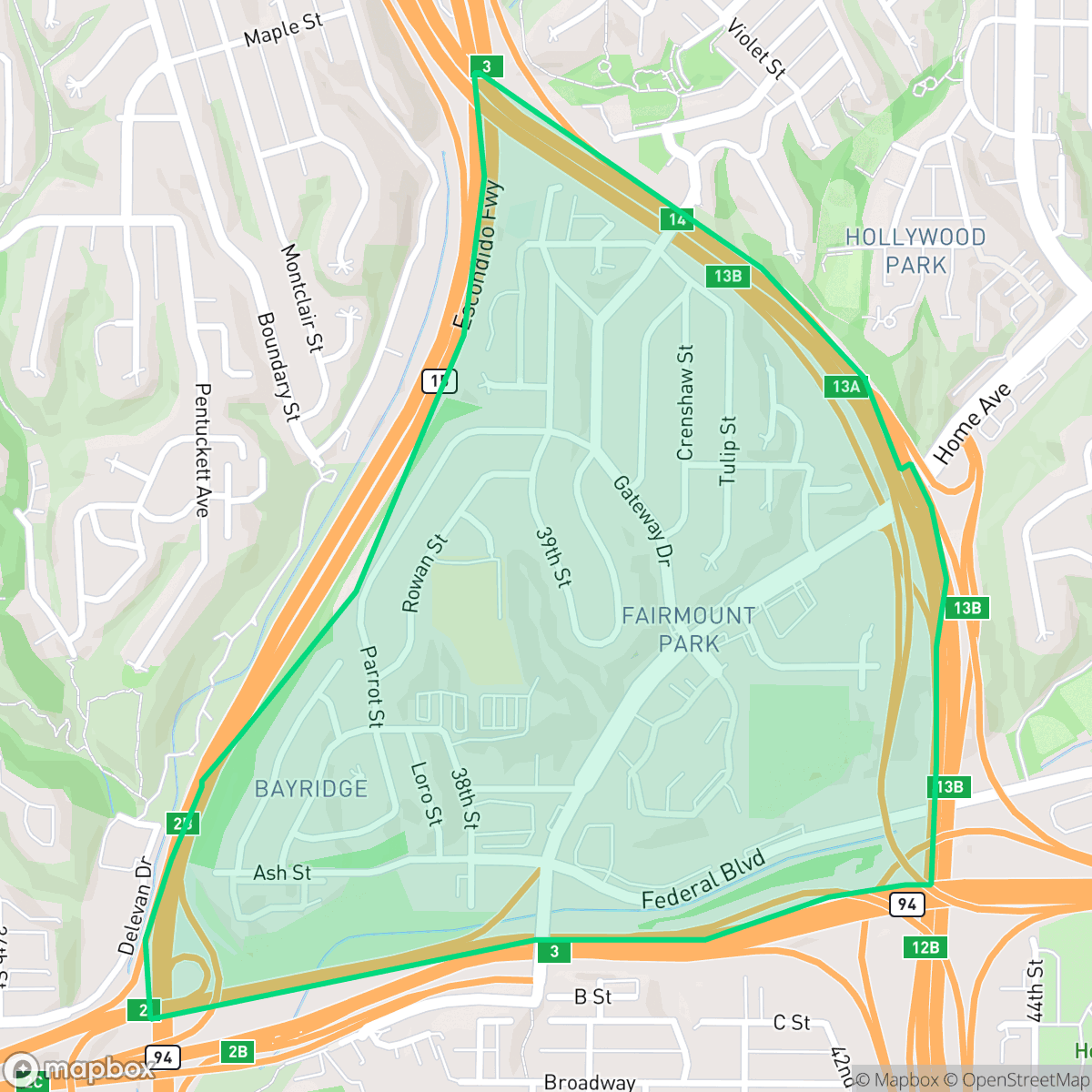
Established in the early 1950s with approximately 500 single-family homes, Fairmount Park is a distinct promontory neighborhood in San Diego. Originally built before the surrounding freeways existed, the neighborhood is now bordered by Interstate 15, Interstate 805, and State Route 94, forming a triangular pocket that locals refer to as the "Golden Triangle" of City Heights. Chollas Creek runs through the community, while Home Avenue serves as its primary diagonal thoroughfare and commercial district. In 1980, the Bayridge duplex townhouse development was built on the neighborhood's westernmost knoll, offering panoramic views of downtown San Diego and the bay. Fairmount Park is historically notable for retaining many multi-generational families and maintaining the highest rate of owner-occupied homes in the City Heights planning area.
Located within the City Heights community of San Diego, Fairmount Park is a settled residential enclave bordered by major transit corridors, including Interstate 15, Interstate 805, and California Highway 94. The neighborhood features a mix of single-family homes and townhouses, with the sub-community of Bayridge known for its prominent views of the surrounding cityscape. It functions as a steady, quiet pocket that maintains a distinct identity, bolstered by long-term residents and a strong sense of local stability. While the area lacks a dense commercial core, it benefits from a small business district along Home Avenue that provides essential services to the local population.
Living in this area involves specific trade-offs for prospective residents, most notably regarding the acoustic environment, as road traffic noise is a persistent factor throughout the neighborhood. The area is not highly walkable, meaning residents typically rely on vehicles for daily errands and commuting. However, the neighborhood is well-regarded for its flood safety and community-oriented atmosphere, making it a suitable choice for families and retirees who prioritize a predictable, residential setting. It offers a balanced urban-rural feel that provides a respite from the intensity of more commercialized districts while remaining within a short drive of downtown San Diego.
Neighborhood Scores Across 15 Qualities
Residential spacing offers a moderate level of seclusion that is slightly higher than the San Diego average. While many homes feature shared fencing and close proximity to neighbors, there is generally a visible buffer between structures.
Quiet streets allow for some pedestrian activity, but the area is significantly less walkable than the San Diego average due to a lack of sidewalks and interruptions from large freeway interchanges. According to iHuus data, navigating the neighborhood on foot can be difficult because the street grid is heavily disrupted by major highway infrastructure.
Residential aesthetics vary between upscale amenities and more uniform, tightly packed housing. According to iHuus data, the overall visual appeal is slightly below the San Diego city average.
Narrow sidewalks and high residential density provide fewer opportunities for walking pets. High levels of freeway noise and a lack of large nearby parks make this area less dog friendly than the San Diego average, according to iHuus data.
A blend of residential tract housing and light industrial zones characterizes the area, which maintains a level of openness similar to the San Diego average. According to iHuus data, some pockets feature denser commercial infrastructure alongside more scattered suburban developments.
Limited commercial activity and a reliance on nearby highway corridors make this area much less active than the San Diego average. Residents will find a quiet, suburban atmosphere with few local businesses within walking distance, though some small dining options and community churches are accessible on foot.
Persistent acoustic disturbance is a significant feature of this area, with noise levels substantially higher than the San Diego average. Sensor data from iHuus indicates that residents may experience frequent loud sounds that impact overall acoustic comfort.
Air quality in this area is moderately acceptable, though it tends to be slightly lower than the San Diego average. Residents may experience occasional days with poor air quality that could affect sensitive groups.
Residential life here is largely uninterrupted by heavy industry, though some light commercial activity and highway-related traffic are present. This neighborhood has noticeably less industrial density than the San Diego average, according to iHuus data.
Health insurance accessibility is notably lower in Fairmount Park than the San Diego average, according to iHuus data. This indicates a higher proportion of uninsured residents compared to most other areas in the city.
Voting patterns and census indicators show a significantly more liberal political leaning than the San Diego average, according to iHuus data.
Residents live alongside a balanced mix of young adults, families, and seniors. This demographic spread is largely consistent with the broader San Diego area according to iHuus data.
Flood risk levels remain undetermined because detailed federal studies have not been completed for this area. According to iHuus data, the risk level is slightly higher than the San Diego city average.
Address-Level Insights for Fairmount Park


iHuus Neighborhood Intelligence Insights
Get address-level neighborhood insights for Fairmount Park
- Street-level scores — see how individual blocks compare, not just neighborhood averages
- Micro-zone boundaries — identify quiet pockets, flood boundaries, and walkable clusters before you visit
- 15 dimensions in full — walkability, noise, air quality, school quality, insurance coverage, population age profile, urban/rural index, and more
- Boundary risk alerts — know if your address sits near a block boundary where scores drop, the kind of detail no listing will ever mention
- School insights — individual school ratings and insights, not just district-level data
- Compare before you commit — side-by-side data across neighborhoods, down to block precision
No credit card required
Compare with Any Neighborhood
| Dimension | Fairmount Park | Adams North |
|---|---|---|
| 🚶 Walkabilityavg 8.58 | ||
| 🔊 Acoustic Comfortavg 3.33 | ||
| 🤫 Privacy Indexavg 4.87 | ||
| 🎨 Visual Appealavg 6.85 | ||
| 🐕 Dog Friendlinessavg 6.91 | ||
| 🗺️ Urban-Rural Indexavg 6.6 | ||
| ✨ Neighborhood Vibeavg 5.12 | ||
| 🏥 Health Insurance Coverageavg 7.53 | ||
| 🌿 Air Qualityavg 6.36 | ||
| 🏭 Industrial Proximityavg 9.12 | ||
| 🌊 Flood Safetyavg 4.2 | ||
| 🗳️ Ideological Leanavg 8.51 | ||
| 👥 Population Age Profileavg 4.8 | ||
| 🔥 Fire Safetyavg 0.61 | ||
| 🏫 School Quality |
Fairmount Park Rankings
School Districts Serving Fairmount Park
School Insights for Fairmount Park
Below average outcomes; significant attendance and academic challenges.
School Insights
See what's really behind every school rating near Fairmount Park
- Individual school ratings — each school's own score with outcome context, not just a district average
- Enrollment & class size data — student-to-teacher ratio and how it compares to the state average
- Full demographics breakdown — ethnicity and gender composition for every school in the enrollment zone
- Every school in the district — all schools within the enrollment boundary ranked by rating, not just the closest one
- Grade levels & benchmarks — elementary through high school, with below/above state-average flags
No credit card required