Encanto, San Diego
Updated · 17,881 residents
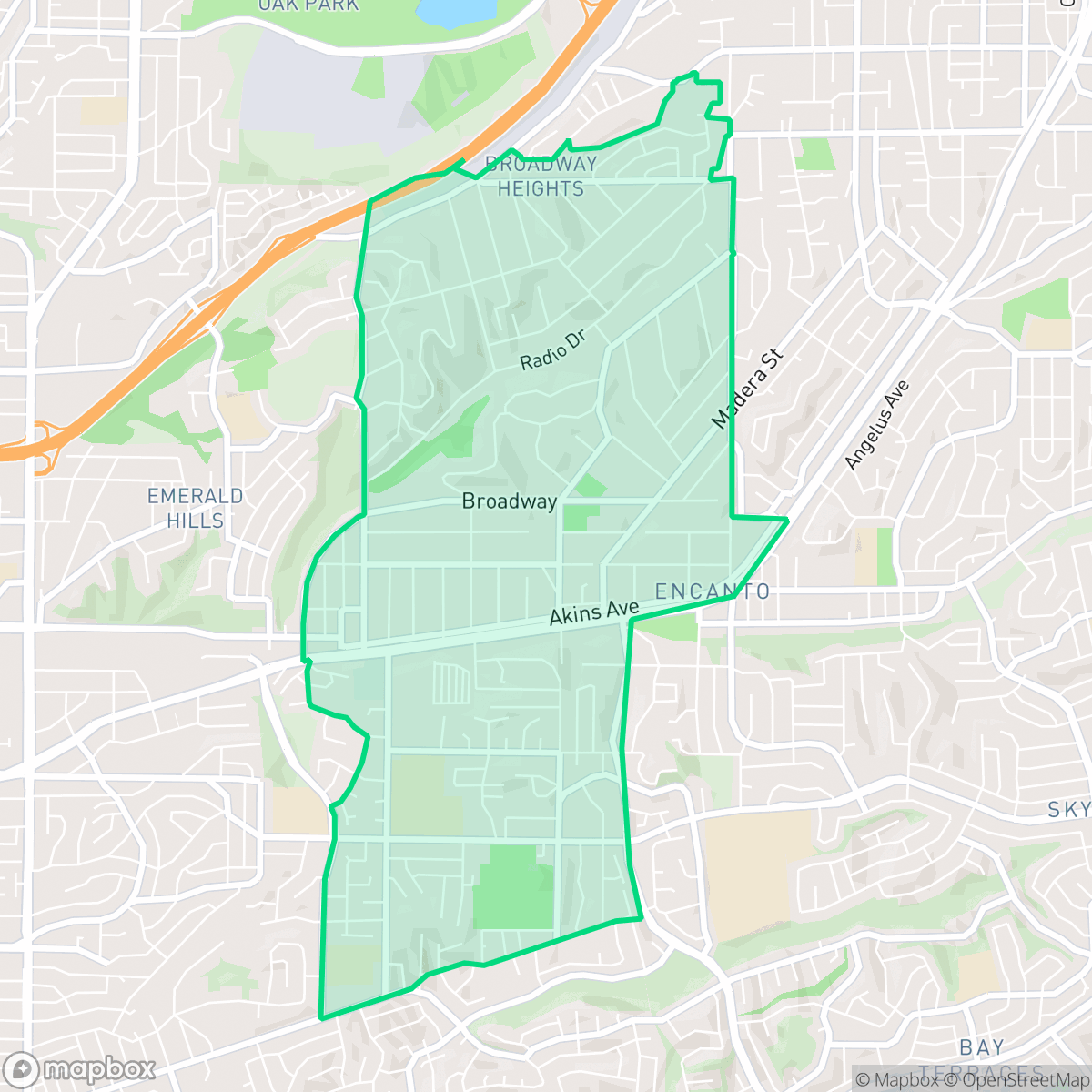
Encanto is a diverse, hilly residential community in San Diego known for its rich cultural heritage and proximity to the Black Arts and Culture District. The area features a dense suburban layout with tightly spaced single-family homes and a quiet, community-focused atmosphere. According to iHuus data, residents benefit from a grid-based street system with consistent sidewalks, although the neighborhood remains primarily car-dependent for most daily errands.
Key Highlights
About Encanto
Initially part of a 19th-century land tract owned by Abraham Klauber, the hilly San Diego neighborhood of Encanto—named for the Spanish word for "enchantment" by Klauber's daughter Ella—was platted in 1891. Subdivided in 1907 as "Encanto Heights," it served as a semi-rural railway stop advertised for small farms and orchards. Following World War II, Encanto transformed into a vital cultural enclave. Because restrictive covenants barred non-white residents from other parts of San Diego, Encanto became one of the city's first neighborhoods where Black, Mexican-American, and Asian-American families could buy homes. Today, this diverse heritage is anchored by Imperial Avenue, which features the San Diego Black Arts & Culture District, and Marie Widman Memorial Park, a hub for local community gatherings and lowrider culture.
The neighborhood is defined by its classic suburban residential fabric, which consists of single-family homes and compact living spaces nestled into the San Diego hills. It maintains a calm, rhythmic pace of life, anchored by social and leisure spots that foster a strong sense of community. While the area is largely residential and institutional, it offers a few local services, such as Sammy's Mexican Bakery and Gualberto's Taco Shop, which serve as neighborhood staples. The lack of heavy industrial hazards makes it a peaceful environment for those seeking a settled, established enclave away from the city's major commercial centers.
Livability in the area involves specific trade-offs, particularly regarding privacy and acoustic comfort. Homes are often closely packed with minimal setbacks, and residents may experience moderate noise levels, primarily driven by road traffic rather than aviation or rail. While the educational landscape is mixed, with district-wide performance variations, local schools like Nye Elementary provide high-quality options for families. The neighborhood is best suited for those who prioritize a quiet, community-oriented lifestyle and are comfortable with a car-dependent environment, as verified by iHuus research on local infrastructure and land use.
Neighborhood Scores Across 15 Qualities
Housing density is slightly above the city average, with property spacing varying between closely packed suburban lots and canyon-facing homes that offer more separation. Residents may find some areas feature minimal setbacks and shared fence lines, particularly near multi-family units and mobile home parks.
Sidewalks and low-traffic cul-de-sacs provide safe paths for walking throughout many residential blocks, though a major arterial road bisecting the area reduces overall walkability compared to the San Diego average. According to iHuus data, while many streets feature continuous sidewalks on both sides, some high-traffic intersections lack distinct pedestrian buffers.
Residential properties vary from standard middle-class tract housing to larger homes featuring private pools and expansive driveways. This level of visual variety is slightly below the San Diego average.
Extensive canyon trails and various local parks provide ample space for exercise; however, overall dog friendliness is slightly below the San Diego average due to limited sidewalk verges in certain residential pockets.
Residential layouts consist primarily of single-family homes and dense suburban tracts interspersed with natural canyon buffers. This landscape is largely consistent with the typical urban-rural balance found across San Diego.
Suburban streets and green spaces provide a tranquil environment, though local business density is lower than the San Diego average. Most social and leisure services are scattered throughout the area, making car access more common than in more densely populated urban centers.
Steady traffic sounds from nearby busy streets are present, though acoustic comfort levels remain higher than the San Diego average. According to iHuus data, the area experiences a consistent hum of local vehicle movement.
Air quality in this area presents a mix of acceptable and unhealthy days. According to iHuus data, conditions are slightly lower than the San Diego city average, which may cause occasional concern for sensitive groups.
Industrial activity is virtually nonexistent here, as the area consists primarily of residential, educational, and light commercial land use. This lack of heavy warehouses or manufacturing facilities makes the neighborhood even cleaner of industrial proximity than the San Diego average.
Health insurance enrollment in Encanto is lower than the San Diego average. This indicates a higher proportion of uninsured residents compared to the rest of the city, according to iHuus data.
Voting patterns and census indicators show a strong liberal leaning that is more pronounced than the San Diego average, according to iHuus data.
Residents live among a diverse demographic of young adults, families, and older individuals. This age distribution is roughly in line with the broader San Diego area according to iHuus data.
Significant flood risk exists due to the area's location within a designated floodplain. According to iHuus data, this vulnerability is higher than the average found throughout San Diego.
Address-Level Insights for Encanto


iHuus Neighborhood Intelligence Insights
Get address-level neighborhood insights for Encanto
- Street-level scores — see how individual blocks compare, not just neighborhood averages
- Micro-zone boundaries — identify quiet pockets, flood boundaries, and walkable clusters before you visit
- 15 dimensions in full — walkability, noise, air quality, school quality, insurance coverage, population age profile, urban/rural index, and more
- Boundary risk alerts — know if your address sits near a block boundary where scores drop, the kind of detail no listing will ever mention
- School insights — individual school ratings and insights, not just district-level data
- Compare before you commit — side-by-side data across neighborhoods, down to block precision
No credit card required
Compare with Any Neighborhood
| Dimension | Encanto | Adams North |
|---|---|---|
| 🚶 Walkabilityavg 8.58 | ||
| 🔊 Acoustic Comfortavg 3.33 | ||
| 🤫 Privacy Indexavg 4.87 | ||
| 🎨 Visual Appealavg 6.85 | ||
| 🐕 Dog Friendlinessavg 6.91 | ||
| 🗺️ Urban-Rural Indexavg 6.6 | ||
| ✨ Neighborhood Vibeavg 5.12 | ||
| 🏥 Health Insurance Coverageavg 7.53 | ||
| 🌿 Air Qualityavg 6.36 | ||
| 🏭 Industrial Proximityavg 9.12 | ||
| 🌊 Flood Safetyavg 4.2 | ||
| 🗳️ Ideological Leanavg 8.51 | ||
| 👥 Population Age Profileavg 4.8 | ||
| 🔥 Fire Safetyavg 0.61 | ||
| 🏫 School Quality |
Encanto Rankings
School Districts Serving Encanto
School Insights for Encanto
Below average outcomes; significant attendance and academic challenges.
School Insights
See what's really behind every school rating near Encanto
- Individual school ratings — each school's own score with outcome context, not just a district average
- Enrollment & class size data — student-to-teacher ratio and how it compares to the state average
- Full demographics breakdown — ethnicity and gender composition for every school in the enrollment zone
- Every school in the district — all schools within the enrollment boundary ranked by rating, not just the closest one
- Grade levels & benchmarks — elementary through high school, with below/above state-average flags
No credit card required