Emerald Hills, San Diego
Updated · 5,507 residents
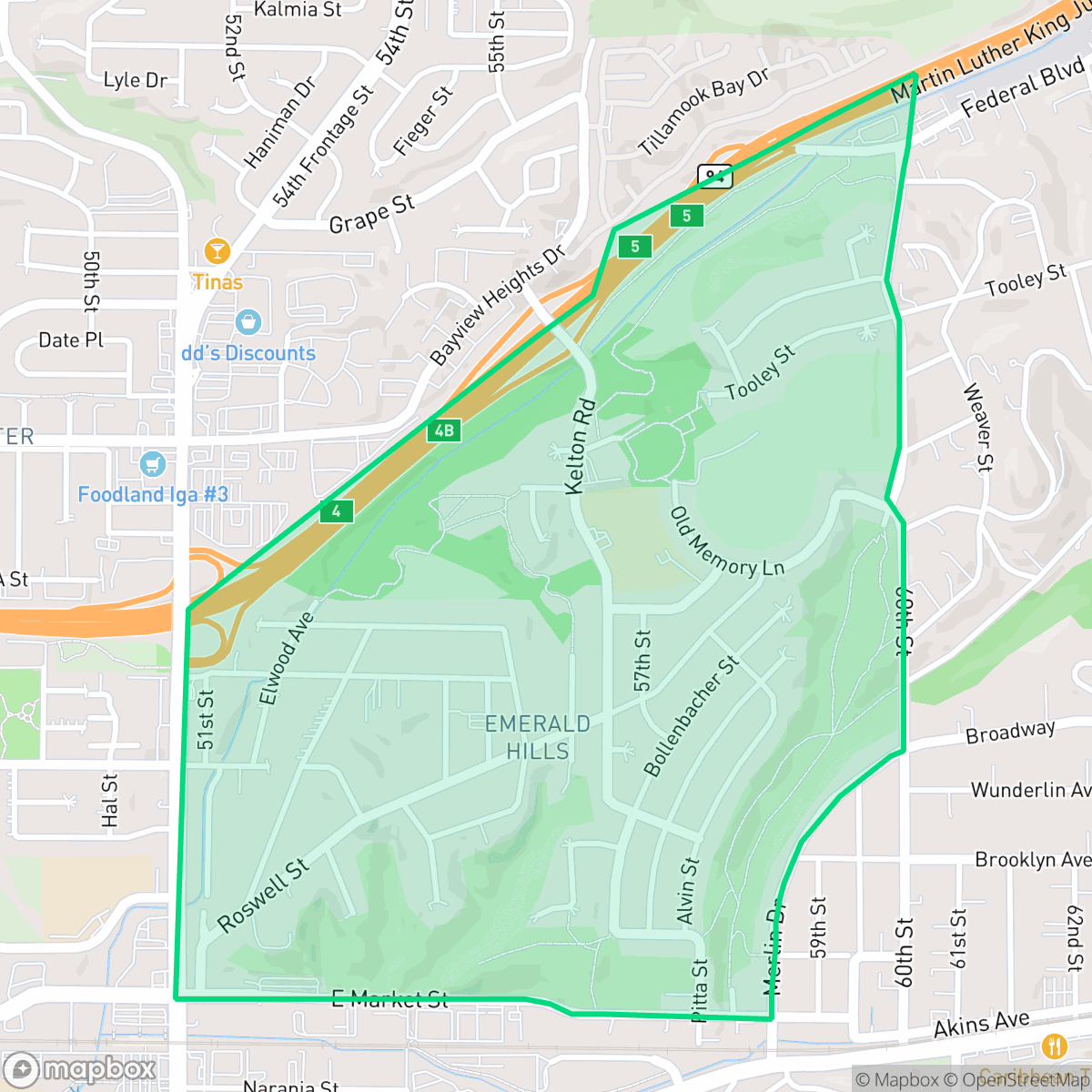
Emerald Hills is a quiet, suburban community defined by its hilly topography and natural canyon buffers. While residents enjoy access to significant green space and dog-friendly trails, the area remains a peaceful residential enclave with limited commercial activity and moderate noise levels from nearby road traffic.
Key Highlights
About Emerald Hills
Established in southeastern San Diego, the Emerald Hills neighborhood is named after the Emerald Hills Country Club and Golf Course, founded in 1929. In 1939, philanthropist Thomas Sharp purchased the club to construct a radio transmitter site for his stations, KFSD-AM/FM (now AM 600 KOGO), which was completed in 1948 atop the neighborhood's highest point. Sharp operated the property as a downsized nine-hole course until 1958, when he sold the remaining land to residential developers. Today, the neighborhood's mid-century housing stock is complemented by natural landmarks like Radio Canyon and Chollas Creek. Notable community hubs include the Malcolm X Library and Performing Arts Center and the Christian Fellowship Congregational Church, which sits on the historic site of the original golf clubhouse.
The neighborhood maintains a distinct suburban character shaped by its mid-century housing stock and prominent natural landmarks. Residents benefit from a mix of property types, ranging from modest suburban homes to larger, well-landscaped residences that take advantage of the hilly terrain. The area is characterized by a low-key, residential atmosphere, with community life centered around local institutions like the Malcolm X Library and Performing Arts Center. Its proximity to natural canyons provides a unique sense of openness, though the overall density remains moderate and consistent with a quiet, established residential district.
Living in this area involves specific trade-offs, particularly regarding connectivity and environmental factors. While the sidewalk network is comprehensive, the steep topography and surrounding highway barriers limit pedestrian accessibility, making vehicle travel necessary for most daily errands. According to iHuus data, the neighborhood provides a stable environment, though prospective residents should consider the higher noise levels associated with road traffic and the specific environmental risks posed by the local terrain. It is best suited for those seeking a tranquil, suburban lifestyle with easy access to outdoor recreation, provided they are comfortable with a commute for major commercial and retail services.
Neighborhood Scores Across 15 Qualities
Housing density varies across the area, with some canyon-facing lots offering more buffer than the closely packed residential clusters. According to iHuus data, this level of spacing provides slightly more privacy than the San Diego average.
Sidewalks are common on residential streets and major intersections, though steep canyon topography and highway barriers limit overall connectivity compared to the San Diego average.
Standard tract housing and apartment complexes define the landscape, featuring boxy rooftops and small yards. This area presents a less varied visual environment compared to the San Diego average.
Extensive natural canyon trails and nearby athletic fields offer significant space for pet exercise. While these green spaces are plentiful, the availability of wide sidewalk verges for walking is slightly below the San Diego average.
Residential streets feature a mix of single-family homes and apartment complexes interspersed with significant natural canyon buffers. This landscape maintains a semi-rural character that is very similar to the San Diego average.
Residential life is characterized by a calm, suburban atmosphere with a steady but low-intensity rhythm of local services. According to iHuus data, the level of activity and commercial density is lower than the San Diego average.
Persistent sounds from nearby freeways and rail lines are common here. This level of acoustic disturbance is consistent with the average found across San Diego.
Air quality fluctuates between acceptable and unhealthy levels, occasionally posing risks to sensitive groups. This rating is slightly lower than the San Diego city average, according to iHuus data.
Residential streets and natural open spaces dominate the area, though some warehouse and commercial activity exists near the southern edge. This lack of heavy industry makes the neighborhood quieter and cleaner than the city average.
Health insurance enrollment among residents is lower than the San Diego average, according to iHuus data. This indicates a higher proportion of uninsured individuals living in the area compared to much of the city.
Voting patterns and census indicators reflect a predominantly liberal community, showing a much higher concentration of liberal-leaning residents than the San Diego average.
Residents live alongside a varied demographic of young adults, families, and seniors. This age distribution is slightly more concentrated toward a single demographic group than the broader San Diego average, according to iHuus data.
Flood risk in this area is slightly higher than the San Diego average, though current assessments remain inconclusive because detailed studies have not been completed for this specific location.
Address-Level Insights for Emerald Hills


iHuus Neighborhood Intelligence Insights
Get address-level neighborhood insights for Emerald Hills
- Street-level scores — see how individual blocks compare, not just neighborhood averages
- Micro-zone boundaries — identify quiet pockets, flood boundaries, and walkable clusters before you visit
- 15 dimensions in full — walkability, noise, air quality, school quality, insurance coverage, population age profile, urban/rural index, and more
- Boundary risk alerts — know if your address sits near a block boundary where scores drop, the kind of detail no listing will ever mention
- School insights — individual school ratings and insights, not just district-level data
- Compare before you commit — side-by-side data across neighborhoods, down to block precision
No credit card required
Compare with Any Neighborhood
| Dimension | Emerald Hills | Adams North |
|---|---|---|
| 🚶 Walkabilityavg 8.58 | ||
| 🔊 Acoustic Comfortavg 3.33 | ||
| 🤫 Privacy Indexavg 4.87 | ||
| 🎨 Visual Appealavg 6.85 | ||
| 🐕 Dog Friendlinessavg 6.91 | ||
| 🗺️ Urban-Rural Indexavg 6.6 | ||
| ✨ Neighborhood Vibeavg 5.12 | ||
| 🏥 Health Insurance Coverageavg 7.53 | ||
| 🌿 Air Qualityavg 6.36 | ||
| 🏭 Industrial Proximityavg 9.12 | ||
| 🌊 Flood Safetyavg 4.2 | ||
| 🗳️ Ideological Leanavg 8.51 | ||
| 👥 Population Age Profileavg 4.8 | ||
| 🔥 Fire Safetyavg 0.61 | ||
| 🏫 School Quality |
Emerald Hills Rankings
School Districts Serving Emerald Hills
School Insights for Emerald Hills
Below average outcomes; significant attendance and academic challenges.
School Insights
See what's really behind every school rating near Emerald Hills
- Individual school ratings — each school's own score with outcome context, not just a district average
- Enrollment & class size data — student-to-teacher ratio and how it compares to the state average
- Full demographics breakdown — ethnicity and gender composition for every school in the enrollment zone
- Every school in the district — all schools within the enrollment boundary ranked by rating, not just the closest one
- Grade levels & benchmarks — elementary through high school, with below/above state-average flags
No credit card required