El Cerrito, San Diego
Updated · 5,380 residents
El Cerrito is a vibrant San Diego neighborhood defined by its diverse architectural character and central hilltop location. Residents enjoy a highly walkable environment with easy access to local coffee shops and community amenities, though the area features a dense suburban layout with limited privacy between homes.
Key Highlights
About El Cerrito
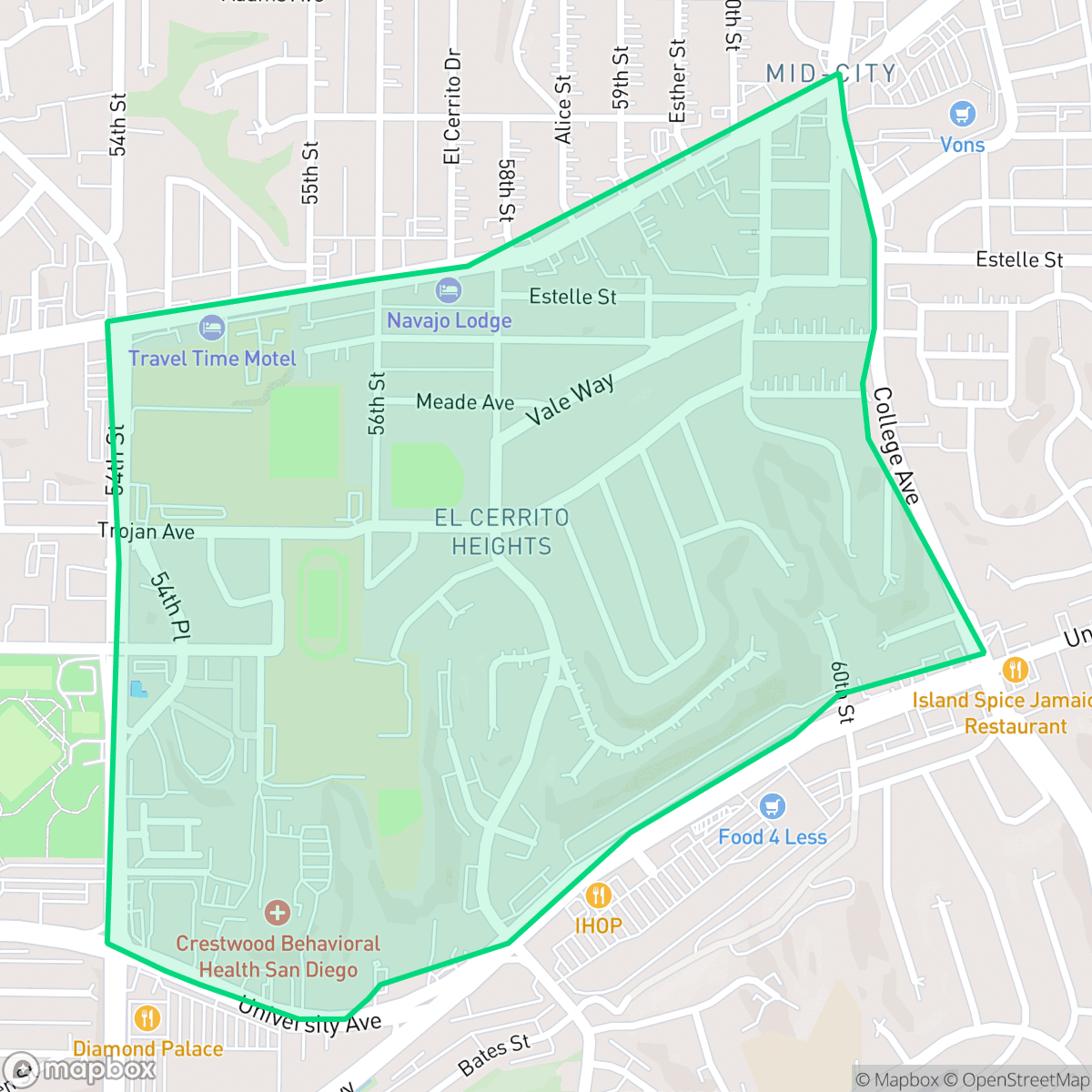
Named for "the little hill" rising between 55th and 58th streets, El Cerrito in San Diego, California, originated in the late 19th century as a rural expanse of orange and lemon orchards. The neighborhood's transition from agriculture to a residential suburb accelerated in the 1920s with the construction of El Cajon Boulevard (historic U.S. Route 80). This era brought subdivisions like El Cerrito Heights and Redland Gardens, giving rise to diverse architectural styles built one by one, including Spanish Colonial and Mediterranean Revival. Post-World War II expansions introduced mid-century modern homes in developments like Cosgrove Terrace and Piedmont Estates. Geographically centered on a hill encircled by Overlook Drive, the neighborhood is anchored by local landmarks such as the historic Blessed Sacrament Catholic Church, which laid its cornerstone on El Cerrito Drive in 1938.
The neighborhood functions as an active community that balances residential comfort with a lively local district. It is characterized by a mix of single-family homes and mid-sized apartment complexes, creating a varied streetscape that avoids the monotony of typical tract housing. Local destinations like Scrimshaw Coffee contribute to a high level of neighborhood engagement, fostering a social atmosphere that stands out within the broader San Diego region. The area remains entirely free from heavy industrial activity, maintaining a focus on residential and educational land use.
Prospective residents should note that the area presents specific trade-offs regarding acoustic comfort and personal space. The proximity of residential structures means that street noise from road traffic is a consistent factor, and the density of the housing stock results in reduced privacy for many properties. While the community is highly walkable, it lacks significant natural disaster protections, such as flood or fire safety infrastructure. It is best suited for individuals who prioritize central access and a social, urban-suburban lifestyle over quiet seclusion or expansive private outdoor space.
Neighborhood Scores Across 15 Qualities
Housing layouts range from detached homes with moderate spacing to more closely packed, shared-wall apartment structures. This level of density and neighbor proximity is typical for the city average.
Extensive sidewalk networks and well-marked crosswalks make navigating the neighborhood on foot easy and safe. According to iHuus data, this level of pedestrian connectivity is slightly above the San Diego average.
Large, well-maintained homes and private backyard pools are frequent throughout the area. According to iHuus data, the overall visual quality is slightly below the San Diego city average.
Access to a large central wooded canyon, park trails, and athletic fields provides more opportunities for pet exercise than the San Diego average. While some residential sidewalks feature narrow grassy verges, the presence of nearby open fields and connected green spaces supports active outdoor use.
Residential pockets feature a dense suburban fabric of single-family homes and apartment complexes interspersed with commercial strip malls. This landscape offers a balance of built environments and open space that is very similar to the broader San Diego area.
Local dining and social spots are more concentrated here than in most parts of San Diego. Residents can find a diverse range of eateries and community landmarks situated along active suburban streets.
Persistent sounds from nearby busy streets characterize the area. This level of acoustic activity is slightly higher than the typical noise levels found across San Diego.
Air quality levels in El Cerrito fluctuate between acceptable and unhealthy ranges. According to iHuus data, conditions are slightly lower than the San Diego average, which may cause occasional concern for sensitive groups.
Residential and light commercial zones dominate the area with very few industrial hazards or heavy warehouses detected. According to iHuus data, the lack of heavy industry in El Cerrito is consistent with the broader San Diego average.
Health insurance access among residents is notably lower than the San Diego average, according to iHuus data. This disparity may indicate a higher reliance on public health programs or uninsured status within the community.
Voting patterns and census indicators show a distinctly liberal political leaning that is more pronounced than the San Diego average. Residents will find a community with deeply established progressive values according to iHuus data.
Residents live among a balanced demographic of young adults, families, and seniors. This age distribution is largely consistent with the broader San Diego area, according to iHuus data.
Properties within this area are located inside a designated floodplain, which signifies a higher vulnerability to flooding than most of San Diego. According to iHuus data, residents may find that flood insurance is a typical requirement for homes in this neighborhood.
Address-Level Insights for El Cerrito


iHuus Neighborhood Intelligence Insights
Get address-level neighborhood insights for El Cerrito
- Street-level scores — see how individual blocks compare, not just neighborhood averages
- Micro-zone boundaries — identify quiet pockets, flood boundaries, and walkable clusters before you visit
- 15 dimensions in full — walkability, noise, air quality, school quality, insurance coverage, population age profile, urban/rural index, and more
- Boundary risk alerts — know if your address sits near a block boundary where scores drop, the kind of detail no listing will ever mention
- School insights — individual school ratings and insights, not just district-level data
- Compare before you commit — side-by-side data across neighborhoods, down to block precision
No credit card required
Compare with Any Neighborhood
| Dimension | El Cerrito | Adams North |
|---|---|---|
| 🚶 Walkabilityavg 8.58 | ||
| 🔊 Acoustic Comfortavg 3.33 | ||
| 🤫 Privacy Indexavg 4.87 | ||
| 🎨 Visual Appealavg 6.85 | ||
| 🐕 Dog Friendlinessavg 6.91 | ||
| 🗺️ Urban-Rural Indexavg 6.6 | ||
| ✨ Neighborhood Vibeavg 5.12 | ||
| 🏥 Health Insurance Coverageavg 7.53 | ||
| 🌿 Air Qualityavg 6.36 | ||
| 🏭 Industrial Proximityavg 9.12 | ||
| 🌊 Flood Safetyavg 4.2 | ||
| 🗳️ Ideological Leanavg 8.51 | ||
| 👥 Population Age Profileavg 4.8 | ||
| 🔥 Fire Safetyavg 0.61 | ||
| 🏫 School Quality |
El Cerrito Rankings
School Districts Serving El Cerrito
School Insights for El Cerrito
Below average outcomes; significant attendance and academic challenges.
School Insights
See what's really behind every school rating near El Cerrito
- Individual school ratings — each school's own score with outcome context, not just a district average
- Enrollment & class size data — student-to-teacher ratio and how it compares to the state average
- Full demographics breakdown — ethnicity and gender composition for every school in the enrollment zone
- Every school in the district — all schools within the enrollment boundary ranked by rating, not just the closest one
- Grade levels & benchmarks — elementary through high school, with below/above state-average flags
No credit card required