Egger Highlands, San Diego
Updated · 10,660 residents
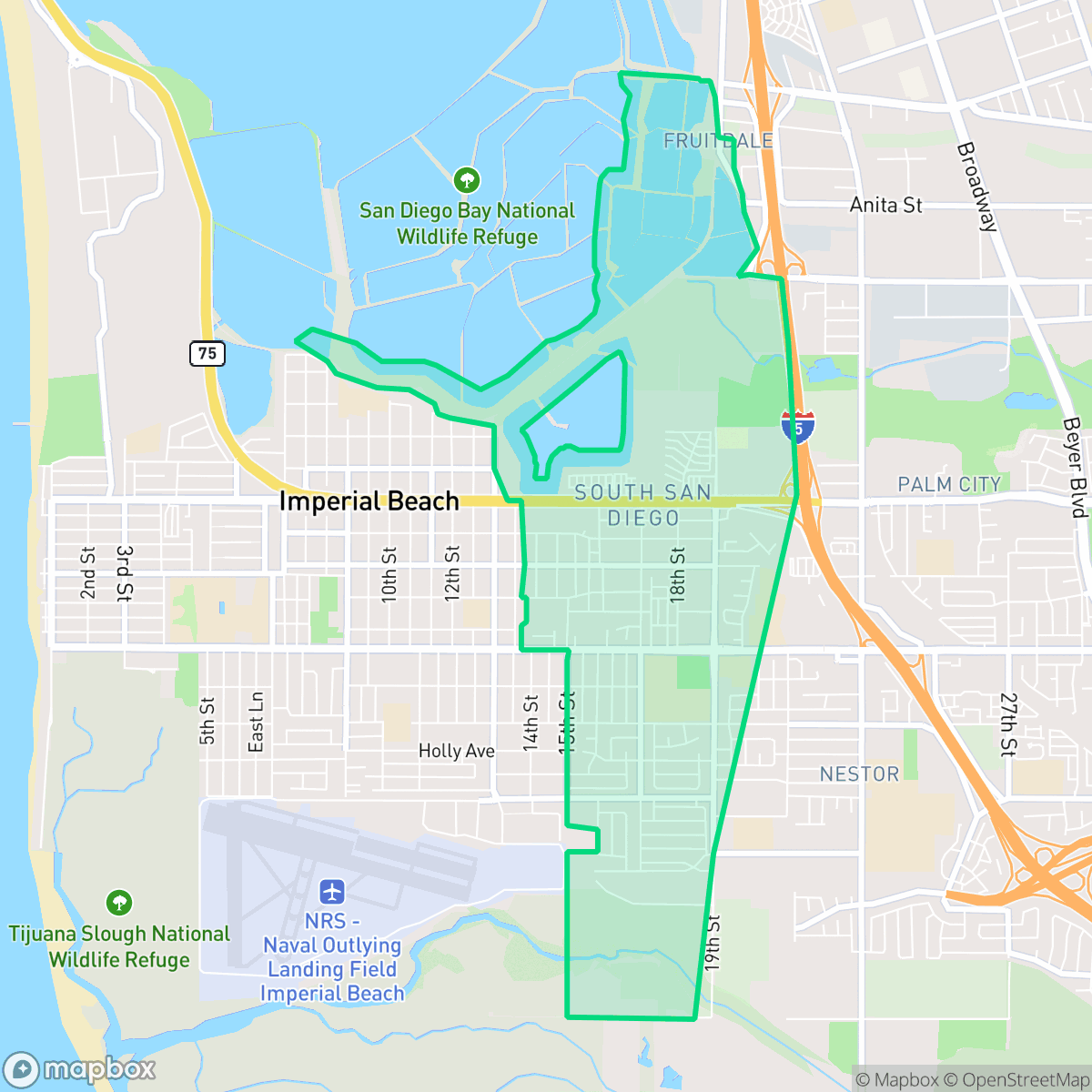
Egger Highlands is a residential community in southern San Diego characterized by its grid-based street layout and standard tract housing. The neighborhood offers a suburban environment with moderate walkability and proximity to local parks, though residents experience some noise from nearby road traffic.
Key Highlights
About Egger Highlands
Located in southern San Diego, Egger Highlands is named after the Egger family, Swiss immigrants who operated a prominent dairy farm in the South Bay area. In 1946, local dairy farmer Robert Egger, Sr. and his family donated a portion of their land on Leyon Avenue to establish St. Charles Catholic Church, the area's first Roman Catholic church, as well as Marian Catholic High School and a local park. Originally unincorporated land in San Diego County, Egger Highlands was officially annexed by the City of San Diego in 1957. Today, the neighborhood's agricultural roots are commemorated at the Robert Egger, Sr. – South Bay Community Park, located at Coronado Avenue and Saturn Boulevard, which remains a central recreational hub for the local community.
The area functions as a dense suburban enclave defined by its uniform residential blocks and proximity to regional industrial zones, including large-scale salt evaporation ponds. While the layout is consistent and features sidewalks on most streets, the density results in closely spaced homes with limited yard space. Residents have access to local dining and green spaces, such as the Robert Egger, Sr. – South Bay Community Park, which serves as a primary recreational node for the community.
Prospective residents should consider the neighborhood's mixed acoustic environment, where road traffic is a notable factor. The educational landscape is varied, with nearby schools ranging from high-performing elementary programs to districts currently facing operational consolidation. This area is well-suited for those prioritizing a straightforward suburban grid and proximity to regional transit arteries, though it requires an acceptance of the trade-offs between suburban density and industrial proximity.
Neighborhood Scores Across 15 Qualities
Residential spacing is somewhat limited, with some clusters of homes and mobile units positioned closely together. According to iHuus data, privacy levels are slightly lower than the San Diego average due to the presence of denser housing developments.
A reliable sidewalk network and marked crosswalks make most residential streets easy to navigate on foot, though major highway proximity can occasionally interrupt pedestrian flow. This level of accessibility is nearly on par with the city average according to iHuus data.
Standard tract housing and mobile home parks characterize the area, which offers a more utilitarian landscape than the San Diego average. Residential lots are typically small with uniform rooflines and minimal private greenery.
Public green space and wide sidewalk verges are relatively sparse here compared to the San Diego average. Most vegetation is found in private backyards, though some residents benefit from proximity to large undeveloped scrubland and corner parks.
Frequent open land and scattered homes amidst woodland or fields provide a slightly more rural atmosphere than the San Diego average. According to iHuus data, the area features a mix of residential grids and expansive open spaces.
A blend of quiet residential pockets and active commercial blocks defines the area, matching the city average for activity levels. While some streets feature accessible dining and social hubs, much of the neighborhood remains low-density and car-dependent.
A steady hum of local traffic from a nearby busy street provides a more noticeable acoustic presence than in many other parts of San Diego. According to iHuus data, the area is relatively quieter than the city average, though some ambient sound remains constant.
Air quality levels fluctuate between acceptable and unhealthy conditions, appearing slightly lower than the San Diego average. Residents sensitive to pollutants may experience occasional concern on certain days according to iHuus data.
Residential and institutional uses dominate the area, with only occasional light commercial structures nearby. While some proximity to salt evaporation ponds exists, the neighborhood lacks heavy manufacturing or large warehouses and remains slightly below the city average for industrial-free surroundings according to iHuus data.
Health insurance enrollment in this area is notably lower than the San Diego average, according to iHuus data. Residents may find fewer neighbors with comprehensive medical coverage compared to other parts of the city.
Political leanings in this area are largely liberal, though the neighborhood leans slightly less progressive than the broader San Diego average according to iHuus data.
Residents live alongside a balanced mix of young adults, families, and older individuals. This demographic distribution is consistent with the broader San Diego area according to iHuus data.
Properties in this area are situated within a known floodplain, which may necessitate flood insurance. According to iHuus data, the risk of flooding in Egger Highlands is higher than the San Diego average.
High levels of wildfire vulnerability exist in this area, representing a significantly greater hazard than the typical San Diego neighborhood. According to iHuus data, extreme precautions and maximum protection measures are necessary for residents.
Address-Level Insights for Egger Highlands


iHuus Neighborhood Intelligence Insights
Get address-level neighborhood insights for Egger Highlands
- Street-level scores — see how individual blocks compare, not just neighborhood averages
- Micro-zone boundaries — identify quiet pockets, flood boundaries, and walkable clusters before you visit
- 15 dimensions in full — walkability, noise, air quality, school quality, insurance coverage, population age profile, urban/rural index, and more
- Boundary risk alerts — know if your address sits near a block boundary where scores drop, the kind of detail no listing will ever mention
- School insights — individual school ratings and insights, not just district-level data
- Compare before you commit — side-by-side data across neighborhoods, down to block precision
No credit card required
Compare with Any Neighborhood
| Dimension | Egger Highlands | Adams North |
|---|---|---|
| 🚶 Walkabilityavg 8.58 | ||
| 🔊 Acoustic Comfortavg 3.33 | ||
| 🤫 Privacy Indexavg 4.87 | ||
| 🎨 Visual Appealavg 6.85 | ||
| 🐕 Dog Friendlinessavg 6.91 | ||
| 🗺️ Urban-Rural Indexavg 6.6 | ||
| ✨ Neighborhood Vibeavg 5.12 | ||
| 🏥 Health Insurance Coverageavg 7.53 | ||
| 🌿 Air Qualityavg 6.36 | ||
| 🏭 Industrial Proximityavg 9.12 | ||
| 🌊 Flood Safetyavg 4.2 | ||
| 🗳️ Ideological Leanavg 8.51 | ||
| 👥 Population Age Profileavg 4.8 | ||
| 🔥 Fire Safetyavg 0.61 | ||
| 🏫 School Quality |
Egger Highlands Rankings
School Districts Serving Egger Highlands
School Insights for Egger Highlands
Below average outcomes; significant attendance and academic challenges.
School Insights
See what's really behind every school rating near Egger Highlands
- Individual school ratings — each school's own score with outcome context, not just a district average
- Enrollment & class size data — student-to-teacher ratio and how it compares to the state average
- Full demographics breakdown — ethnicity and gender composition for every school in the enrollment zone
- Every school in the district — all schools within the enrollment boundary ranked by rating, not just the closest one
- Grade levels & benchmarks — elementary through high school, with below/above state-average flags
No credit card required