Del Mar Heights, San Diego
Updated · 5,523 residents
Del Mar Heights is a coastal San Diego mesa community defined by its mid-century residential architecture and expansive access to local open spaces. The neighborhood is highly walkable and dog-friendly, offering a quiet, suburban atmosphere that balances daily convenience with a serene, low-density environment.
Key Highlights
About Del Mar Heights
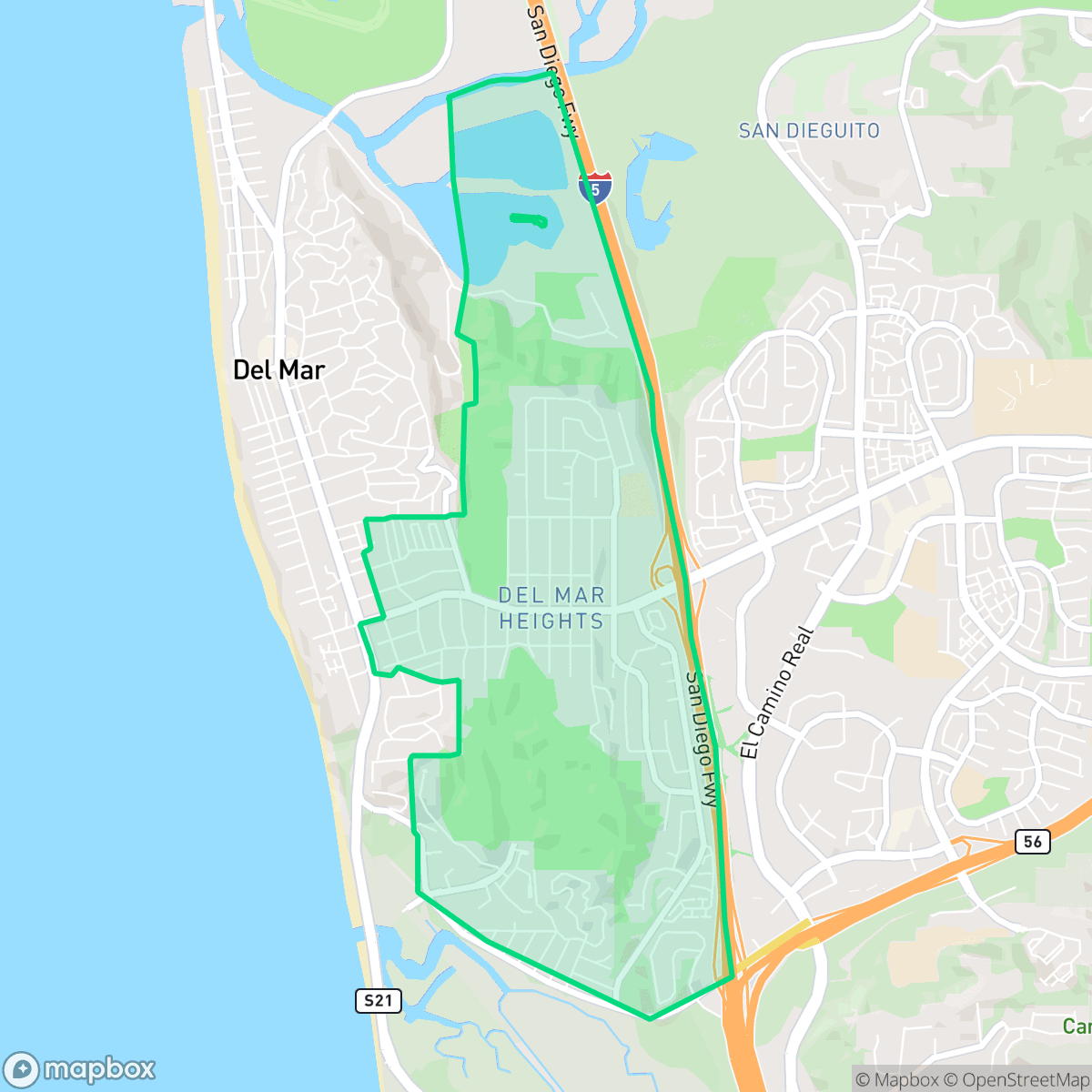
Del Mar Heights, located in northwestern San Diego, originated as part of the coastal territory served by the Del Mar post office. When the neighboring seaside resort of Del Mar incorporated as an independent city in 1959 to prevent high-rise development, residents of the higher, inland mesa chose to remain part of the City of San Diego. The city subsequently designated this annexed area as Del Mar Heights. Much of the neighborhood remained open space until the 1960s and 1970s, when post-war demand for coastal housing led to its development as a 760-lot subdivision. Built out primarily between the 1960s and 1980s, the hilly neighborhood is characterized by mid-century single-family homes, the historic Del Mar Heights School (established in 1959), and proximity to the Crest Canyon Open Space Park.
The area features a blend of residential comfort and accessible commercial amenities, including a variety of local dining options and wellness businesses. While the layout is car-oriented in some sections, the overall neighborhood maintains high walkability and a strong sense of community. Residents benefit from exceptional health insurance coverage and proximity to elite elementary school districts, which remain a primary draw for families settling in the region.
Prospective residents should note that the neighborhood experiences moderate noise levels primarily due to nearby highway traffic. While the area is free from industrial hazards, it faces significant fire safety risks, a common characteristic of the local landscape. The vibe is notably tranquil rather than high-energy, making it well-suited for those prioritizing a quiet, stable environment over an active nightlife scene.
Neighborhood Scores Across 15 Qualities
Residential spacing is varied, with some neighbors positioned closely together while others maintain a buffer. According to iHuus data, the level of separation between structures is slightly higher than the San Diego average.
Continuous sidewalks and low-traffic cul-de-sacs provide a secure environment for walking. This level of walkability is roughly in line with the San Diego average.
Large residential properties and frequent upscale amenities contribute to a visual landscape that is more aesthetically pleasing than the San Diego average. According to iHuus data, the area features spacious driveways and well-maintained surroundings.
Frequent green verges and small parks offer ample space for pet walking. This area is notably more accommodating to dogs than the San Diego average due to the presence of connected green spaces and wide paths.
Frequent open land and scattered greenery provide a more spacious, semi-rural atmosphere than the San Diego average. According to iHuus data, the landscape transitions from pockets of woodland to dense suburban sections featuring office parks and multi-story apartments.
A steady mix of residential life and local services provides a balanced atmosphere, though the car-dependent layout results in a slightly lower level of activity compared to the San Diego average. Residents can find various dining and wellness spots scattered throughout the area, but many daily errands may require driving.
Frequent noise from nearby freeways and transit corridors is a notable feature of this area. According to iHuus data, acoustic levels are slightly higher than the San Diego average.
Air quality remains consistently clear with infrequent periods of poor circulation. According to iHuus data, the air quality in this area is better than the San Diego average.
Industrial activity and heavy warehouse presence are absent from this area, providing a landscape that is very similar to the broader San Diego average. Residents can expect a quiet environment free from large-scale manufacturing or hazardous industrial sites.
Health insurance access is exceptionally high among residents, significantly surpassing the San Diego city average according to iHuus data.
Voting patterns and census indicators show a predominantly liberal community, slightly more so than the San Diego average according to iHuus data.
Residents experience a varied demographic mix of young adults, families, and seniors. According to iHuus data, this population spread is more balanced than the average seen across San Diego.
Some areas within the neighborhood are situated in a flood zone, though this level of risk is notably higher than the San Diego average according to iHuus data.
Wildfire hazards in this area are extremely high, representing a danger level that is slightly above the San Diego average. Residents should be aware of the significant fire safety precautions required for this location according to iHuus data.
Address-Level Insights for Del Mar Heights


iHuus Neighborhood Intelligence Insights
Get address-level neighborhood insights for Del Mar Heights
- Street-level scores — see how individual blocks compare, not just neighborhood averages
- Micro-zone boundaries — identify quiet pockets, flood boundaries, and walkable clusters before you visit
- 15 dimensions in full — walkability, noise, air quality, school quality, insurance coverage, population age profile, urban/rural index, and more
- Boundary risk alerts — know if your address sits near a block boundary where scores drop, the kind of detail no listing will ever mention
- School insights — individual school ratings and insights, not just district-level data
- Compare before you commit — side-by-side data across neighborhoods, down to block precision
No credit card required
Compare with Any Neighborhood
| Dimension | Del Mar Heights | Adams North |
|---|---|---|
| 🚶 Walkabilityavg 8.58 | ||
| 🔊 Acoustic Comfortavg 3.33 | ||
| 🤫 Privacy Indexavg 4.87 | ||
| 🎨 Visual Appealavg 6.85 | ||
| 🐕 Dog Friendlinessavg 6.91 | ||
| 🗺️ Urban-Rural Indexavg 6.6 | ||
| ✨ Neighborhood Vibeavg 5.12 | ||
| 🏥 Health Insurance Coverageavg 7.53 | ||
| 🌿 Air Qualityavg 6.36 | ||
| 🏭 Industrial Proximityavg 9.12 | ||
| 🌊 Flood Safetyavg 4.2 | ||
| 🗳️ Ideological Leanavg 8.51 | ||
| 👥 Population Age Profileavg 4.8 | ||
| 🔥 Fire Safetyavg 0.61 | ||
| 🏫 School Quality |
Del Mar Heights Rankings
School Districts Serving Del Mar Heights
School Insights for Del Mar Heights
Below average outcomes; significant attendance and academic challenges.
School Insights
See what's really behind every school rating near Del Mar Heights
- Individual school ratings — each school's own score with outcome context, not just a district average
- Enrollment & class size data — student-to-teacher ratio and how it compares to the state average
- Full demographics breakdown — ethnicity and gender composition for every school in the enrollment zone
- Every school in the district — all schools within the enrollment boundary ranked by rating, not just the closest one
- Grade levels & benchmarks — elementary through high school, with below/above state-average flags
No credit card required