Del Cerro, San Diego
Updated · 7,618 residents
Del Cerro is a scenic residential community defined by its hilly terrain, custom mid-century homes, and immediate access to Mission Trails Regional Park. While the area offers high visual appeal and excellent health insurance coverage, residents should anticipate notable noise levels from nearby highway traffic.
Key Highlights
About Del Cerro
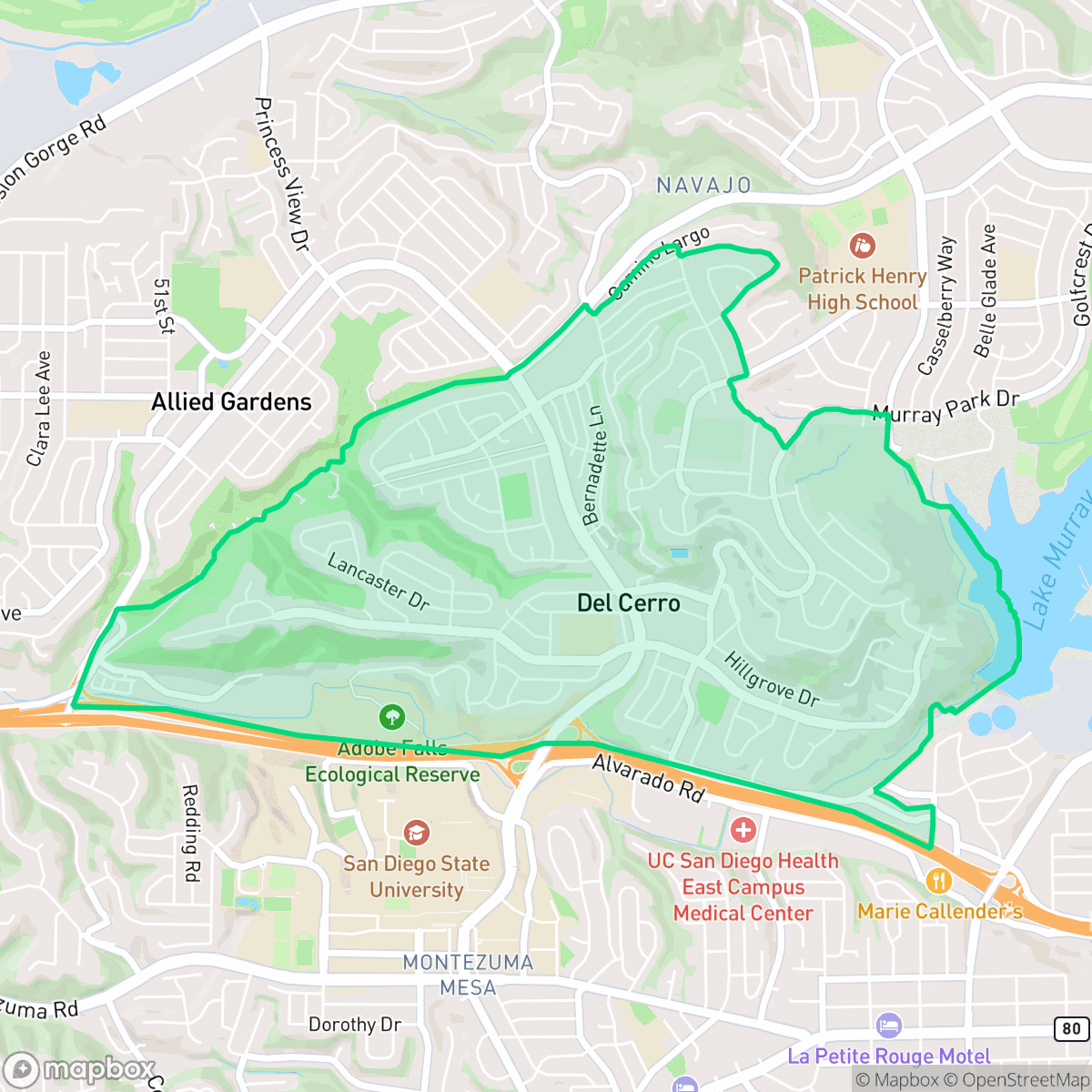
Del Cerro, meaning "of the hill" in Spanish, developed as a scenic residential suburb in the late 1950s, 1960s, and 1970s to accommodate San Diego State University's growth. Its development began in 1957 when Jackson Scott purchased flatland south of the hill. Unlike typical tract housing, developers sold scattered lots, resulting in a neighborhood of custom-looking, single-story mid-century homes. A defining local landmark is Adobe Falls, a historic waterfall site that has been the subject of preservation efforts by the Del Cerro Action Council. The neighborhood borders the western edge of Mission Trails Regional Park and Lake Murray. Its small commercial center along Del Cerro Boulevard features longstanding local staples like the Windmill Farms organic grocery store. Del Cerro is also notable as the childhood home of Academy Award-winning actress Annette Bening and professional golfer Phil Mickelson.
The neighborhood is characterized by its distinct topography and a collection of custom-built mid-century residences that contribute to its high visual appeal. It serves as a quiet enclave for families, bolstered by the presence of the top-rated Hearst Elementary School. Residents enjoy direct access to outdoor recreation, including the western trails of Mission Trails Regional Park and the recreational opportunities at Lake Murray, which provide a serene environment despite the urban setting.
Living in this area involves specific trade-offs, particularly regarding acoustic comfort. The proximity to major highways results in elevated ambient noise levels, which prospective residents should consider when evaluating specific properties. Furthermore, the neighborhood faces a higher risk of fire compared to the city average, necessitating diligence in home maintenance and emergency preparedness. While the area provides a peaceful, suburban environment, it remains largely car-dependent for daily errands and commuting.
Neighborhood Scores Across 15 Qualities
Residential spacing is slightly higher than the San Diego average, providing a moderate level of separation between homes. While some areas feature houses positioned close together, most lots offer a degree of buffer from neighboring properties according to iHuus data.
Continuous sidewalks are available throughout residential blocks, though proximity to the freeway can impact pedestrian comfort. This area is slightly less walkable than the San Diego average.
Large homes and premium amenities provide a more aesthetically pleasing environment than the San Diego average. According to iHuus data, the area features expansive driveways and various upscale features alongside standard residential developments.
Wide sidewalks and several small green patches provide reliable walking routes that are slightly better than the San Diego average. According to iHuus data, these connected spaces and consistent sidewalk verges offer a safe environment for pet owners.
Residential areas feature significant natural topography and open land interspersed with single-family homes. This landscape provides a slightly more open, semi-rural character than the typical San Diego urban environment.
Suburban blocks offer a mix of serene green spaces and occasional lively social hubs. While some dining and retail options are accessible via walkable paths, much of the area's activity is concentrated near major highway corridors and remains largely car-dependent, which is consistent with the city average.
Frequent noise from nearby major freeways and transit corridors characterizes this area. According to iHuus data, acoustic comfort in Del Cerro is notably lower than the San Diego average.
Air quality levels fluctuate between acceptable and unhealthy, presenting occasional concerns for sensitive groups. According to iHuus data, the air quality in Del Cerro is slightly lower than the San Diego city average.
Industrial presence is virtually non-existent, as the area consists of residential and commercial zones without warehouses or heavy industrial hazards. This lack of industrial proximity is slightly better than the San Diego average according to iHuus data.
Nearly all residents are covered by health insurance, which is significantly higher than the San Diego average according to iHuus data.
Political leanings in this area align closely with the broader San Diego average, characterized by a liberal majority and a small conservative presence according to iHuus data.
A balanced variety of age groups resides here, ranging from young adults to older residents. According to iHuus data, this demographic distribution is slightly more varied than the average found across San Diego.
Flood risk in this area is notably lower than the San Diego average, though some residual risk remains within the 500 year floodplain according to iHuus data.
High levels of wildfire vulnerability exist in this area due to the surrounding landscape. According to iHuus data, this risk level is notably higher than the San Diego average.
Address-Level Insights for Del Cerro


iHuus Neighborhood Intelligence Insights
Get address-level neighborhood insights for Del Cerro
- Street-level scores — see how individual blocks compare, not just neighborhood averages
- Micro-zone boundaries — identify quiet pockets, flood boundaries, and walkable clusters before you visit
- 15 dimensions in full — walkability, noise, air quality, school quality, insurance coverage, population age profile, urban/rural index, and more
- Boundary risk alerts — know if your address sits near a block boundary where scores drop, the kind of detail no listing will ever mention
- School insights — individual school ratings and insights, not just district-level data
- Compare before you commit — side-by-side data across neighborhoods, down to block precision
No credit card required
Compare with Any Neighborhood
| Dimension | Del Cerro | Adams North |
|---|---|---|
| 🚶 Walkabilityavg 8.58 | ||
| 🔊 Acoustic Comfortavg 3.33 | ||
| 🤫 Privacy Indexavg 4.87 | ||
| 🎨 Visual Appealavg 6.85 | ||
| 🐕 Dog Friendlinessavg 6.91 | ||
| 🗺️ Urban-Rural Indexavg 6.6 | ||
| ✨ Neighborhood Vibeavg 5.12 | ||
| 🏥 Health Insurance Coverageavg 7.53 | ||
| 🌿 Air Qualityavg 6.36 | ||
| 🏭 Industrial Proximityavg 9.12 | ||
| 🌊 Flood Safetyavg 4.2 | ||
| 🗳️ Ideological Leanavg 8.51 | ||
| 👥 Population Age Profileavg 4.8 | ||
| 🔥 Fire Safetyavg 0.61 | ||
| 🏫 School Quality |
Del Cerro Rankings
School Districts Serving Del Cerro
School Insights for Del Cerro
Below average outcomes; significant attendance and academic challenges.
School Insights
See what's really behind every school rating near Del Cerro
- Individual school ratings — each school's own score with outcome context, not just a district average
- Enrollment & class size data — student-to-teacher ratio and how it compares to the state average
- Full demographics breakdown — ethnicity and gender composition for every school in the enrollment zone
- Every school in the district — all schools within the enrollment boundary ranked by rating, not just the closest one
- Grade levels & benchmarks — elementary through high school, with below/above state-average flags
No credit card required