Cortez Hill, San Diego
Updated · 2,767 residents
Cortez Hill is a highly walkable urban district in downtown San Diego, defined by a dense mix of historic architecture and modern high-rise living. While it offers excellent access to city amenities and a vibrant atmosphere, residents should be prepared for significant street noise and limited residential privacy due to the high-density environment.
Key Highlights
About Cortez Hill
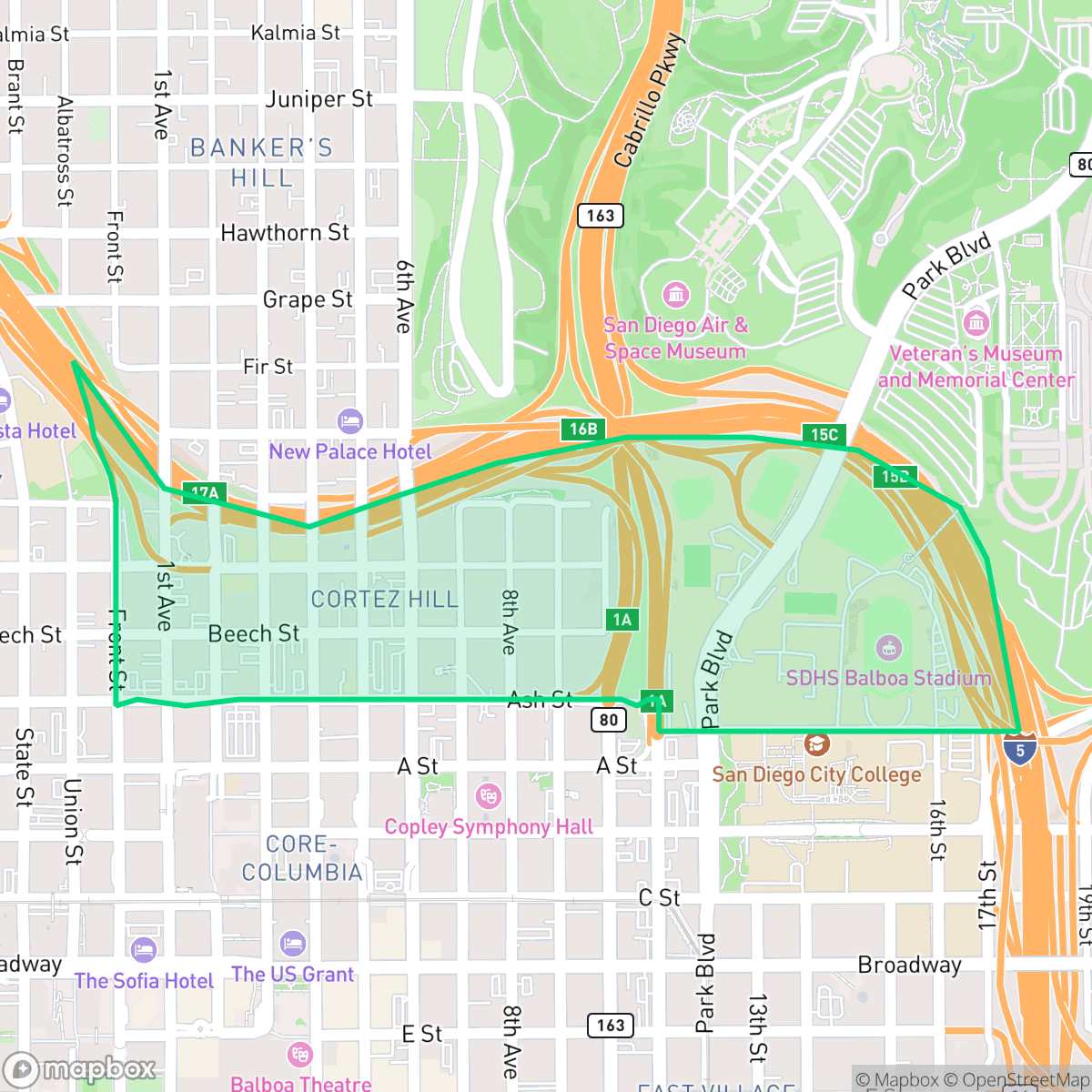
As one of San Diego’s oldest residential neighborhoods, Cortez Hill—originally known as Prospect Hill—developed in the 1880s as an enclave for prominent businessmen who built grand Victorian homes to capture sweeping views of the bay. The area is named for its crown jewel, the El Cortez Hotel. Completed in 1927 in Spanish Renaissance style, the hotel stood as the city's tallest building until 1963 and made history in 1956 by installing the nation's first exterior glass elevator. Other historic landmarks dotting the neighborhood’s 30 blocks include the 1875 St. Joseph Cathedral and the 1904 Tudor-style First Church of Christ Scientist, designed by Hebbard and Gill. Today, this tranquil, elevated district blends its preserved Victorian and mid-century architectural heritage with modern high-rises and the campus of the California Western School of Law.
This area serves as a central residential hub, balancing a rich architectural legacy with a fast-paced, urban lifestyle. It features a consistent grid layout that makes it exceptionally walkable for those commuting to nearby business districts or visiting local dining spots such as The Kebab Shop and Maestro Lounge. The neighborhood maintains a high-energy atmosphere, supported by its proximity to the downtown core and its integration of residential high-rises with commercial activity.
Prospective residents should consider the trade-offs of living in such a dense, central location. According to iHuus data, the area experiences high noise levels primarily from road traffic and lacks the quiet, low-density feel of suburban living. While it provides a strong sense of community and excellent access to public transit, the lack of private outdoor space and the intense urban environment make it better suited for professionals and those who prioritize convenience over acoustic privacy.
Neighborhood Scores Across 15 Qualities
Buildings are closely packed with minimal separation between structures. According to iHuus data, this level of density is significantly higher than the San Diego average.
Extremely easy to navigate on foot due to a dense grid of wide sidewalks and pedestrian-priority infrastructure. This level of walkability is significantly higher than the San Diego average, offering many marked crosswalks and safe crossings over nearby highways.
The landscape features a mix of modern high-rises and mid-range apartment blocks with limited private greenery. This urban density and lack of estate-style features result in a visual profile that is slightly below the San Diego average.
Limited sidewalk verges and a dense urban grid make much of the neighborhood difficult for walking dogs. However, access to large public parks and stadium green spaces in the northeast provides significant relief for pet owners.
Sparse building density and significant open space characterize this area, making it much less urbanized than the San Diego average. According to iHuus data, the landscape consists of medium density residential blocks and major infrastructure rather than a continuous high-rise core.
Dense concentrations of dining, museums, and social venues create an urban energy that is significantly higher than the San Diego average. This area functions as a major regional epicenter for activity, offering a diverse mix of high-rise developments and lively streetscapes according to iHuus data.
Persistent noise from nearby freeway corridors and transit infrastructure is a notable feature of this area. According to iHuus data, acoustic comfort levels are lower than the San Diego average.
Air quality levels fluctuate between acceptable and unhealthy, presenting occasional concerns for sensitive groups. According to iHuus data, the air quality in Cortez Hill is slightly lower than the San Diego city average.
Zero heavy industrial facilities or warehouses are present within the area. This neighborhood remains entirely free of manufacturing hazards, which is more notable than the typical urban distribution seen across San Diego.
Health insurance accessibility is significantly lower than the San Diego average. According to iHuus data, a very small portion of the resident population possesses medical coverage.
Voting patterns and census indicators show a predominantly liberal community, which is more pronounced here than the San Diego average according to iHuus data.
Residents live among a balanced demographic of young professionals, families, and older adults. According to iHuus data, this age distribution is slightly more diverse than the San Diego average.
Flood risk in this area is slightly higher than the San Diego average, though official FEMA studies for this specific zone remain incomplete. According to iHuus data, the lack of detailed federal mapping means residents should remain cautious regarding potential localized drainage issues.
Fire hazards in this area are exceptionally high, representing a significantly greater danger than the San Diego average. Residents should prepare for extreme wildfire threats according to iHuus data.
Address-Level Insights for Cortez Hill


iHuus Neighborhood Intelligence Insights
Get address-level neighborhood insights for Cortez Hill
- Street-level scores — see how individual blocks compare, not just neighborhood averages
- Micro-zone boundaries — identify quiet pockets, flood boundaries, and walkable clusters before you visit
- 15 dimensions in full — walkability, noise, air quality, school quality, insurance coverage, population age profile, urban/rural index, and more
- Boundary risk alerts — know if your address sits near a block boundary where scores drop, the kind of detail no listing will ever mention
- School insights — individual school ratings and insights, not just district-level data
- Compare before you commit — side-by-side data across neighborhoods, down to block precision
No credit card required
Compare with Any Neighborhood
| Dimension | Cortez Hill | Adams North |
|---|---|---|
| 🚶 Walkabilityavg 8.58 | ||
| 🔊 Acoustic Comfortavg 3.33 | ||
| 🤫 Privacy Indexavg 4.87 | ||
| 🎨 Visual Appealavg 6.85 | ||
| 🐕 Dog Friendlinessavg 6.91 | ||
| 🗺️ Urban-Rural Indexavg 6.6 | ||
| ✨ Neighborhood Vibeavg 5.12 | ||
| 🏥 Health Insurance Coverageavg 7.53 | ||
| 🌿 Air Qualityavg 6.36 | ||
| 🏭 Industrial Proximityavg 9.12 | ||
| 🌊 Flood Safetyavg 4.2 | ||
| 🗳️ Ideological Leanavg 8.51 | ||
| 👥 Population Age Profileavg 4.8 | ||
| 🔥 Fire Safetyavg 0.61 | ||
| 🏫 School Quality |
Cortez Hill Rankings
School Districts Serving Cortez Hill
School Insights for Cortez Hill
Below average outcomes; significant attendance and academic challenges.
School Insights
See what's really behind every school rating near Cortez Hill
- Individual school ratings — each school's own score with outcome context, not just a district average
- Enrollment & class size data — student-to-teacher ratio and how it compares to the state average
- Full demographics breakdown — ethnicity and gender composition for every school in the enrollment zone
- Every school in the district — all schools within the enrollment boundary ranked by rating, not just the closest one
- Grade levels & benchmarks — elementary through high school, with below/above state-average flags
No credit card required