Core-Columbia, San Diego
Updated · 7,283 residents
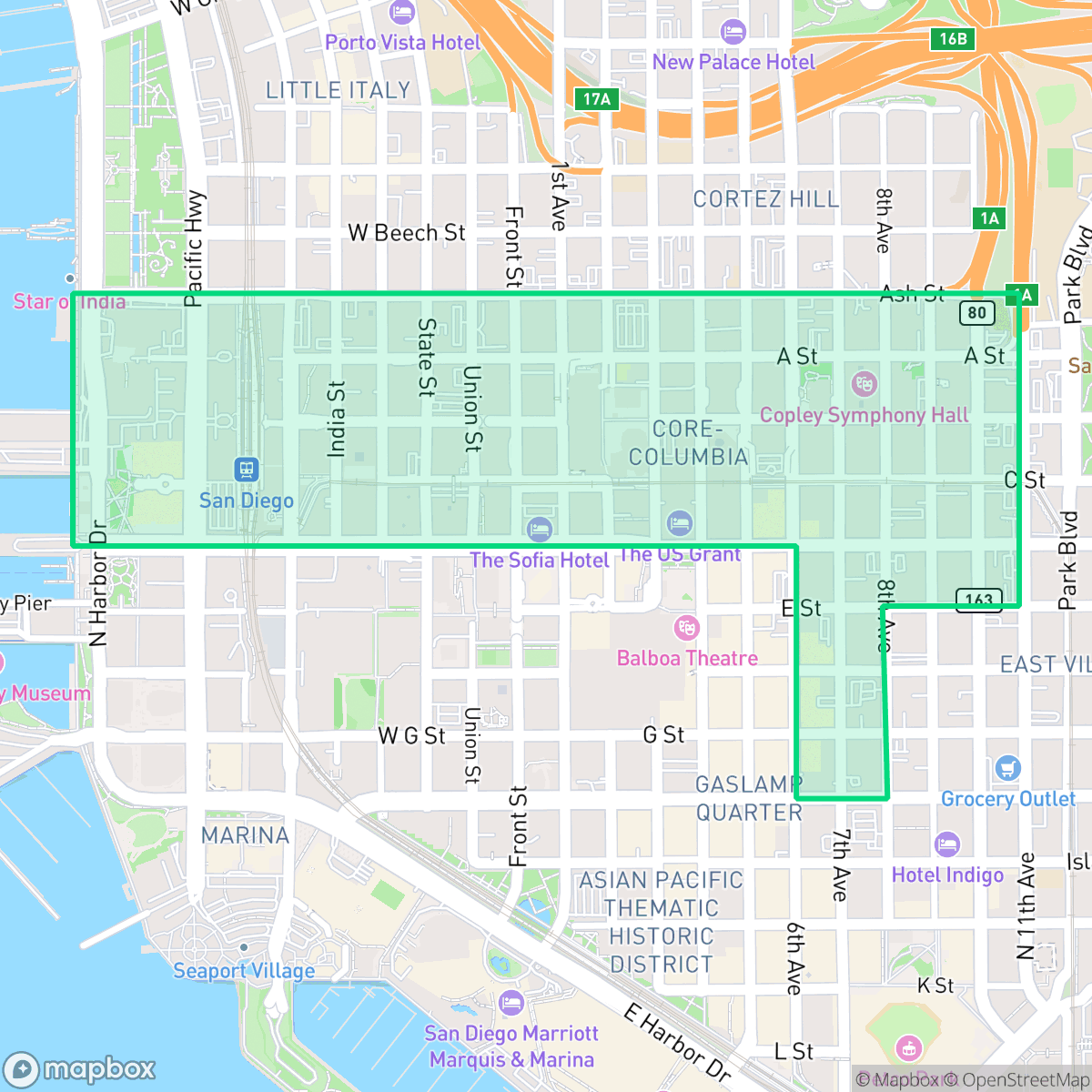
Core-Columbia is a high-density urban district in downtown San Diego defined by its exceptional walkability and vibrant, high-energy atmosphere. Residents benefit from immediate access to major transit and diverse dining, though the area is characterized by limited private outdoor space and elevated urban noise levels.
Key Highlights
About Core-Columbia
Downtown San Diego’s Core-Columbia neighborhood, blending the historic central business and waterfront districts, originated in the mid-19th century as a bustling maritime hub of shipbuilding and trade. Its transformation from an industrial waterfront to a modern urban center is anchored by the landmark Santa Fe Depot, a 1915 Mission Revival-style transit hub famous for its twin domes. The neighborhood’s maritime legacy is preserved along its western edge, home to the Maritime Museum of San Diego and the USS Midway Museum. Culturally, Core-Columbia serves as a civic and artistic center, housing the Museum of Contemporary Art San Diego (MCASD) and the historic Spreckels Theatre. It also holds a key place in local culinary history as the birthplace of San Diego's modern craft beer movement, where Karl Strauss Brewing Company opened its original brewpub in 1989.
This neighborhood serves as the primary urban core of downtown San Diego, functioning as a dense, concrete-heavy environment where commercial and residential buildings share a tight, interconnected grid. The area is defined by its constant activity, featuring a wide array of dining options and high-rise developments that cater to a fast-paced, city-centric lifestyle. With a walkability score that represents the highest tier of accessibility, the district is designed for pedestrians who prioritize proximity to transit and central civic amenities over suburban sprawl.
Living in this area involves distinct trade-offs, particularly regarding privacy and acoustic comfort. Due to the high-density nature of the architecture, residents often share walls or live in close proximity to neighbors, and according to iHuus data, the environment is notably louder than quieter residential pockets of the city. While the neighborhood lacks extensive green space and dog-friendly infrastructure, it remains a top choice for professionals and individuals seeking a central location that eliminates the need for a vehicle. It is best suited for those who thrive in a bustling, high-energy environment and value urban convenience above all else.
Neighborhood Scores Across 15 Qualities
High-density skyscrapers and shared-wall residential complexes create a tightly packed environment with minimal separation between buildings. This level of density is significantly lower than the San Diego average, as noted by iHuus data.
Pedestrian infrastructure is exceptional in this area, featuring continuous sidewalk grids, wide crossings, and waterfront promenades that are significantly more comprehensive than the San Diego average. According to iHuus data, the consistent street grid and dedicated pedestrian-priority zones make navigating the neighborhood on foot highly efficient.
Modern high-rises and apartment blocks with shared rooftop amenities characterize the landscape. This dense urban mix offers a functional aesthetic that sits slightly below the city average for visual variety.
Dense urban pavement and narrow sidewalks dominate the area, making it less dog friendly than the San Diego average. While Waterfront Park and the Embarcadero provide essential relief, pet owners will find very few small parks or grassy verges within the immediate concrete grid.
High-rise towers and extensive pavement dominate the landscape, resulting in a significantly higher concentration of buildings and much less greenery than the San Diego average. According to iHuus data, this area is characterized by massive shadows and minimal unpaved ground.
Dense high-rise developments and major regional attractions create a level of activity and energy that is significantly higher than the San Diego average. This urban core offers constant social engagement through diverse dining, cultural landmarks, and a highly concentrated landscape of interest.
Frequent noise from nearby railroad tracks and major freeway traffic characterizes this area. Levels of acoustic disturbance are higher here than the typical San Diego average, according to iHuus data.
Air quality levels fluctuate between acceptable and unhealthy at times, which is slightly lower than the San Diego average. According to iHuus data, sensitive groups may experience occasional concern during certain periods.
Heavy manufacturing and large warehouses are largely absent from the immediate neighborhood, though proximity to maritime piers and southern rail yards can introduce intermittent noise and traffic. This area remains largely focused on commercial and residential uses, making it comparable to the broader city average regarding industrial proximity.
Health insurance access is significantly lower than the San Diego city average. According to iHuus data, a small portion of the local population maintains medical coverage.
Voting patterns and census indicators reflect a predominantly liberal political leaning that is more pronounced than the San Diego average, according to iHuus data.
Residents live alongside a balanced mix of young professionals, families, and older adults. According to iHuus data, the age distribution in Core-Columbia is slightly more varied than the city average.
Flood risk levels are slightly higher than the San Diego average; however, official FEMA studies for this specific area remain incomplete. According to iHuus data, the precise level of inundation risk for this neighborhood is currently undetermined.
Fire hazards in this area are significant, matching the levels found across San Diego. Residents should remain vigilant regarding local safety protocols and emergency preparedness.
Address-Level Insights for Core-Columbia


iHuus Neighborhood Intelligence Insights
Get address-level neighborhood insights for Core-Columbia
- Street-level scores — see how individual blocks compare, not just neighborhood averages
- Micro-zone boundaries — identify quiet pockets, flood boundaries, and walkable clusters before you visit
- 15 dimensions in full — walkability, noise, air quality, school quality, insurance coverage, population age profile, urban/rural index, and more
- Boundary risk alerts — know if your address sits near a block boundary where scores drop, the kind of detail no listing will ever mention
- School insights — individual school ratings and insights, not just district-level data
- Compare before you commit — side-by-side data across neighborhoods, down to block precision
No credit card required
Compare with Any Neighborhood
| Dimension | Core-Columbia | Adams North |
|---|---|---|
| 🚶 Walkabilityavg 8.58 | ||
| 🔊 Acoustic Comfortavg 3.33 | ||
| 🤫 Privacy Indexavg 4.87 | ||
| 🎨 Visual Appealavg 6.85 | ||
| 🐕 Dog Friendlinessavg 6.91 | ||
| 🗺️ Urban-Rural Indexavg 6.6 | ||
| ✨ Neighborhood Vibeavg 5.12 | ||
| 🏥 Health Insurance Coverageavg 7.53 | ||
| 🌿 Air Qualityavg 6.36 | ||
| 🏭 Industrial Proximityavg 9.12 | ||
| 🌊 Flood Safetyavg 4.2 | ||
| 🗳️ Ideological Leanavg 8.51 | ||
| 👥 Population Age Profileavg 4.8 | ||
| 🔥 Fire Safetyavg 0.61 | ||
| 🏫 School Quality |
Core-Columbia Rankings
School Districts Serving Core-Columbia
School Insights for Core-Columbia
Below average outcomes; significant attendance and academic challenges.
School Insights
See what's really behind every school rating near Core-Columbia
- Individual school ratings — each school's own score with outcome context, not just a district average
- Enrollment & class size data — student-to-teacher ratio and how it compares to the state average
- Full demographics breakdown — ethnicity and gender composition for every school in the enrollment zone
- Every school in the district — all schools within the enrollment boundary ranked by rating, not just the closest one
- Grade levels & benchmarks — elementary through high school, with below/above state-average flags
No credit card required