College West, San Diego
Updated · 12,073 residents
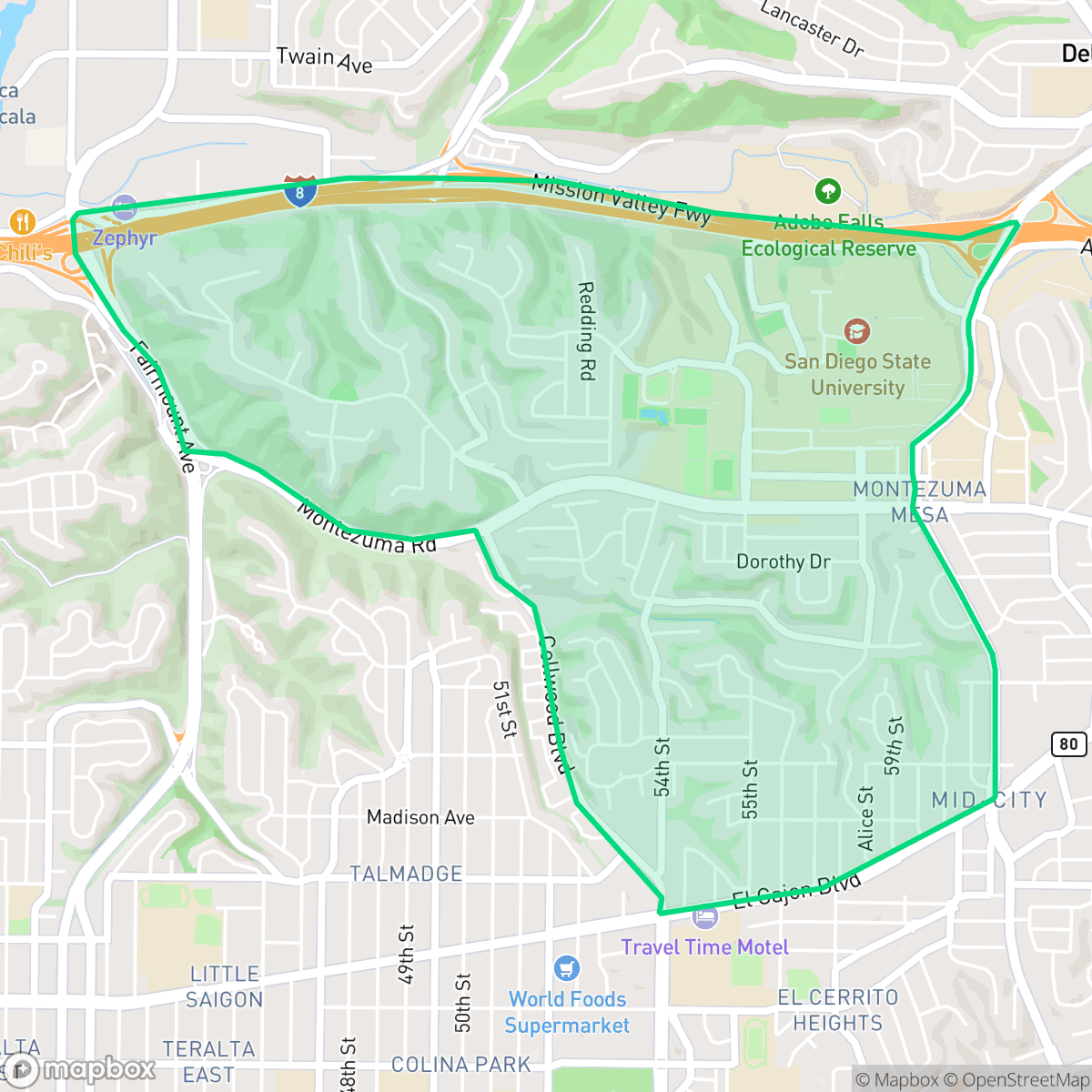
College West is a highly walkable, affluent neighborhood defined by its proximity to San Diego State University and a dense suburban layout. Residents enjoy well-maintained properties and diverse local dining, though the area experiences notable noise levels due to its location near major roadways.
Key Highlights
About College West
Directly west of the San Diego State University (SDSU) campus, the College West neighborhood developed rapidly following the university's 1931 relocation to Montezuma Mesa. The neighborhood transitioned from open land into a thriving academic and residential hub. A post-World War II housing boom, fueled by the GI Bill and university faculty growth, shaped its residential character. This era left a lasting architectural legacy of 1940s bungalows and mid-century modern single-family homes along tree-lined streets like Hardy Avenue and Hewlett Drive. College West is anchored by the Spanish Revival architecture of SDSU's campus, including the landmark Hepner Hall. Locally significant sites include Hardy Elementary School and the nearby intersection of College Avenue and El Cajon Boulevard, which historically hosted the 1948 Campus Drive-In, celebrated today by its preserved historic neon drum majorette signs.
The area offers a distinct blend of residential comfort and academic energy, characterized by its high walkability and well-manicured properties. With a strong visual appeal marked by private pools and established landscaping, the neighborhood maintains a clean, industrial-free environment that is predominantly residential or light commercial in nature. Local amenities range from quiet, tree-lined streets to vibrant dining spots like the Crab Pub and various eateries along major thoroughfares, providing a balanced suburban lifestyle that supports both students and long-term residents. Prospective residents should consider the trade-offs of living in a high-traffic zone, as acoustic comfort is limited by consistent road noise. While the area provides excellent access to schools like the highly rated Hardy Elementary, it is best suited for those who prioritize pedestrian connectivity and proximity to campus life over absolute silence. The community is well-supported by high health insurance coverage rates, though individuals should be aware of the elevated fire risk typical of this region.
Neighborhood Scores Across 15 Qualities
Building spacing provides a moderate level of buffer between neighbors, which is higher than the typical density found across San Diego. Residential layouts vary from detached homes with moderate separation to denser apartment clusters near the campus sector.
Connected sidewalk networks and clear pedestrian crossings facilitate safe movement throughout the campus and surrounding residential streets. While slightly below the San Diego average, the area offers reliable pedestrian infrastructure for local travel.
Manicured landscaping, large homes, and frequent private pools contribute to a visual environment that is more polished than the San Diego average. According to iHuus data, the area features well-maintained residential properties and high-quality campus facilities.
Access to wooded canyons, campus trails, and continuous sidewalk verges provides ample space for pet owners. According to iHuus data, these connected green spaces offer a walking experience nearly on par with the San Diego average.
Residential areas feature a dense suburban mix of single-family homes, apartments, and large institutional buildings. This landscape is largely consistent with the typical urban-rural balance found across San Diego.
Social hubs and diverse dining options are more concentrated here than in most parts of San Diego. While some pockets remain quiet and suburban, many areas feature a notable presence of local cafes, restaurants, and community landmarks.
Frequent disturbances from nearby freeway traffic and railroad corridors characterize the area. According to iHuus data, acoustic comfort in this neighborhood is notably lower than the San Diego average.
Air quality levels fluctuate between acceptable and unhealthy, presenting occasional concerns for sensitive groups. According to iHuus data, the air quality in College West is slightly lower than the San Diego city average.
Land use is strictly limited to residential, institutional, and light commercial zones with no detectable warehouses or hazardous industrial facilities. This area is notably clearer of heavy industry than the San Diego average, according to iHuus data.
Health insurance enrollment among residents is high and remains slightly above the San Diego city average, according to iHuus data.
Voting patterns and census indicators reflect a highly liberal political leaning that is more pronounced than the San Diego average, according to iHuus data.
A higher concentration of young adults is present here compared to the San Diego average. This results in a population profile that leans slightly more toward a younger demographic than most of the city.
Flood risk in this area is slightly higher than the San Diego average, though specific details remain undetermined due to incomplete federal studies. According to iHuus data, the region carries a moderate level of uncertainty regarding potential flood hazards.
Fire hazards in this area are exceptionally high, representing a significantly greater danger than the typical level found across San Diego. Residents should prioritize extreme protection measures due to the severe risk levels identified in iHuus data.
Address-Level Insights for College West


iHuus Neighborhood Intelligence Insights
Get address-level neighborhood insights for College West
- Street-level scores — see how individual blocks compare, not just neighborhood averages
- Micro-zone boundaries — identify quiet pockets, flood boundaries, and walkable clusters before you visit
- 15 dimensions in full — walkability, noise, air quality, school quality, insurance coverage, population age profile, urban/rural index, and more
- Boundary risk alerts — know if your address sits near a block boundary where scores drop, the kind of detail no listing will ever mention
- School insights — individual school ratings and insights, not just district-level data
- Compare before you commit — side-by-side data across neighborhoods, down to block precision
No credit card required
Compare with Any Neighborhood
| Dimension | College West | Adams North |
|---|---|---|
| 🚶 Walkabilityavg 8.58 | ||
| 🔊 Acoustic Comfortavg 3.33 | ||
| 🤫 Privacy Indexavg 4.87 | ||
| 🎨 Visual Appealavg 6.85 | ||
| 🐕 Dog Friendlinessavg 6.91 | ||
| 🗺️ Urban-Rural Indexavg 6.6 | ||
| ✨ Neighborhood Vibeavg 5.12 | ||
| 🏥 Health Insurance Coverageavg 7.53 | ||
| 🌿 Air Qualityavg 6.36 | ||
| 🏭 Industrial Proximityavg 9.12 | ||
| 🌊 Flood Safetyavg 4.2 | ||
| 🗳️ Ideological Leanavg 8.51 | ||
| 👥 Population Age Profileavg 4.8 | ||
| 🔥 Fire Safetyavg 0.61 | ||
| 🏫 School Quality |
College West Rankings
School Districts Serving College West
School Insights for College West
Below average outcomes; significant attendance and academic challenges.
School Insights
See what's really behind every school rating near College West
- Individual school ratings — each school's own score with outcome context, not just a district average
- Enrollment & class size data — student-to-teacher ratio and how it compares to the state average
- Full demographics breakdown — ethnicity and gender composition for every school in the enrollment zone
- Every school in the district — all schools within the enrollment boundary ranked by rating, not just the closest one
- Grade levels & benchmarks — elementary through high school, with below/above state-average flags
No credit card required