College East, San Diego
Updated · 10,164 residents
College East is a lively, high-energy neighborhood defined by its proximity to the San Diego State University campus and a dense mix of mid-century residential architecture. While the area offers excellent walkability and a vibrant selection of local dining options, residents should be prepared for significant noise levels from nearby traffic and a high-density urban environment.
Key Highlights
About College East
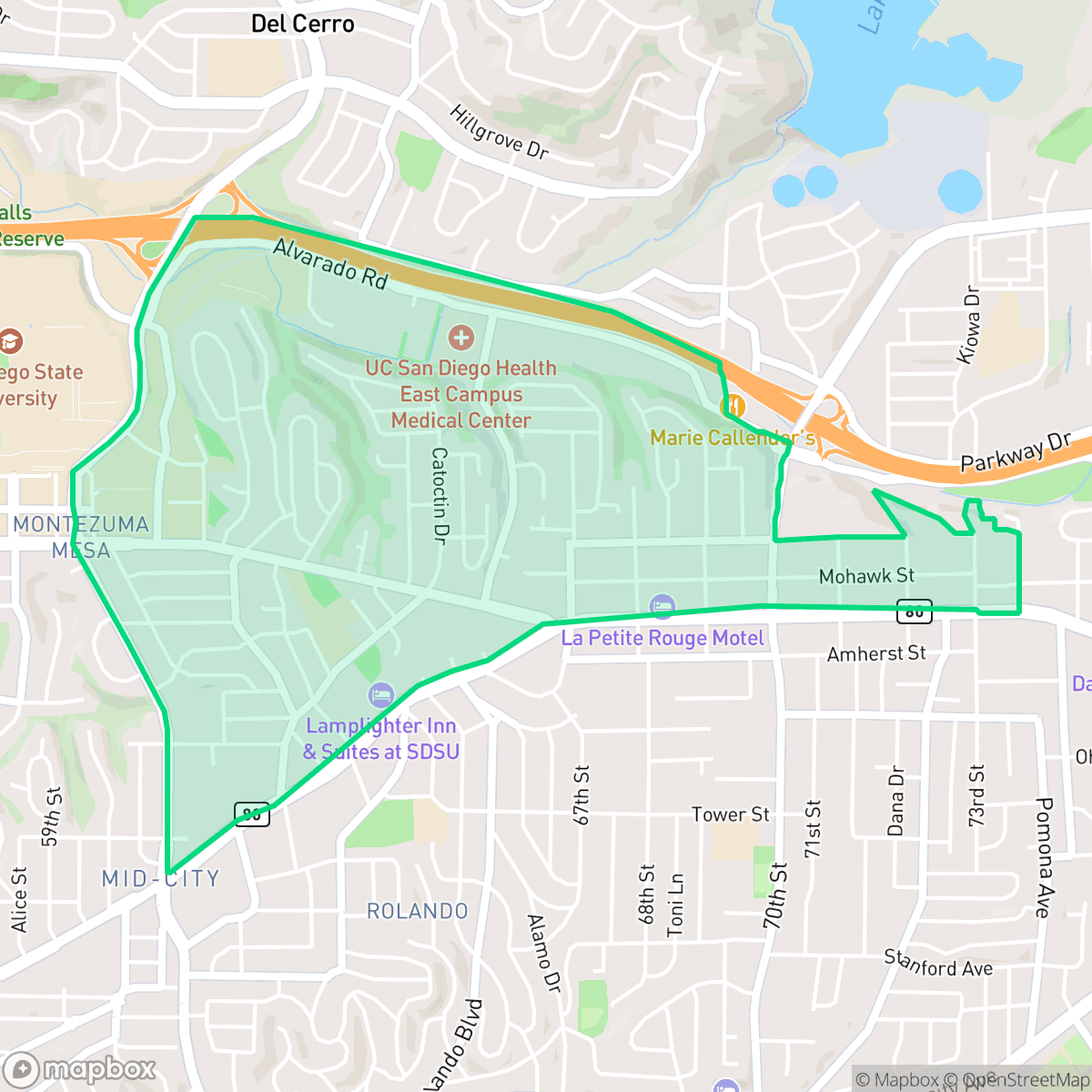
College East, situated on Montezuma Mesa in San Diego, developed in tandem with the relocation of San Diego State Teachers College (now SDSU) in 1931. Positioned directly east of the campus, the neighborhood experienced a post-World War II housing boom during the 1950s and 1960s, accelerated by the completion of nearby Interstate 8. Historically characterized by a mix of mid-century single-family homes and student-focused apartment complexes, College East's growth has long been intertwined with the university's expansion. Key local landmarks include the Alvarado Medical Center (now UC San Diego Health East Campus) and its accompanying San Diego Trolley station. El Cajon Boulevard, which forms the neighborhood's southern boundary, remains a historic commercial corridor featuring longtime local businesses and dining staples.
The area maintains a distinct character shaped by its academic surroundings, featuring a blend of single-family homes with private pools and mid-density apartment complexes. Residents benefit from consistent sidewalk infrastructure and a variety of social hubs, ranging from casual eateries to convenient campus-adjacent amenities. The visual appeal is bolstered by well-maintained driveways and suburban greenery, creating a cohesive aesthetic that feels both established and active. According to iHuus data, the neighborhood provides a unique balance of institutional and residential life that remains free from industrial hazards.
Prospective residents should weigh the benefits of this central location against specific environmental factors. The neighborhood experiences high noise levels due to its proximity to major thoroughfares, and the overall density results in closer proximity to neighbors than in more sprawling suburban areas. While the area offers strong access to health services, it is important to note the local fire safety profile. The community is well-suited for students, faculty, and professionals who prioritize access to campus life and walkable amenities over absolute acoustic quiet.
Neighborhood Scores Across 15 Qualities
Housing density varies across the area, ranging from closely spaced multi-unit buildings to detached homes with moderate setbacks. This level of privacy and separation between neighbors is roughly in line with the San Diego average.
A comprehensive sidewalk network and marked crosswalks facilitate easy pedestrian movement throughout the area. This level of connectivity is nearly comparable to the San Diego average, though proximity to the freeway can impact pedestrian comfort in certain sections.
The area features a blend of upscale homes with private pools alongside standard tract housing and multi-family apartment complexes. According to iHuus data, the visual variety and level of amenities are consistent with the San Diego average.
Sidewalks with green verges and access to canyon trails and campus parks provide adequate spaces for pets. According to iHuus data, these amenities are slightly below the San Diego city average.
Residential pockets feature a blend of single-family homes and multi-story apartments interspersed with natural topography. This landscape is largely comparable to the broader San Diego area in terms of its balance between developed spaces and open greenery.
Diverse dining options and local social hubs provide a noticeably more lively atmosphere than the San Diego average. While some blocks remain quiet and suburban, many areas feature a dense mix of restaurants and community landmarks within walking distance.
Frequent aircraft noise from the nearby airport runway makes for an environment with very low acoustic comfort. This level of disruption is significantly higher than the average found across San Diego.
Air quality levels in College East fluctuate between acceptable and unhealthy periods. According to iHuus data, the air quality is slightly below the San Diego city average, which may cause occasional concern for sensitive groups.
Industrial hazards and large warehouses are virtually non-existent throughout most of the area, with land use focused on residential, institutional, and light commercial zones. According to iHuus data, this lack of heavy industry makes the neighborhood comparable to the rest of San Diego in terms of industrial proximity.
Health insurance access is more prevalent here than the San Diego average, according to iHuus data. Most residents in the area are covered by a health insurance plan.
Voting patterns and census indicators in College East reflect a significantly more liberal leaning than the San Diego average, according to iHuus data.
A varied demographic of young adults, families, and seniors creates a balanced community age profile. This distribution is slightly lower than the San Diego average, indicating a slightly more concentrated presence of certain age groups according to iHuus data.
Flood safety levels are slightly above the San Diego average, though a lack of detailed FEMA studies means the specific risk remains unverified. Residents should note that official flood maps for this area have not been fully updated.
Severe fire hazards are present in this area, representing a significantly higher risk level than the San Diego average. According to iHuus data, the neighborhood requires maximum protection measures due to this extreme volatility.
Address-Level Insights for College East


iHuus Neighborhood Intelligence Insights
Get address-level neighborhood insights for College East
- Street-level scores — see how individual blocks compare, not just neighborhood averages
- Micro-zone boundaries — identify quiet pockets, flood boundaries, and walkable clusters before you visit
- 15 dimensions in full — walkability, noise, air quality, school quality, insurance coverage, population age profile, urban/rural index, and more
- Boundary risk alerts — know if your address sits near a block boundary where scores drop, the kind of detail no listing will ever mention
- School insights — individual school ratings and insights, not just district-level data
- Compare before you commit — side-by-side data across neighborhoods, down to block precision
No credit card required
Compare with Any Neighborhood
| Dimension | College East | Adams North |
|---|---|---|
| 🚶 Walkabilityavg 8.58 | ||
| 🔊 Acoustic Comfortavg 3.33 | ||
| 🤫 Privacy Indexavg 4.87 | ||
| 🎨 Visual Appealavg 6.85 | ||
| 🐕 Dog Friendlinessavg 6.91 | ||
| 🗺️ Urban-Rural Indexavg 6.6 | ||
| ✨ Neighborhood Vibeavg 5.12 | ||
| 🏥 Health Insurance Coverageavg 7.53 | ||
| 🌿 Air Qualityavg 6.36 | ||
| 🏭 Industrial Proximityavg 9.12 | ||
| 🌊 Flood Safetyavg 4.2 | ||
| 🗳️ Ideological Leanavg 8.51 | ||
| 👥 Population Age Profileavg 4.8 | ||
| 🔥 Fire Safetyavg 0.61 | ||
| 🏫 School Quality |
College East Rankings
School Districts Serving College East
School Insights for College East
Below average outcomes; significant attendance and academic challenges.
School Insights
See what's really behind every school rating near College East
- Individual school ratings — each school's own score with outcome context, not just a district average
- Enrollment & class size data — student-to-teacher ratio and how it compares to the state average
- Full demographics breakdown — ethnicity and gender composition for every school in the enrollment zone
- Every school in the district — all schools within the enrollment boundary ranked by rating, not just the closest one
- Grade levels & benchmarks — elementary through high school, with below/above state-average flags
No credit card required