Colina del Sol, San Diego
Updated · 10,514 residents
Colina del Sol is an exceptionally walkable neighborhood in San Diego, characterized by a dense residential grid and a vibrant, dog-friendly atmosphere centered around a large community park. Residents enjoy convenient access to a variety of international eateries along major corridors, though the area features tightly packed housing with limited privacy and moderate noise levels from local road traffic.
Key Highlights
About Colina del Sol
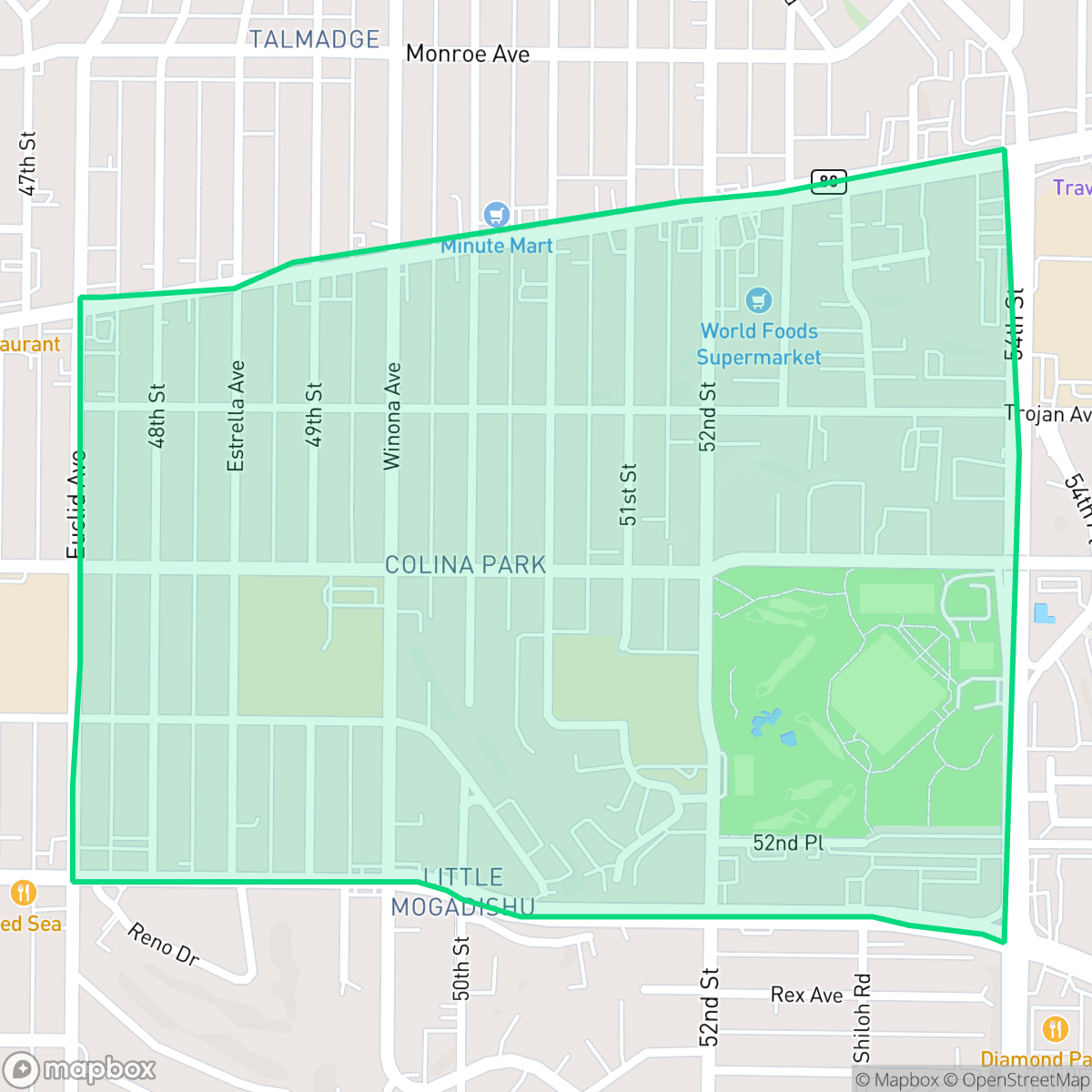
The history of San Diego’s Colina del Sol neighborhood, situated in the Mid-City region, dates back to the 1880s when developers Abraham Klauber and Samuel Steiner purchased over 240 acres of land northeast of Balboa Park. Originally subdivided as Colina Park, the area was incorporated into the city of East San Diego in 1912 before being annexed by the City of San Diego in 1923. Developed primarily between the 1940s and 1970s with a mix of single-family homes and mid-century apartment complexes, the neighborhood evolved into a vibrant, multicultural hub. Today, it is celebrated for its diverse population, including significant East African, Hispanic, and Southeast Asian communities. The neighborhood's cultural heart centers around the 20-acre Colina del Sol Park and the bustling international eateries along University Avenue and El Cajon Boulevard.
The neighborhood functions as a dense, urban-suburban hybrid that prioritizes pedestrian connectivity and community access. Its layout supports a high degree of walkability, allowing residents to navigate between residential blocks and local commercial hubs with ease. The area is defined by its lively atmosphere, which is bolstered by the presence of diverse international dining options and expansive green spaces that provide significant utility for pet owners and outdoor enthusiasts. According to iHuus data, the neighborhood maintains a consistent urban feel with a mix of apartment structures and residential homes that maximize land use within the Mid-City region.
Prospective residents should consider that the high density results in limited private outdoor space and a moderate level of ambient noise generated by road traffic. While the neighborhood offers excellent recreational access, the academic landscape is varied, as it falls within a school district currently managing significant operational and budgetary transitions. The area is best suited for individuals who prioritize walkability and cultural diversity over suburban seclusion, and who value being within reach of the city's central amenities.
Neighborhood Scores Across 15 Qualities
Residential structures are often positioned closely together with minimal distance between neighbors. This level of density is slightly higher than the San Diego average, meaning property buffers are less common here.
A comprehensive sidewalk network and continuous pedestrian crossings throughout the residential blocks make walking easy and safe. This connectivity is notably higher than the San Diego average, providing seamless access to local park connections and street networks.
Uniform rooflines and small yards characterize much of the area, making the visual landscape slightly less varied than the San Diego average. Some pockets of the neighborhood feature well-manicured landscaping and private pools, according to iHuus data.
Accessible walking paths and nearby school fields offer reliable space for pets, though the overall level of dog friendliness is slightly below the San Diego average. According to iHuus data, residents can utilize continuous sidewalks and nearby greenery, but some residential areas feature narrower verges and fewer public parks.
Residential streets and green spaces are found in roughly equal measure, though the area is slightly less dense than the San Diego average. This landscape features a balanced blend of single-family homes, apartment complexes, and commercial strip malls according to iHuus data.
Frequent movement and a notable concentration of local dining hubs make this area significantly more active than the San Diego average. According to iHuus data, the neighborhood features a diverse mix of social spots ranging from dense urban pockets to quiet suburban streets with accessible eateries.
Steady hums from nearby busy streets are present, though the acoustic environment remains more tranquil than the average for San Diego according to iHuus data.
Air quality levels in Colina del Sol fluctuate between acceptable and unhealthy, slightly trailing the San Diego city average. Sensitive individuals may experience occasional concern during certain periods, according to iHuus data.
Residential and light commercial zones dominate the landscape with an absence of heavy industry or hazardous facilities. This area maintains a higher level of separation from large warehouse complexes and industrial machinery than the San Diego average, according to iHuus data.
Health insurance accessibility is significantly lower than the San Diego average, according to iHuus data. Residents may face greater challenges in accessing employer-sponsored or private medical coverage within this area.
Voting patterns and census indicators show a predominantly liberal leaning that is more pronounced than the San Diego city average. According to iHuus data, the area exhibits strong progressive political tendencies.
Residents live alongside a balanced mix of young adults, families, and seniors. This demographic spread is largely consistent with the typical age distribution found across San Diego.
Located within a designated 100-year floodplain, this area carries a significantly higher risk of flooding than the San Diego average. Residents should be aware that flood insurance is typically required for properties in this zone according to iHuus data.
Address-Level Insights for Colina del Sol


iHuus Neighborhood Intelligence Insights
Get address-level neighborhood insights for Colina del Sol
- Street-level scores — see how individual blocks compare, not just neighborhood averages
- Micro-zone boundaries — identify quiet pockets, flood boundaries, and walkable clusters before you visit
- 15 dimensions in full — walkability, noise, air quality, school quality, insurance coverage, population age profile, urban/rural index, and more
- Boundary risk alerts — know if your address sits near a block boundary where scores drop, the kind of detail no listing will ever mention
- School insights — individual school ratings and insights, not just district-level data
- Compare before you commit — side-by-side data across neighborhoods, down to block precision
No credit card required
Compare with Any Neighborhood
| Dimension | Colina del Sol | Adams North |
|---|---|---|
| 🚶 Walkabilityavg 8.58 | ||
| 🔊 Acoustic Comfortavg 3.33 | ||
| 🤫 Privacy Indexavg 4.87 | ||
| 🎨 Visual Appealavg 6.85 | ||
| 🐕 Dog Friendlinessavg 6.91 | ||
| 🗺️ Urban-Rural Indexavg 6.6 | ||
| ✨ Neighborhood Vibeavg 5.12 | ||
| 🏥 Health Insurance Coverageavg 7.53 | ||
| 🌿 Air Qualityavg 6.36 | ||
| 🏭 Industrial Proximityavg 9.12 | ||
| 🌊 Flood Safetyavg 4.2 | ||
| 🗳️ Ideological Leanavg 8.51 | ||
| 👥 Population Age Profileavg 4.8 | ||
| 🔥 Fire Safetyavg 0.61 | ||
| 🏫 School Quality |
Colina del Sol Rankings
School Districts Serving Colina del Sol
School Insights for Colina del Sol
Below average outcomes; significant attendance and academic challenges.
School Insights
See what's really behind every school rating near Colina del Sol
- Individual school ratings — each school's own score with outcome context, not just a district average
- Enrollment & class size data — student-to-teacher ratio and how it compares to the state average
- Full demographics breakdown — ethnicity and gender composition for every school in the enrollment zone
- Every school in the district — all schools within the enrollment boundary ranked by rating, not just the closest one
- Grade levels & benchmarks — elementary through high school, with below/above state-average flags
No credit card required