Clairemont Mesa West, San Diego
Updated · 11,747 residents
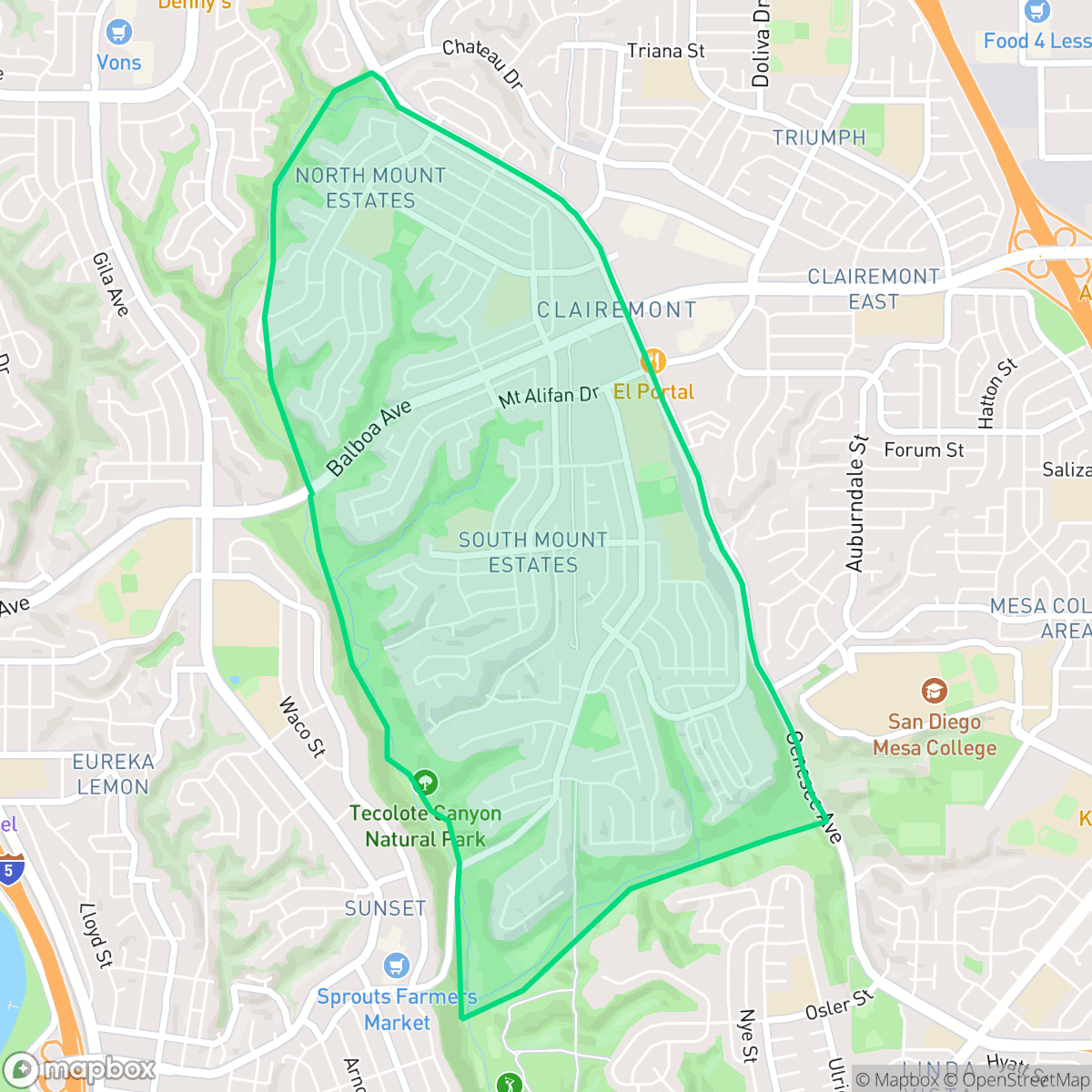
Clairemont Mesa West is a quiet, residential community defined by its mid-century architecture and proximity to the rugged terrain of Tecolote Canyon. It offers high walkability and a peaceful suburban atmosphere, making it a stable choice for families and those seeking a low-density environment.
Key Highlights
About Clairemont Mesa West
Clairemont Mesa West, situated on the western edge of San Diego’s Clairemont Mesa, transitioned from Kumeyaay land and agricultural fields to a post-World War II master-planned community. Developed starting in 1950 by Carlos Tavares and Lou Burgener, the neighborhood was named in honor of Tavares’s wife, Clara. Breaking from traditional grid layouts, the area was designed with winding, curvilinear streets and scenic lots to complement the natural topography of the bluffs and canyons. It is characterized by mid-century Tract Ranch and Contemporary Modern architecture, with many homes offering views of Mission Bay and the Pacific Ocean. To protect these scenic vistas, the city adopted the West Clairemont Height Limitation Overlay Zone in 1972. The neighborhood is anchored by the historic Clairemont Town Square shopping center and bordered by the preserved wilderness of Tecolote Canyon Natural Park.
The neighborhood is characterized by its predominantly residential and institutional land use, featuring a lack of industrial hazards or warehouses. Residents benefit from well-manicured properties and a layout that emphasizes privacy through suburban spacing. Educational needs are supported by several local institutions, including the highly-rated John Muir and High Tech High Mesa schools, which serve as anchors for the local community. The area maintains a consistent rhythm of daily life, supported by accessible local services and a design that prioritizes green space over commercial density.
While the area provides a serene living environment, prospective residents should consider the trade-offs of its suburban nature. The neighborhood is largely car-oriented, and while it is highly walkable, the limited number of local businesses means that most social and commercial activities require travel beyond the immediate vicinity. The area also experiences moderate noise levels primarily from road traffic, and residents should be aware of the regional fire safety profile. It is best suited for individuals or families who prioritize a quiet, stable, and well-maintained residential setting over a high-energy urban lifestyle.
Neighborhood Scores Across 15 Qualities
Residential spacing varies from shared-wall apartment complexes to detached homes with modest buffers between neighbors. This level of density is higher than the San Diego average, according to iHuus data.
Continuous sidewalks and well-defined crossings exist on most residential streets and major arterials, making the area more walkable than the San Diego average. This extensive network provides safe, connected paths through both cul-de-sacs and commercial zones according to iHuus data.
Well-maintained landscaping, private pools, and larger residential lots contribute to a visual environment that is more upscale than the San Diego average. While some areas feature standard apartment complexes, much of the neighborhood displays a manicured and spacious appearance.
Expansive canyon trails, golf course perimeters, and large public park fields provide ample space for pets. This accessibility to green space and connected walking paths is notably higher than the San Diego average.
Residential layouts primarily feature a mix of single-family homes, apartment complexes, and neighborhood commercial zones. This landscape is slightly more developed than the San Diego average, according to iHuus data.
Primarily a low-density suburban environment, this area features a serene atmosphere with limited commercial activity. Most daily needs require a vehicle, as there are few businesses within walking distance compared to the city average.
Local traffic from nearby busy streets creates a consistent level of ambient noise. This level of acoustic activity is higher than the average seen across San Diego.
Air quality in this area is slightly below the San Diego average, characterized by a mix of acceptable days and occasional periods of concern for sensitive groups according to iHuus data.
Residential and light commercial land uses dominate the area, with no visible warehouses, heavy industry, or hazardous facilities detected. This neighborhood maintains a higher level of industrial separation than the San Diego average according to iHuus data.
Health insurance access is more prevalent among residents here than in the San Diego average, according to iHuus data.
Political leanings in this area are notably liberal, aligning closely with the broader San Diego metropolitan average.
A diverse range of age groups resides here, providing a more varied demographic spread than the San Diego average. According to iHuus data, the area maintains a balanced distribution of young adults, families, and seniors.
Flood risk in this area is higher than the San Diego average, though official FEMA studies for the neighborhood remain incomplete. According to iHuus data, there is a moderate level of uncertainty regarding potential flooding in certain parts of the community.
Extreme fire hazards are present in this area, representing a greater risk level than the San Diego average. Residents should prioritize maximum protection measures and stay informed on local fire safety protocols according to iHuus data.
Address-Level Insights for Clairemont Mesa West


iHuus Neighborhood Intelligence Insights
Get address-level neighborhood insights for Clairemont Mesa West
- Street-level scores — see how individual blocks compare, not just neighborhood averages
- Micro-zone boundaries — identify quiet pockets, flood boundaries, and walkable clusters before you visit
- 15 dimensions in full — walkability, noise, air quality, school quality, insurance coverage, population age profile, urban/rural index, and more
- Boundary risk alerts — know if your address sits near a block boundary where scores drop, the kind of detail no listing will ever mention
- School insights — individual school ratings and insights, not just district-level data
- Compare before you commit — side-by-side data across neighborhoods, down to block precision
No credit card required
Compare with Any Neighborhood
| Dimension | Clairemont Mesa West | Adams North |
|---|---|---|
| 🚶 Walkabilityavg 8.58 | ||
| 🔊 Acoustic Comfortavg 3.33 | ||
| 🤫 Privacy Indexavg 4.87 | ||
| 🎨 Visual Appealavg 6.85 | ||
| 🐕 Dog Friendlinessavg 6.91 | ||
| 🗺️ Urban-Rural Indexavg 6.6 | ||
| ✨ Neighborhood Vibeavg 5.12 | ||
| 🏥 Health Insurance Coverageavg 7.53 | ||
| 🌿 Air Qualityavg 6.36 | ||
| 🏭 Industrial Proximityavg 9.12 | ||
| 🌊 Flood Safetyavg 4.2 | ||
| 🗳️ Ideological Leanavg 8.51 | ||
| 👥 Population Age Profileavg 4.8 | ||
| 🔥 Fire Safetyavg 0.61 | ||
| 🏫 School Quality |
Clairemont Mesa West Rankings
School Districts Serving Clairemont Mesa West
School Insights for Clairemont Mesa West
Below average outcomes; significant attendance and academic challenges.
School Insights
See what's really behind every school rating near Clairemont Mesa West
- Individual school ratings — each school's own score with outcome context, not just a district average
- Enrollment & class size data — student-to-teacher ratio and how it compares to the state average
- Full demographics breakdown — ethnicity and gender composition for every school in the enrollment zone
- Every school in the district — all schools within the enrollment boundary ranked by rating, not just the closest one
- Grade levels & benchmarks — elementary through high school, with below/above state-average flags
No credit card required