Clairemont Mesa East, San Diego
Updated · 25,501 residents
Clairemont Mesa East is a highly walkable San Diego community defined by its winding mid-century streets and proximity to Tecolote Canyon. While the area provides excellent access to local schools and daily services, residents often experience elevated noise levels from nearby major roadways and high-density residential spacing.
Key Highlights
About Clairemont Mesa East
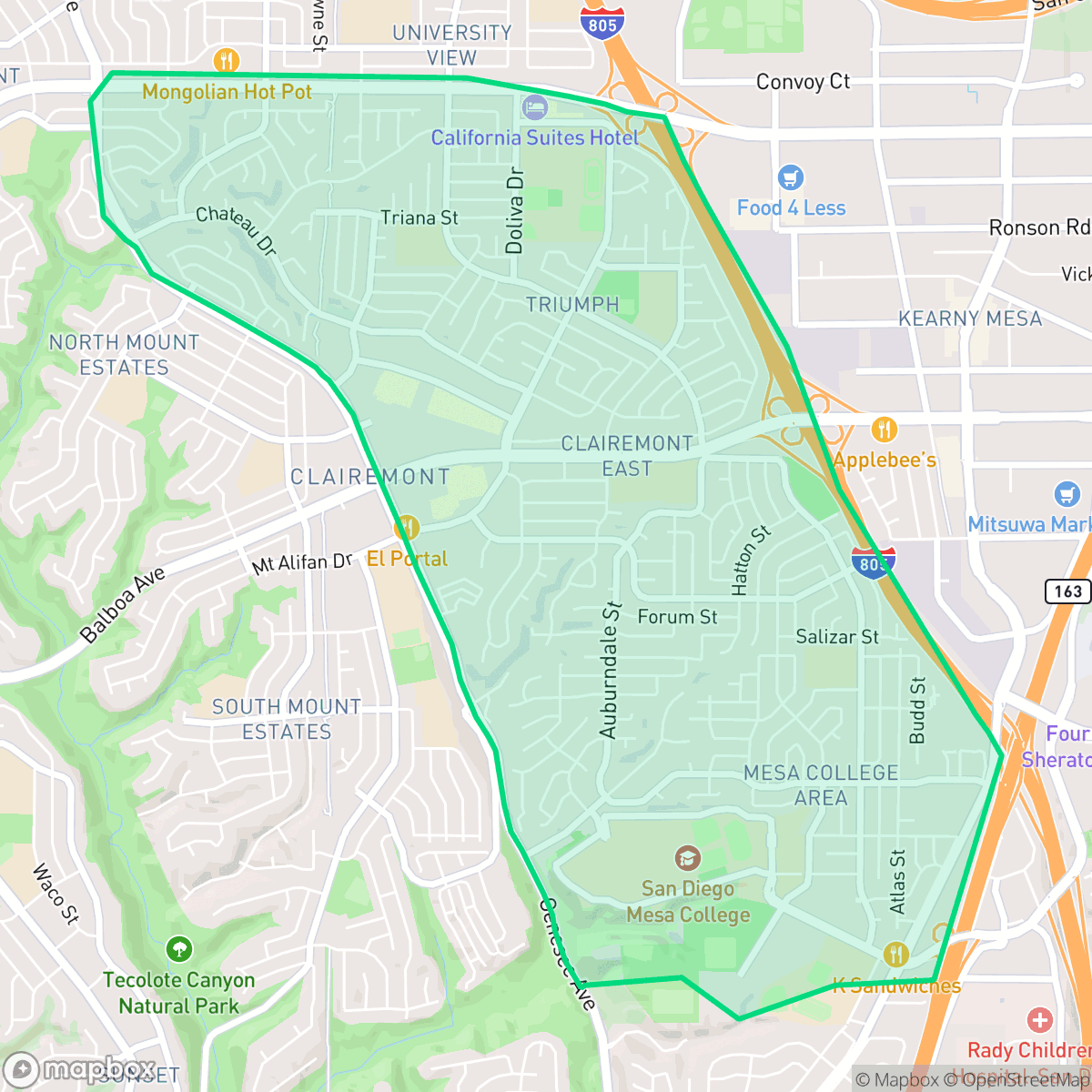
Developed during the post-World War II suburban boom of the 1950s, Clairemont Mesa East was shaped by real estate developers Carlos Tavares and Lou Burgener as part of their "Village Within a City" master plan. Diverging from traditional grid layouts, the neighborhood was designed with winding streets and cul-de-sacs that conformed to the area's natural mesas and canyons. Before this mid-century residential transformation, much of the land was utilized for agricultural purposes. This heritage is preserved at Olive Grove Park on Printwood Way, which was built directly on the site of a former olive farm. Today, Clairemont Mesa East retains its mid-century character, bounded by the scenic Tecolote Canyon to the south and the bustling commercial corridors of Balboa Avenue and Genesee Avenue.
The neighborhood functions as a dense suburban hub, balancing residential comfort with active commercial corridors like Balboa and Genesee Avenue. It features a diverse housing stock ranging from single-family homes to multi-unit complexes, all integrated into a landscape that prioritizes pedestrian connectivity. Families are particularly drawn to the area for its educational opportunities, including the highly-rated Sequoia Elementary and the specialized programs within the Kearny school cluster.
Living here requires balancing the benefits of high walkability with certain urban trade-offs. The neighborhood experiences significant acoustic impact from road traffic, and the density of housing often results in limited privacy between neighbors. Additionally, while the area is well-situated for daily errands, prospective residents should be aware of fire safety risks and the ongoing operational challenges within the local school district. It is best suited for those who prioritize neighborhood connectivity and school access over total acoustic isolation.
Neighborhood Scores Across 15 Qualities
Residential spacing varies from standard suburban blocks with private yards to more densely packed multi-unit complexes. According to iHuus data, this level of privacy is slightly higher than the San Diego average.
Continuous sidewalks and clear crosswalks exist throughout most residential and commercial areas, making the area more walkable than the San Diego average. While a major freeway creates a barrier to the east, pedestrian bridges and well-defined networks maintain high connectivity across the neighborhood.
Manicured landscaping and a high frequency of private backyard pools contribute to a visual quality that sits above the San Diego average. Many properties feature large driveways and well-maintained greenery, though some denser apartment areas present more uniform architectural patterns.
Public parks, school athletic fields, and a central canyon provide reliable spaces for dog walking. While many green areas are located within private yards, the neighborhood offers slightly less accessible pet space than the San Diego average.
Suburban sprawl characterizes this area, featuring a mix of single-family homes, apartment complexes, and commercial zones that closely aligns with the typical San Diego density. According to iHuus data, the landscape consists primarily of residential pockets interspersed with school grounds and retail clusters.
Residential life here is characterized by a steady but low-key energy, slightly below the typical activity levels found elsewhere in San Diego. While various dining options and social hubs provide local amenities, the area remains primarily a serene suburban environment where many errands require a car.
Frequent noise from nearby freeways and flight paths characterizes the area. This level of acoustic disturbance is notably higher than the San Diego average, according to iHuus data.
Air quality in this area fluctuates between acceptable and unhealthy levels, appearing slightly lower than the San Diego average according to iHuus data. Residents with respiratory sensitivities may experience occasional concerns on certain days.
Minimal heavy industry or large-scale warehouses are present within the neighborhood, making the area comparable to the San Diego average for industrial proximity. Residents should note that some eastern edges near the highway feature a cluster of warehouses and commercial structures that may increase localized traffic.
Health insurance coverage among residents is relatively high, though slightly below the San Diego city average according to iHuus data.
Political leanings in this area are predominantly liberal, staying very close to the overall San Diego average. This demographic trend is reflected in the local community composition according to iHuus data.
A diverse mix of young adults, families, and older residents defines the community. This age distribution is largely consistent with the broader San Diego area, according to iHuus data.
Flood risk levels in this area are higher than the San Diego average, though local data remains inconclusive because official federal studies have not been finalized for this specific zone.
Extreme fire hazards are present in this area, matching the high levels of risk seen across San Diego. Residents should be prepared for significant fire safety precautions and emergency preparedness requirements.
Address-Level Insights for Clairemont Mesa East


iHuus Neighborhood Intelligence Insights
Get address-level neighborhood insights for Clairemont Mesa East
- Street-level scores — see how individual blocks compare, not just neighborhood averages
- Micro-zone boundaries — identify quiet pockets, flood boundaries, and walkable clusters before you visit
- 15 dimensions in full — walkability, noise, air quality, school quality, insurance coverage, population age profile, urban/rural index, and more
- Boundary risk alerts — know if your address sits near a block boundary where scores drop, the kind of detail no listing will ever mention
- School insights — individual school ratings and insights, not just district-level data
- Compare before you commit — side-by-side data across neighborhoods, down to block precision
No credit card required
Compare with Any Neighborhood
| Dimension | Clairemont Mesa East | Adams North |
|---|---|---|
| 🚶 Walkabilityavg 8.58 | ||
| 🔊 Acoustic Comfortavg 3.33 | ||
| 🤫 Privacy Indexavg 4.87 | ||
| 🎨 Visual Appealavg 6.85 | ||
| 🐕 Dog Friendlinessavg 6.91 | ||
| 🗺️ Urban-Rural Indexavg 6.6 | ||
| ✨ Neighborhood Vibeavg 5.12 | ||
| 🏥 Health Insurance Coverageavg 7.53 | ||
| 🌿 Air Qualityavg 6.36 | ||
| 🏭 Industrial Proximityavg 9.12 | ||
| 🌊 Flood Safetyavg 4.2 | ||
| 🗳️ Ideological Leanavg 8.51 | ||
| 👥 Population Age Profileavg 4.8 | ||
| 🔥 Fire Safetyavg 0.61 | ||
| 🏫 School Quality |
Clairemont Mesa East Rankings
School Districts Serving Clairemont Mesa East
School Insights for Clairemont Mesa East
Below average outcomes; significant attendance and academic challenges.
School Insights
See what's really behind every school rating near Clairemont Mesa East
- Individual school ratings — each school's own score with outcome context, not just a district average
- Enrollment & class size data — student-to-teacher ratio and how it compares to the state average
- Full demographics breakdown — ethnicity and gender composition for every school in the enrollment zone
- Every school in the district — all schools within the enrollment boundary ranked by rating, not just the closest one
- Grade levels & benchmarks — elementary through high school, with below/above state-average flags
No credit card required