Chollas View, San Diego
Updated · 5,264 residents
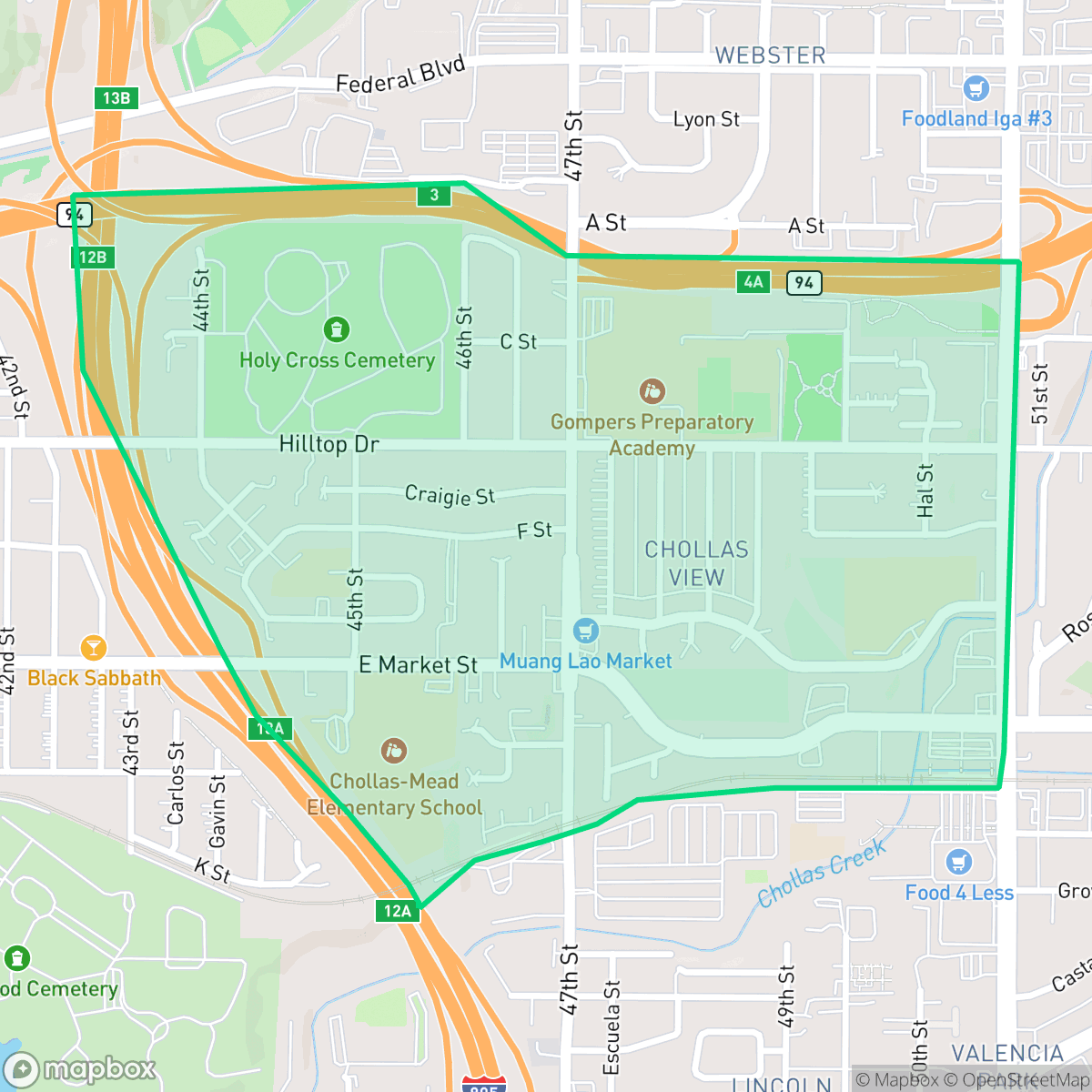
Chollas View is a dense, diverse suburban community in southeastern San Diego characterized by its mix of historic housing and proximity to light industrial zones. While residents benefit from a consistent sidewalk network and local green spaces like Gompers Park, the area experiences elevated noise levels from nearby highway traffic and commercial activity.
Key Highlights
About Chollas View
Named for the abundant cholla cactus that once covered the landscape, Chollas View in southeastern San Diego began to develop around a World War II defense housing project built between 1941 and 1942. This federal project, consisting of duplexes that still stand today, spurred residential growth throughout the 1950s. The neighborhood's most prominent landmark is the Holy Cross Cemetery, established in 1919, whose blue-domed mausoleum overlooks State Route 94. Another local fixture is the El Rey Trailer Park, known for its distinctive 100-foot-tall palm trees. Culturally, Chollas View has evolved into a diverse community, notably home to a significant Laotian American population. The neighborhood’s history of redlining and displacement from freeway construction was recently featured in the San Diego History Center's "Lost Neighborhoods" exhibition.
The neighborhood functions as a practical, central hub in southeastern San Diego, blending residential life with active commercial corridors. The landscape features a mix of single-family homes, apartments, and light industrial units, creating a dense suburban environment that prioritizes connectivity. Residents have access to a variety of casual local dining options, such as Mariscos German and Los Reyes Mexican Food, which contribute to the area's distinct local character. The presence of multiple neighborhood parks provides necessary green space, offering a functional balance to the surrounding industrial-style architecture and paved infrastructure.
According to iHuus data, the area is well-suited for those who value proximity to major transit routes and a central location over quiet seclusion. While the walkability is respectable for the region, prospective residents should be aware of the acoustic environment, as the neighborhood experiences consistent noise from State Route 94 and nearby rail infrastructure. It remains a viable option for commuters and individuals seeking a straightforward, urban-suburban lifestyle within the city.
Neighborhood Scores Across 15 Qualities
Housing density is slightly higher than the San Diego average, with many properties featuring closely spaced lots or shared walls. Residents may find more privacy near the canyon edges, though several clusters feature homes situated very near one another.
Sidewalks and safe crossings are available within residential pockets, but massive highway interchanges and steep canyon topography act as significant pedestrian barriers. According to iHuus data, the ease of navigating the area on foot is lower than the San Diego average.
Uniform tract housing and dense apartment complexes define the local landscape. This area features smaller yards and less greenery than the San Diego average.
Large natural canyons, athletic fields, and nearby cemetery grounds offer substantial space for dog walking. According to iHuus data, the availability of these green spaces is slightly below the San Diego city average.
A blend of single-family homes and apartment complexes exists alongside large-scale infrastructure and commercial zones. This layout is roughly in line with the typical urban-rural balance found across San Diego.
Suburban streets and light industrial areas create a tranquil atmosphere that is less active than the San Diego average. While diverse dining options exist, most businesses are not within easy walking distance of residential blocks.
Frequent noise from nearby heavy transit corridors and railroad activity characterizes the area. This level of acoustic disturbance is notably higher than the San Diego average, according to iHuus data.
Air quality in Chollas View fluctuates between acceptable and unhealthy levels, sitting slightly below the San Diego average. Sensitive groups may experience occasional concerns during certain weather patterns, according to iHuus data.
Warehouse clusters and truck loading docks along the southern edge and near major freeway interchanges introduce more commercial activity and noise than is typical for San Diego. Residents may experience higher levels of traffic and industrial-style infrastructure compared to the city average.
Health insurance access among residents is notably lower than the San Diego average, according to iHuus data. This lack of coverage represents a significant disparity compared to the rest of the city.
Voting patterns and census indicators reflect a much more liberal political leaning than the San Diego average. This ideological trend is highly pronounced throughout the Chollas View area according to iHuus data.
Residents live alongside a diverse range of age groups, including young adults, families, and seniors. This age distribution is slightly lower than the San Diego average, according to iHuus data.
Significant flood risk exists here due to the area's location within a designated floodplain. According to iHuus data, this risk level is notably higher than the San Diego average, which may necessitate specialized flood insurance.
Address-Level Insights for Chollas View


iHuus Neighborhood Intelligence Insights
Get address-level neighborhood insights for Chollas View
- Street-level scores — see how individual blocks compare, not just neighborhood averages
- Micro-zone boundaries — identify quiet pockets, flood boundaries, and walkable clusters before you visit
- 15 dimensions in full — walkability, noise, air quality, school quality, insurance coverage, population age profile, urban/rural index, and more
- Boundary risk alerts — know if your address sits near a block boundary where scores drop, the kind of detail no listing will ever mention
- School insights — individual school ratings and insights, not just district-level data
- Compare before you commit — side-by-side data across neighborhoods, down to block precision
No credit card required
Compare with Any Neighborhood
| Dimension | Chollas View | Adams North |
|---|---|---|
| 🚶 Walkabilityavg 8.58 | ||
| 🔊 Acoustic Comfortavg 3.33 | ||
| 🤫 Privacy Indexavg 4.87 | ||
| 🎨 Visual Appealavg 6.85 | ||
| 🐕 Dog Friendlinessavg 6.91 | ||
| 🗺️ Urban-Rural Indexavg 6.6 | ||
| ✨ Neighborhood Vibeavg 5.12 | ||
| 🏥 Health Insurance Coverageavg 7.53 | ||
| 🌿 Air Qualityavg 6.36 | ||
| 🏭 Industrial Proximityavg 9.12 | ||
| 🌊 Flood Safetyavg 4.2 | ||
| 🗳️ Ideological Leanavg 8.51 | ||
| 👥 Population Age Profileavg 4.8 | ||
| 🔥 Fire Safetyavg 0.61 | ||
| 🏫 School Quality |
Chollas View Rankings
School Districts Serving Chollas View
School Insights for Chollas View
Below average outcomes; significant attendance and academic challenges.
School Insights
See what's really behind every school rating near Chollas View
- Individual school ratings — each school's own score with outcome context, not just a district average
- Enrollment & class size data — student-to-teacher ratio and how it compares to the state average
- Full demographics breakdown — ethnicity and gender composition for every school in the enrollment zone
- Every school in the district — all schools within the enrollment boundary ranked by rating, not just the closest one
- Grade levels & benchmarks — elementary through high school, with below/above state-average flags
No credit card required