Castle, San Diego
Updated · 10,148 residents
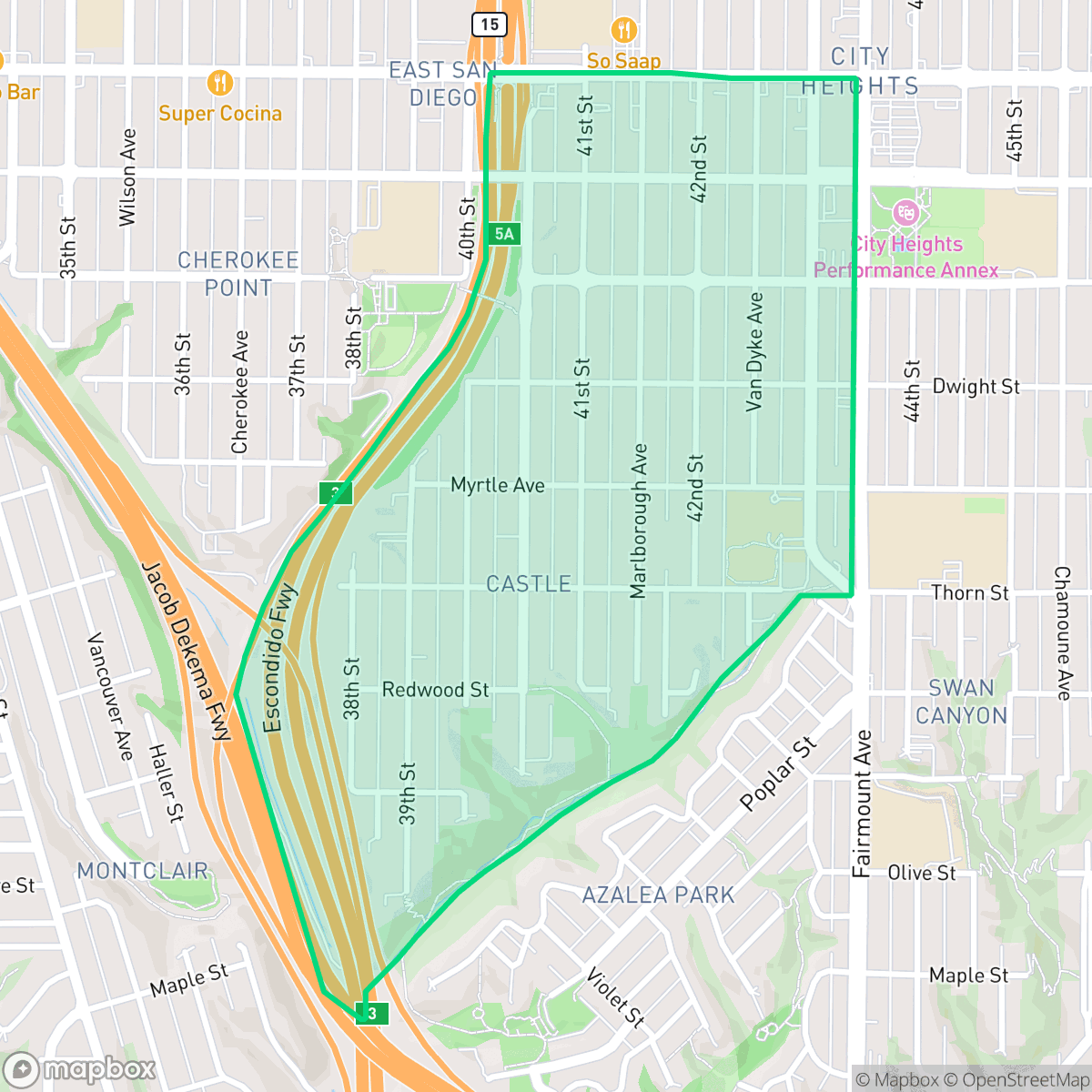
Castle is a highly walkable neighborhood in San Diego known for its dense residential grid and diverse cultural community. Residents benefit from easy access to local commerce along major corridors, though the area is notably loud due to consistent road traffic and features limited private outdoor space.
Key Highlights
About Castle
Located in San Diego's City Heights area, the Castle neighborhood is named for its distinctive 1920s and 1930s residential architecture, which features Spanish-style stucco homes alongside unique, castle-like residences complete with turrets and battlements. Originally inhabited by the Kumeyaay, the land was later partitioned into Mexican ranches before American developers began building homes here in the late 19th and early 20th centuries. Castle was annexed into San Diego in 1923. Centered around its commercial corridor at Fairmount and University avenues, the densely populated neighborhood underwent revitalization in the late 20th century. Today, Castle is celebrated for its rich cultural diversity, serving as a vibrant home to large Mexican-American and Southeast Asian—particularly Vietnamese and Cambodian—communities.
The area is defined by a dense, low-rise urban grid that prioritizes pedestrian access, earning it top marks for walkability. While the neighborhood is primarily residential, it maintains a steady pulse of activity through its diverse local dining scene and commercial blocks at the intersections of Fairmount and University avenues. According to iHuus data, the architectural landscape remains functional and compact, reflecting a history of efficient land use that places neighbors in close proximity.
Prospective residents should note that the neighborhood presents specific trade-offs regarding acoustic comfort and private space. The proximity to major transit corridors results in elevated noise levels, and the high-density layout means homes often share property lines with minimal buffers. It is well-suited for individuals who prioritize a walkable, transit-connected lifestyle over quiet suburban seclusion or extensive private yards.
Neighborhood Scores Across 15 Qualities
Residential structures are closely packed with minimal separation between property lines. This high density results in less privacy than the San Diego average, as homes often share walls or feature very narrow buffers.
Continuous sidewalks and clearly marked pedestrian crossings throughout the street grid make navigating the area on foot easy. This level of connectivity for pedestrians is notably higher than the San Diego average, according to iHuus data.
Standard tract housing and apartment complexes define the area, featuring compact lots and uniform roof geometries. This visual landscape is slightly less varied than the San Diego average, according to iHuus data.
Walking routes for pets are somewhat limited compared to the city average, as some areas feature narrow sidewalk verges and primarily private yards. However, certain sections of the neighborhood provide access to large school fields, green canyons, and central park spaces for exercise.
Residential lots range from dense, low-rise urban grids to more spread out suburban layouts. This area maintains a balance of built environments and open spaces that is roughly in line with the city average.
Suburban streets and green spaces characterize the area, offering a balanced atmosphere similar to the city average. While a few local dining options and services are accessible, most commercial amenities are sparse and located away from residential blocks.
Frequent noise from nearby freeway and railroad traffic characterizes this area. According to iHuus data, acoustic comfort is lower than the San Diego average.
Air quality in Castle fluctuates between acceptable and unhealthy levels on certain days. According to iHuus data, these conditions are slightly lower than the San Diego city average and may present occasional concerns for sensitive groups.
Exclusively residential and light commercial uses define this area, with no warehouses or heavy industrial hazards detected. According to iHuus data, this neighborhood is notably cleaner of industrial facilities than the San Diego average.
Health insurance access among residents is lower than the San Diego average, according to iHuus data. This indicates a higher proportion of uninsured individuals living in the area compared to most other parts of the city.
Voting patterns and census indicators reflect a highly liberal community. This political leaning is notably more pronounced than the average seen across San Diego.
Residents will find a varied demographic spread consisting of young adults, families, and older individuals. This age distribution is slightly lower than the typical profile seen across San Diego.
Coastal high-hazard zones in this area are subject to wave action and significant flood danger. According to iHuus data, these risks are considerably higher than the San Diego average and may lead to elevated or prohibitive insurance costs.
Address-Level Insights for Castle


iHuus Neighborhood Intelligence Insights
Get address-level neighborhood insights for Castle
- Street-level scores — see how individual blocks compare, not just neighborhood averages
- Micro-zone boundaries — identify quiet pockets, flood boundaries, and walkable clusters before you visit
- 15 dimensions in full — walkability, noise, air quality, school quality, insurance coverage, population age profile, urban/rural index, and more
- Boundary risk alerts — know if your address sits near a block boundary where scores drop, the kind of detail no listing will ever mention
- School insights — individual school ratings and insights, not just district-level data
- Compare before you commit — side-by-side data across neighborhoods, down to block precision
No credit card required
Compare with Any Neighborhood
| Dimension | Castle | Adams North |
|---|---|---|
| 🚶 Walkabilityavg 8.58 | ||
| 🔊 Acoustic Comfortavg 3.33 | ||
| 🤫 Privacy Indexavg 4.87 | ||
| 🎨 Visual Appealavg 6.85 | ||
| 🐕 Dog Friendlinessavg 6.91 | ||
| 🗺️ Urban-Rural Indexavg 6.6 | ||
| ✨ Neighborhood Vibeavg 5.12 | ||
| 🏥 Health Insurance Coverageavg 7.53 | ||
| 🌿 Air Qualityavg 6.36 | ||
| 🏭 Industrial Proximityavg 9.12 | ||
| 🌊 Flood Safetyavg 4.2 | ||
| 🗳️ Ideological Leanavg 8.51 | ||
| 👥 Population Age Profileavg 4.8 | ||
| 🔥 Fire Safetyavg 0.61 | ||
| 🏫 School Quality |
Castle Rankings
School Districts Serving Castle
School Insights for Castle
Below average outcomes; significant attendance and academic challenges.
School Insights
See what's really behind every school rating near Castle
- Individual school ratings — each school's own score with outcome context, not just a district average
- Enrollment & class size data — student-to-teacher ratio and how it compares to the state average
- Full demographics breakdown — ethnicity and gender composition for every school in the enrollment zone
- Every school in the district — all schools within the enrollment boundary ranked by rating, not just the closest one
- Grade levels & benchmarks — elementary through high school, with below/above state-average flags
No credit card required