Carmel Valley, San Diego
Updated · 47,553 residents
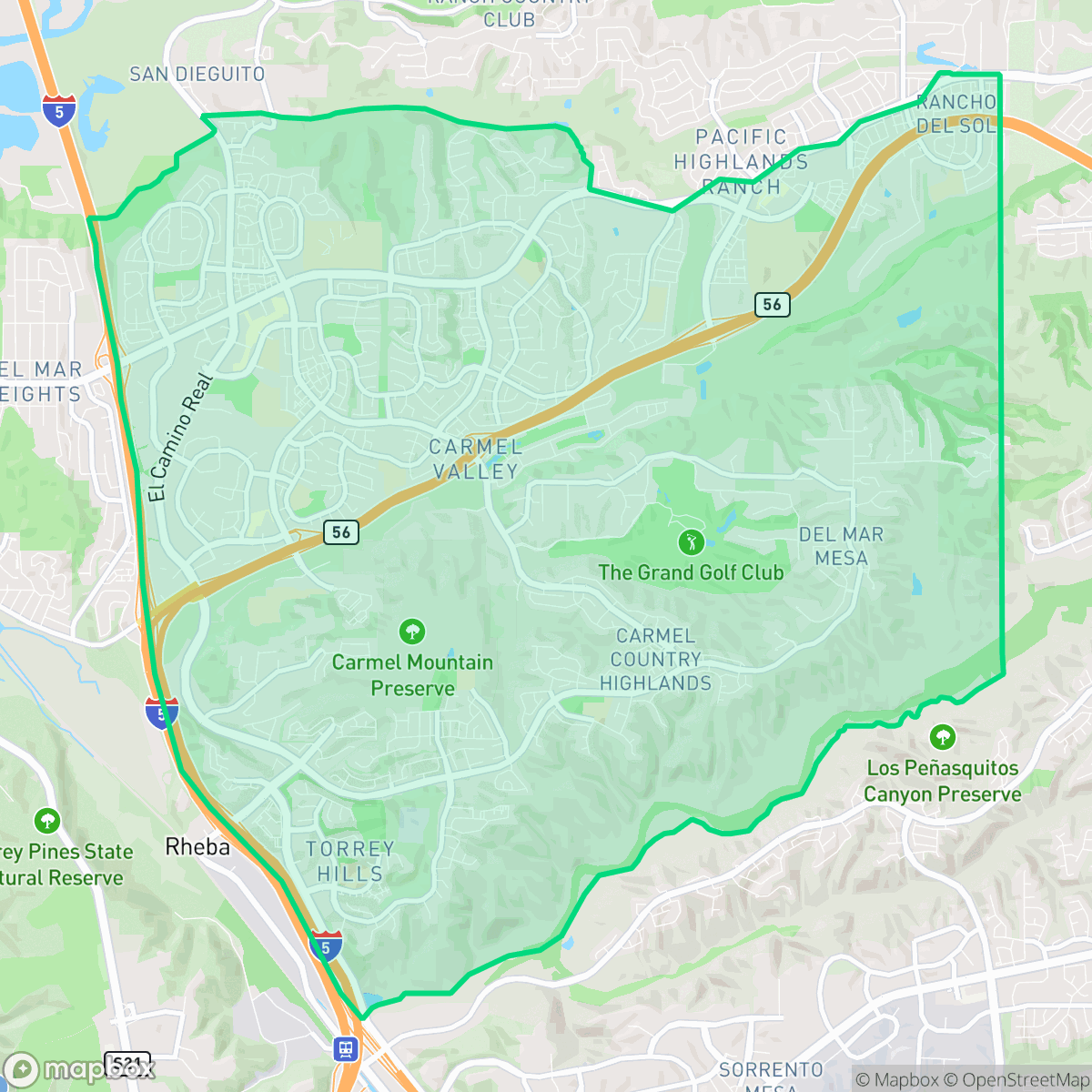
Carmel Valley is a master-planned community in northwestern San Diego characterized by its high walkability, extensive greenbelts, and affluent residential atmosphere. The area features a blend of modern commercial hubs like One Paseo and quiet, well-manicured suburban tracts. According to iHuus data, residents benefit from top-tier schools and a safe, residential-focused environment with minimal industrial presence.
Key Highlights
About Carmel Valley
Carmel Valley, a master-planned community in northwestern San Diego, traces its name to the Catholic Sisters of Mercy, who established a dairy farm and monastery in lower McGonigle Canyon in 1905 and named a nearby hill Mount Carmel. Historically home to Kumeyaay villages and later Spanish ranches, the area remained agricultural until the late 20th century. Originally designated as "North City West" in a 1974 master plan, residential construction began in 1983, featuring Spanish-inspired stucco designs with tile roofs. In 1991, local residents officially adopted the name Carmel Valley. Today, the neighborhood has evolved from its farming roots into a bustling suburban hub centered around major community landmarks like the Del Mar Highlands Town Center and the modern One Paseo mixed-use development.
The neighborhood offers a highly structured suburban environment defined by wide sidewalks, pedestrian bridges, and proximity to natural canyon trails. Residents enjoy a high standard of living with well-maintained landscaping, private amenities, and access to upscale retail centers such as the Del Mar Highlands Town Center. The area is largely residential, keeping industrial activity at bay and maintaining a peaceful atmosphere that prioritizes community recreation and family-oriented services.
While the area is exceptionally walkable for a suburban setting, some errands remain car-dependent due to the low-density layout. Prospective residents should note the high fire safety risk associated with the region, a factor that contrasts with the otherwise stable and high-performing school districts. It is well-suited for families and professionals who value academic excellence, quiet streets, and proximity to both coastal amenities and open-space preserves.
Neighborhood Scores Across 15 Qualities
Residential density is higher than the San Diego average, featuring a mix of closely clustered townhomes and single-family houses. While some areas provide buffer space near open canyons, other sections consist of dense housing clusters with minimal distance between structures.
Extensive sidewalk networks and dedicated pedestrian bridges provide a safe environment for walking. This area offers a more pedestrian-friendly experience than the San Diego average due to well-marked crossings and low-traffic streets.
Large homes with private pools and manicured landscaping define much of the area, providing a higher level of visual polish than the San Diego average. According to iHuus data, the neighborhood features frequent upscale amenities and well-maintained residential tracts.
Abundant greenbelts, canyon trails, and wide sidewalk verges offer much better walking conditions for pets than the San Diego average. According to iHuus data, the suburban layout provides safe, connected spaces for exercise away from heavy traffic.
Abundant undeveloped canyon land and natural open spaces provide a more rural landscape than the typical San Diego suburban setting. According to iHuus data, the area features significant natural buffers and greenery that distinguish it from more densely developed parts of the city.
Low-density residential blocks and vast open spaces characterize the area, resulting in a more subdued rhythm of life than the city average. While some pockets offer diverse dining and wellness services, much of the neighborhood is car-dependent with limited commercial density.
Steady traffic sounds from nearby busy streets are common here. According to iHuus data, acoustic levels are slightly higher than the San Diego average.
Air quality remains consistently good with only rare instances of elevated readings. According to iHuus data, these levels are notably cleaner than the San Diego average.
Industrial activity and heavy warehouses are absent from the area, providing a landscape focused on residential and recreational use. This lack of industrial proximity is slightly better than the San Diego average, according to iHuus data.
Health insurance access is exceptionally high among residents, significantly exceeding the San Diego average according to iHuus data.
Political leanings in this area are predominantly liberal, though the degree of this tendency is slightly lower than the San Diego city average according to iHuus data.
Residents experience a balanced demographic mix of young adults, families, and older individuals. This age distribution is consistent with the broader San Diego area according to iHuus data.
Some areas within the neighborhood fall within a floodplain, though safety levels remain notably higher than the San Diego city average according to iHuus data.
Fire hazard levels are notably higher than the San Diego average due to local terrain and vegetation. Residents should be aware of increased wildfire risks and the necessity for enhanced fire mitigation measures, according to iHuus data.
Address-Level Insights for Carmel Valley


iHuus Neighborhood Intelligence Insights
Get address-level neighborhood insights for Carmel Valley
- Street-level scores — see how individual blocks compare, not just neighborhood averages
- Micro-zone boundaries — identify quiet pockets, flood boundaries, and walkable clusters before you visit
- 15 dimensions in full — walkability, noise, air quality, school quality, insurance coverage, population age profile, urban/rural index, and more
- Boundary risk alerts — know if your address sits near a block boundary where scores drop, the kind of detail no listing will ever mention
- School insights — individual school ratings and insights, not just district-level data
- Compare before you commit — side-by-side data across neighborhoods, down to block precision
No credit card required
Compare with Any Neighborhood
| Dimension | Carmel Valley | Adams North |
|---|---|---|
| 🚶 Walkabilityavg 8.58 | ||
| 🔊 Acoustic Comfortavg 3.33 | ||
| 🤫 Privacy Indexavg 4.87 | ||
| 🎨 Visual Appealavg 6.85 | ||
| 🐕 Dog Friendlinessavg 6.91 | ||
| 🗺️ Urban-Rural Indexavg 6.6 | ||
| ✨ Neighborhood Vibeavg 5.12 | ||
| 🏥 Health Insurance Coverageavg 7.53 | ||
| 🌿 Air Qualityavg 6.36 | ||
| 🏭 Industrial Proximityavg 9.12 | ||
| 🌊 Flood Safetyavg 4.2 | ||
| 🗳️ Ideological Leanavg 8.51 | ||
| 👥 Population Age Profileavg 4.8 | ||
| 🔥 Fire Safetyavg 0.61 | ||
| 🏫 School Quality |
Carmel Valley Rankings
School Districts Serving Carmel Valley
School Insights for Carmel Valley
Below average outcomes; significant attendance and academic challenges.
School Insights
See what's really behind every school rating near Carmel Valley
- Individual school ratings — each school's own score with outcome context, not just a district average
- Enrollment & class size data — student-to-teacher ratio and how it compares to the state average
- Full demographics breakdown — ethnicity and gender composition for every school in the enrollment zone
- Every school in the district — all schools within the enrollment boundary ranked by rating, not just the closest one
- Grade levels & benchmarks — elementary through high school, with below/above state-average flags
No credit card required