Carmel Mountain, San Diego
Updated · 12,987 residents
Carmel Mountain is a master-planned community in northeastern San Diego known for its blend of residential tracts and large-format commercial hubs. While the area offers high walkability and access to top-rated schools, residents experience frequent noise from arterial road traffic and relatively close proximity between homes.
Key Highlights
About Carmel Mountain
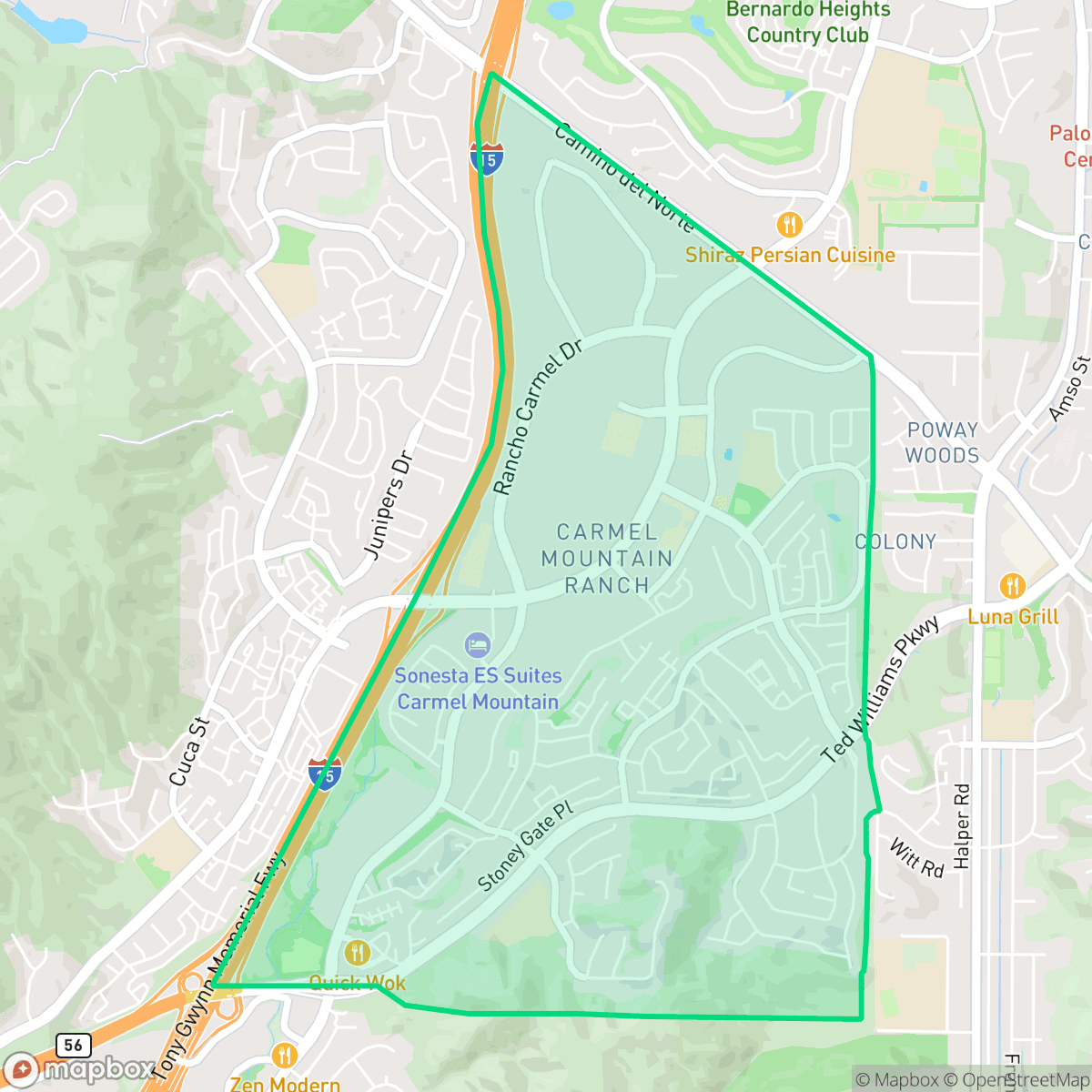
Carmel Mountain Ranch (often shortened to Carmel Mountain) in northeastern San Diego was originally the ancestral home of the Kumeyaay people and later part of an 1820s Mexican land grant. Its name originates from the Carmelite Sisters of Mercy, who established a dairy farm and monastery in the area in 1905. Despite its name, the neighborhood actually lies in the shadow of Black Mountain, roughly ten miles east of Carmel Mountain proper. The 1,489-acre master-planned community was established under a 1984 community plan, transitioning agricultural land into a balanced suburban and commercial hub. Notable local landmarks include the Carmel Mountain Ranch Community Park and the former Carmel Mountain Ranch Country Club golf course, which is undergoing redevelopment into "The Trails at Carmel Mountain Ranch" to introduce new housing, public parks, and multi-use trails.
The area functions as a dense suburban hub characterized by uniform housing tracts and significant commercial infrastructure. Residents benefit from the high-performing Poway Unified School District, with local options like Highland Ranch Elementary and Shoal Creek Elementary providing stable academic environments. The neighborhood maintains a balanced urban-rural feel, offering easy access to both essential retail centers and the natural landscapes surrounding Black Mountain.
Those considering a move to the area should account for the trade-offs inherent in its dense layout. While pedestrian infrastructure is well-developed, the neighborhood experiences elevated noise levels from surrounding road traffic. Privacy is limited due to the close spacing of residences, and prospective residents should be aware of the environmental risks associated with fire safety in this region. Overall, the community is well-suited for families and professionals who prioritize school quality and retail convenience over complete acoustic isolation.
Neighborhood Scores Across 15 Qualities
Residential spacing is consistent with the city average, featuring a mix of suburban layouts with moderate buffers between neighbors. According to iHuus data, some denser clusters exist where homes are closely positioned, though many areas maintain typical backyard separation.
Residential streets feature continuous sidewalks and dedicated pedestrian paths, though some arterial roads present challenges due to wide lanes and frequent commercial driveways. This level of walkability is roughly comparable to the San Diego average, according to iHuus data.
Large modern homes and frequent upscale amenities characterize this area. According to iHuus data, the visual landscape features more spacious properties and private amenities than the San Diego average.
Abundant green spaces, including natural canyon trails and wide parkways, provide ample room for pets. This area offers slightly better access to continuous sidewalks and open fields than the San Diego average.
Residential tracts and commercial plazas are interspersed with pockets of open land, making the area slightly more semi-rural than the San Diego average. According to iHuus data, the landscape features a mix of planned housing developments and significant grey cover from office parks and retail centers.
Vibrant pockets of dining and social hubs are interspersed with quiet, low-density residential blocks and green spaces. This level of activity is roughly in line with the city average, though much of the local commerce remains car-dependent.
Frequent noise from nearby major freeways and transit corridors is a notable feature of this area. Residents can expect higher levels of acoustic disturbance than is typical for the rest of San Diego, according to iHuus data.
Air quality remains consistently clean with infrequent periods of elevated readings. According to iHuus data, these levels are notably better than the San Diego city average.
Industrial presence is minimal, as the area consists mostly of residential streets and light commercial zones. According to iHuus data, this neighborhood has slightly more industrial activity than the San Diego average, though no significant warehouses or heavy manufacturing hazards are present.
Health insurance access is very high among residents, significantly exceeding the San Diego city average. According to iHuus data, the vast majority of the population maintains comprehensive medical coverage.
Political leanings in this area are largely liberal, though the neighborhood is notably less progressive than the San Diego city average.
Residents live alongside a balanced blend of young professionals, families, and seniors. This demographic distribution is consistent with the broader San Diego area.
Properties in this area are situated within a designated floodplain, which presents a higher risk of flooding than the San Diego average. According to iHuus data, residents should anticipate the potential requirement for flood insurance.
Wildfire hazards are notably higher here than the San Diego average, necessitating increased awareness of local mitigation and evacuation protocols. According to iHuus data, the surrounding landscape presents a significant risk for fire incidents.
Address-Level Insights for Carmel Mountain


iHuus Neighborhood Intelligence Insights
Get address-level neighborhood insights for Carmel Mountain
- Street-level scores — see how individual blocks compare, not just neighborhood averages
- Micro-zone boundaries — identify quiet pockets, flood boundaries, and walkable clusters before you visit
- 15 dimensions in full — walkability, noise, air quality, school quality, insurance coverage, population age profile, urban/rural index, and more
- Boundary risk alerts — know if your address sits near a block boundary where scores drop, the kind of detail no listing will ever mention
- School insights — individual school ratings and insights, not just district-level data
- Compare before you commit — side-by-side data across neighborhoods, down to block precision
No credit card required
Compare with Any Neighborhood
| Dimension | Carmel Mountain | Adams North |
|---|---|---|
| 🚶 Walkabilityavg 8.58 | ||
| 🔊 Acoustic Comfortavg 3.33 | ||
| 🤫 Privacy Indexavg 4.87 | ||
| 🎨 Visual Appealavg 6.85 | ||
| 🐕 Dog Friendlinessavg 6.91 | ||
| 🗺️ Urban-Rural Indexavg 6.6 | ||
| ✨ Neighborhood Vibeavg 5.12 | ||
| 🏥 Health Insurance Coverageavg 7.53 | ||
| 🌿 Air Qualityavg 6.36 | ||
| 🏭 Industrial Proximityavg 9.12 | ||
| 🌊 Flood Safetyavg 4.2 | ||
| 🗳️ Ideological Leanavg 8.51 | ||
| 👥 Population Age Profileavg 4.8 | ||
| 🔥 Fire Safetyavg 0.61 | ||
| 🏫 School Quality |
Carmel Mountain Rankings
School Districts Serving Carmel Mountain
School Insights for Carmel Mountain
Below average outcomes; significant attendance and academic challenges.
School Insights
See what's really behind every school rating near Carmel Mountain
- Individual school ratings — each school's own score with outcome context, not just a district average
- Enrollment & class size data — student-to-teacher ratio and how it compares to the state average
- Full demographics breakdown — ethnicity and gender composition for every school in the enrollment zone
- Every school in the district — all schools within the enrollment boundary ranked by rating, not just the closest one
- Grade levels & benchmarks — elementary through high school, with below/above state-average flags
No credit card required