Burlingame, San Diego
Updated · 891 residents
Burlingame is a highly walkable residential enclave in San Diego, characterized by its quiet streets and proximity to local parks. The area provides a peaceful living environment with excellent access to pet-friendly spaces and nearby dining options.
Key Highlights
About Burlingame
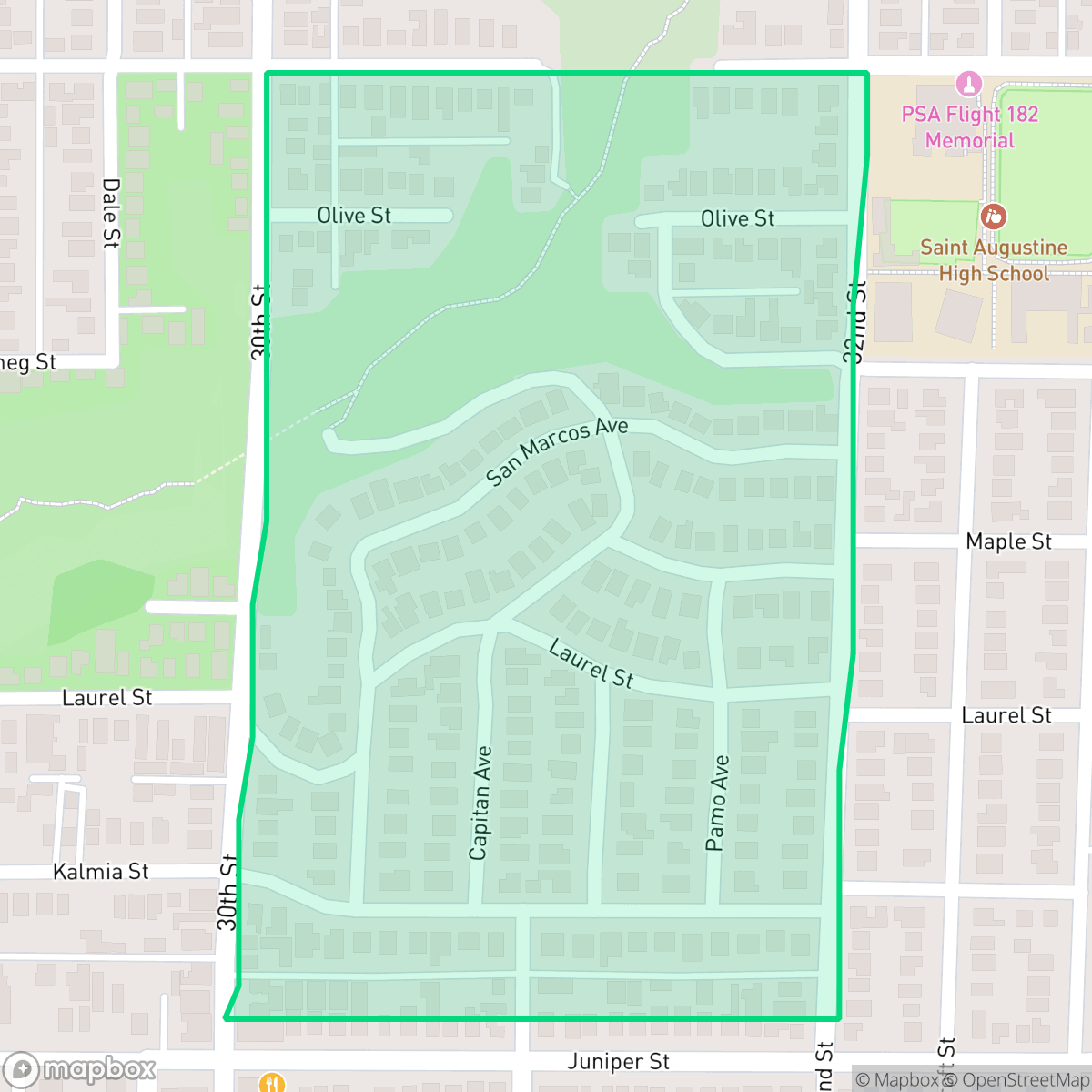
Established in 1912 by developers Joseph McFadden and George Buxton, the Burlingame neighborhood in San Diego is a historically designated residential tract known for its unique suburban planning. Unlike the surrounding grid pattern, Burlingame’s streets were designed to curve along the natural contours of Switzer Canyon. The neighborhood is instantly recognizable by its signature rose-colored concrete sidewalks, intentionally tinted pink to reduce glare from the Southern California sun. Developed during a pre-World War I building boom, the district showcases an eclectic mix of architectural styles, including Craftsman, Mission Revival, and Spanish Colonial Revival, designed by notable architects like William H. Wheeler. Many homes incorporate local volcanic river stones, colloquially known as "dinosaur eggs" or "Kensington cobble," in their chimneys and retaining walls, reinforcing the neighborhood's distinct, highly preserved historic character.
This neighborhood serves as a quiet, residential retreat that avoids the noise and industrial clutter found in other parts of the city. Residents benefit from a highly walkable environment that encourages outdoor activity, supported by well-maintained sidewalks and access to nearby green spaces. While the area maintains a suburban atmosphere, it remains close to popular local establishments such as The Taco Stand and Cori Pastificio Trattoria, offering a balance between peaceful living and convenient access to neighborhood amenities.
Prospective residents should consider that the area falls within the San Diego City Unified School District, which currently experiences a mix of educational performance and operational instability due to budget constraints. The neighborhood is particularly well-suited for those who prioritize a quiet, dog-friendly environment and a strong sense of community. Its lack of industrial proximity and high acoustic comfort make it an ideal choice for individuals or families seeking a stable, low-stress living experience in Southern California.
Neighborhood Scores Across 15 Qualities
Residential lots offer a moderate level of separation with some buffer between neighbors, which is higher than the San Diego average. Houses are primarily detached with varying yard sizes that increase in space near the canyon areas, according to iHuus data.
Pedestrian access is excellent due to a dense street grid with consistent sidewalks and frequent crosswalks. According to iHuus data, the ease of navigating the area on foot is notably higher than the San Diego average.
Manicured landscaping, large homes, and frequent private pools create a highly polished visual environment that is notably more premium than the San Diego average. According to iHuus data, the area is characterized by spacious properties and high-quality amenities.
Abundant trails, wooded canyons, and a large adjacent golf course provide significant area for pets to roam. This level of accessibility to open space is notably higher than the San Diego average, according to iHuus data.
Residential pockets feature a blend of single-family homes and small apartment blocks bordering canyon landscapes. This density is largely consistent with the broader San Diego area.
Suburban streets and green spaces create a calm atmosphere, though the area has less commercial activity than the San Diego average. Residents can enjoy local dining options like The Taco Stand or Communal Coffee, but most services require a short drive.
Steady noise from nearby busy streets is present, though levels remain significantly quieter than the San Diego city average according to iHuus data.
Air quality fluctuates between acceptable and unhealthy levels, presenting occasional concerns for sensitive groups. According to iHuus data, the air quality in Burlingame is slightly lower than the San Diego average.
Industrial presence is non-existent in this area, which consists entirely of residential and recreational spaces. This neighborhood offers a significantly cleaner landscape than the San Diego average, as no warehouses or hazardous sites are detected via iHuus data.
Health insurance access is exceptionally high among Burlingame residents, significantly surpassing the San Diego average according to iHuus data.
Voting patterns and census indicators show a distinctly liberal political leaning that is more pronounced than the San Diego average, according to iHuus data.
A diverse mix of young adults, families, and older residents characterizes the area. This distribution is slightly more varied than the typical San Diego age profile, according to iHuus data.
Flood safety levels are notably higher than the San Diego average, though some residual risk remains as parts of the area fall within the 500-year floodplain. According to iHuus data, residents may encounter minor seasonal flooding risks during extreme weather events.
Fire hazards in this area are notably higher than the San Diego average. Residents should be aware of increased vegetation or structural risks as indicated by iHuus data.
Address-Level Insights for Burlingame


iHuus Neighborhood Intelligence Insights
Get address-level neighborhood insights for Burlingame
- Street-level scores — see how individual blocks compare, not just neighborhood averages
- Micro-zone boundaries — identify quiet pockets, flood boundaries, and walkable clusters before you visit
- 15 dimensions in full — walkability, noise, air quality, school quality, insurance coverage, population age profile, urban/rural index, and more
- Boundary risk alerts — know if your address sits near a block boundary where scores drop, the kind of detail no listing will ever mention
- School insights — individual school ratings and insights, not just district-level data
- Compare before you commit — side-by-side data across neighborhoods, down to block precision
No credit card required
Compare with Any Neighborhood
| Dimension | Burlingame | Adams North |
|---|---|---|
| 🚶 Walkabilityavg 8.58 | ||
| 🔊 Acoustic Comfortavg 3.33 | ||
| 🤫 Privacy Indexavg 4.87 | ||
| 🎨 Visual Appealavg 6.85 | ||
| 🐕 Dog Friendlinessavg 6.91 | ||
| 🗺️ Urban-Rural Indexavg 6.6 | ||
| ✨ Neighborhood Vibeavg 5.12 | ||
| 🏥 Health Insurance Coverageavg 7.53 | ||
| 🌿 Air Qualityavg 6.36 | ||
| 🏭 Industrial Proximityavg 9.12 | ||
| 🌊 Flood Safetyavg 4.2 | ||
| 🗳️ Ideological Leanavg 8.51 | ||
| 👥 Population Age Profileavg 4.8 | ||
| 🔥 Fire Safetyavg 0.61 | ||
| 🏫 School Quality |
Burlingame Rankings
School Districts Serving Burlingame
School Insights for Burlingame
Below average outcomes; significant attendance and academic challenges.
School Insights
See what's really behind every school rating near Burlingame
- Individual school ratings — each school's own score with outcome context, not just a district average
- Enrollment & class size data — student-to-teacher ratio and how it compares to the state average
- Full demographics breakdown — ethnicity and gender composition for every school in the enrollment zone
- Every school in the district — all schools within the enrollment boundary ranked by rating, not just the closest one
- Grade levels & benchmarks — elementary through high school, with below/above state-average flags
No credit card required