Bird Land, San Diego
Updated · 5,592 residents
Bird Land is a primarily residential community defined by its mid-century ranch homes and its role as a regional medical hub. While the area offers decent walkability for local errands and access to green space, residents should be prepared for significant noise levels due to its proximity to major highways.
Key Highlights
About Bird Land
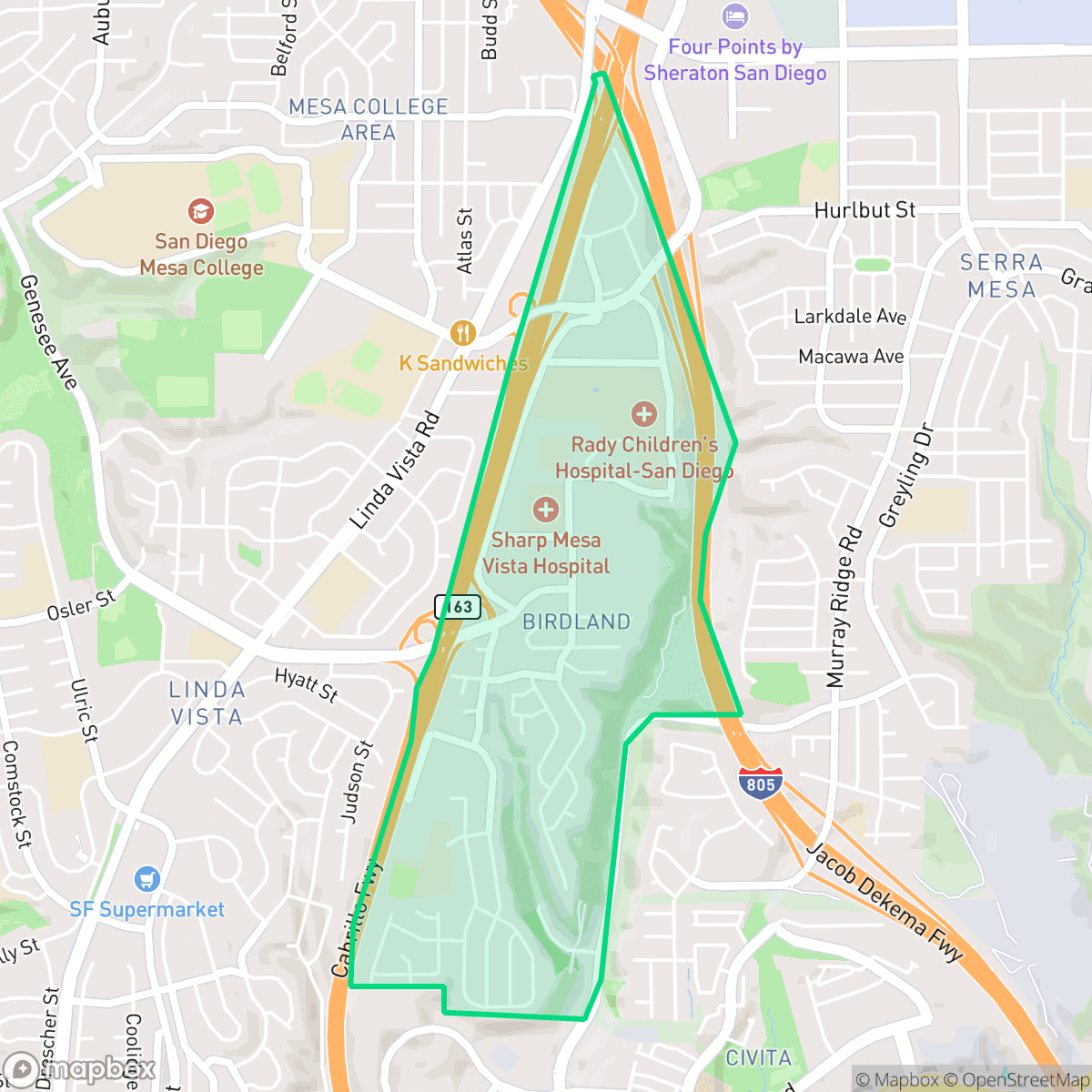
Developed in the late 1950s and early 1960s, the Birdland neighborhood in San Diego—originally designated as "El Dorado" in planning documents—is situated on a mesa between State Route 163, Interstate 805, and Mission Valley. The community derived its name from its streets, which are almost exclusively named after bird species. A local development dispute famously led to the naming of Haveteur Way ("have it your way"). Characterized by mid-century single-family ranch homes, Birdland is most prominently recognized as a major medical hub. It hosts several of the region's leading healthcare facilities, including Sharp Memorial Hospital, Sharp Mary Birch Hospital for Women & Newborns, and Rady Children's Hospital.
The neighborhood functions as a quiet suburban enclave characterized by its unique street naming conventions and mid-century architectural aesthetic. It serves as a central medical anchor for San Diego, housing major facilities that provide essential services to the broader region. According to iHuus data, the area maintains a moderate urban-rural balance, offering a mix of residential streets and accessible green spaces that contribute to its suburban feel.
Prospective residents should consider the trade-offs associated with the location, particularly regarding acoustic comfort. The neighborhood experiences high noise levels from adjacent highway traffic, which may impact those sensitive to sound. While it offers a reasonable level of walkability for daily needs, the area is best suited for those who prioritize proximity to healthcare employment or regional transit corridors over complete acoustic seclusion.
Neighborhood Scores Across 15 Qualities
Housing density is slightly above the San Diego average, with a mix of closely spaced homes and multi-unit complexes. Residents will encounter varying levels of separation between neighbors, ranging from shared walls to standard suburban spacing.
Continuous sidewalks and pedestrian bridges provide reliable connectivity across residential and commercial zones, though the large highway to the east acts as a significant barrier. While highly accessible, walking ease in this area is slightly below the San Diego average according to iHuus data.
Uniform tract housing and mid-sized apartment complexes define the visual landscape. This area features less architectural variety and greenery than the San Diego average, according to iHuus data.
Limited public green space and narrow street verges make off-leash exercise more difficult here than in many other San Diego neighborhoods. While some residents benefit from nearby canyon access and school fields, most pet owners will rely on private yards or traveling to larger parks.
Residential layouts here feature a dense suburban blend of single-family homes, apartment complexes, and commercial zones. This landscape is largely consistent with the broader San Diego urban-rural balance.
Suburban streets and green spaces offer a calm atmosphere with a steady presence of local dining and essential services. This level of activity is slightly below the San Diego average, providing a more tranquil setting than more densely populated urban areas.
Frequent noise from the adjacent airport runway is a constant presence; according to iHuus data, acoustic comfort levels here are significantly lower than the San Diego average.
Air quality levels fluctuate between acceptable and unhealthy at times, which may cause occasional concern for sensitive groups. This neighborhood's air quality is slightly below the San Diego city average according to iHuus data.
Industrial activity is virtually nonexistent in this area, as the neighborhood consists primarily of residential, institutional, and light commercial uses. According to iHuus data, this lack of heavy manufacturing or warehousing makes the area even more free of industrial hazards than the San Diego average.
Health insurance accessibility is strong in this area, with coverage levels trending above the San Diego average according to iHuus data.
Voting patterns and census indicators in Bird Land align with a strong liberal leaning, which is slightly more pronounced than the San Diego city average according to iHuus data.
A balanced mix of young adults, families, and older residents characterizes this area; according to iHuus data, this demographic spread is slightly lower than the San Diego average.
Flood risk in this area is slightly higher than the San Diego average, though precise assessments are currently unavailable due to incomplete federal studies. Residents should remain aware of potential vulnerabilities during extreme weather events according to iHuus data.
Address-Level Insights for Bird Land


iHuus Neighborhood Intelligence Insights
Get address-level neighborhood insights for Bird Land
- Street-level scores — see how individual blocks compare, not just neighborhood averages
- Micro-zone boundaries — identify quiet pockets, flood boundaries, and walkable clusters before you visit
- 15 dimensions in full — walkability, noise, air quality, school quality, insurance coverage, population age profile, urban/rural index, and more
- Boundary risk alerts — know if your address sits near a block boundary where scores drop, the kind of detail no listing will ever mention
- School insights — individual school ratings and insights, not just district-level data
- Compare before you commit — side-by-side data across neighborhoods, down to block precision
No credit card required
Compare with Any Neighborhood
| Dimension | Bird Land | Adams North |
|---|---|---|
| 🚶 Walkabilityavg 8.58 | ||
| 🔊 Acoustic Comfortavg 3.33 | ||
| 🤫 Privacy Indexavg 4.87 | ||
| 🎨 Visual Appealavg 6.85 | ||
| 🐕 Dog Friendlinessavg 6.91 | ||
| 🗺️ Urban-Rural Indexavg 6.6 | ||
| ✨ Neighborhood Vibeavg 5.12 | ||
| 🏥 Health Insurance Coverageavg 7.53 | ||
| 🌿 Air Qualityavg 6.36 | ||
| 🏭 Industrial Proximityavg 9.12 | ||
| 🌊 Flood Safetyavg 4.2 | ||
| 🗳️ Ideological Leanavg 8.51 | ||
| 👥 Population Age Profileavg 4.8 | ||
| 🔥 Fire Safetyavg 0.61 | ||
| 🏫 School Quality |
Bird Land Rankings
School Districts Serving Bird Land
School Insights for Bird Land
Below average outcomes; significant attendance and academic challenges.
School Insights
See what's really behind every school rating near Bird Land
- Individual school ratings — each school's own score with outcome context, not just a district average
- Enrollment & class size data — student-to-teacher ratio and how it compares to the state average
- Full demographics breakdown — ethnicity and gender composition for every school in the enrollment zone
- Every school in the district — all schools within the enrollment boundary ranked by rating, not just the closest one
- Grade levels & benchmarks — elementary through high school, with below/above state-average flags
No credit card required