Bay Terraces, San Diego
Updated · 29,911 residents
Bay Terraces is a predominantly residential community in San Diego known for its dense suburban tract housing and strong Filipino-American cultural heritage. The neighborhood offers high walkability through its connected sidewalk network, though it remains a quiet area with limited local commercial activity. Residents benefit from proximity to canyon greenbelts and various school-based recreational spaces.
Key Highlights
About Bay Terraces
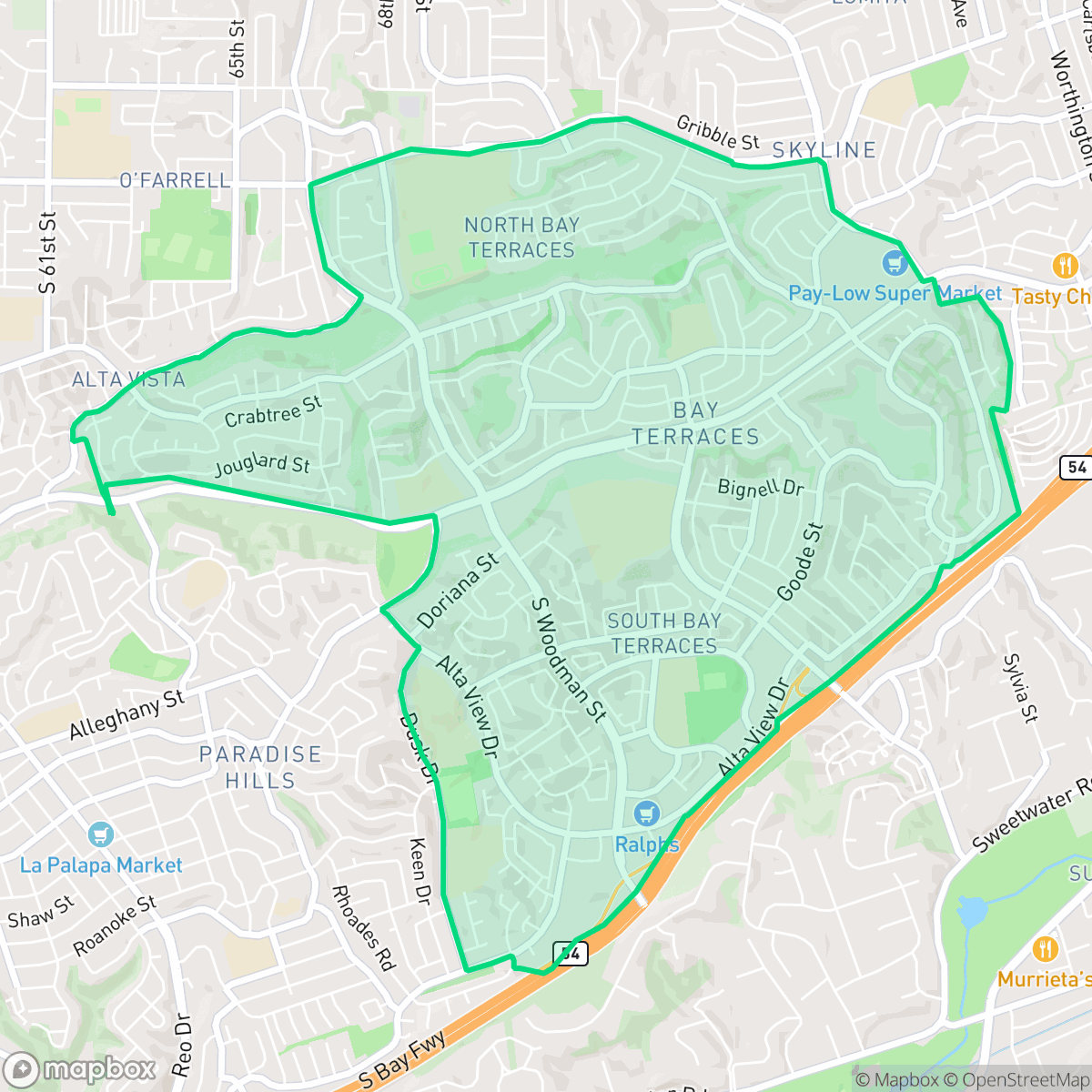
Annexed by San Diego in 1969, the hilly neighborhood of Bay Terraces was developed from an unused canyon tract during the late 1970s and early 1980s under plans submitted by Peñasquitos, Inc. Divided into North and South sections by Paradise Valley Road, the area was built out primarily with single-family tract homes. Early developers utilized federal subsidies and local programs to attract buyers to the area. A massive influx of Filipino immigrants—many of whom served in the U.S. Navy and sought housing near Naval Base San Diego—profoundly shaped the community’s cultural identity. Today, Bay Terraces retains a vibrant, diverse population with a strong Filipino-American presence, marked by local landmarks like the Itliong-Vera Cruz Memorial Bridge on Woodman Avenue.
The neighborhood is characterized by a dense suburban layout featuring uniform single-family homes and consistent residential street patterns. It functions as a quiet, purely residential zone, completely free of industrial warehouses or hazardous commercial sites. The area is highly pedestrian-friendly, with continuous sidewalks on both sides of most streets and safe cul-de-sacs that connect to local parks and school athletic fields. While the atmosphere is generally calm, the proximity to major roads contributes to a moderate level of traffic noise, and the lack of local businesses means that most daily errands require travel outside of the immediate vicinity.
Prospective residents should consider that the area presents a mix of educational options, ranging from high-performing schools like Bethune K-8 to campuses with lower proficiency rates. The neighborhood is well-suited for families seeking a stable, community-focused environment, though it is important to note the elevated risk profiles for fire and flooding in the region. With its combination of accessible green spaces and a tight-knit residential feel, the area provides a distinct suburban experience that balances walkability with a remote, low-traffic lifestyle.
Neighborhood Scores Across 15 Qualities
Residential spacing varies throughout the area, offering more separation between neighbors than the San Diego average. While some sections feature tightly packed homes with minimal setbacks, other parts of the neighborhood provide more substantial buffers between structures.
Extensive sidewalk networks and low-traffic residential cul-de-sacs provide safe pedestrian paths that are slightly better than the San Diego average. While pedestrian-friendly trails and parks are accessible, the nearby highway and steep canyon topography can create occasional barriers to movement.
Uniform tract housing and shared community amenities characterize the local landscape. This area presents a visual profile similar to the San Diego average, featuring consistent rooflines and modest yard sizes.
Extensive canyon greenbelts, school fields, and wide sidewalk verges provide ample space for pet exercise. This level of accessibility for dogs is roughly in line with the San Diego average.
Standard suburban density defines this area, featuring a mix of single-family homes and multi-unit complexes alongside central school and park infrastructure. This level of development is consistent with the typical urban-rural balance found throughout San Diego.
Suburban blocks and green spaces define this area, providing a serene atmosphere with a steady but low-density rhythm of social spots. While some dining and leisure locations are reachable on foot, the overall level of activity is slightly below the city average.
Steady sound from nearby busy streets is present, though acoustic conditions remain more favorable than the San Diego city average.
Air quality levels are generally acceptable, though sensitive groups may experience occasional periods of concern. According to iHuus data, the air quality in Bay Terraces is slightly lower than the San Diego city average.
Industrial activity is non-existent here, as the area consists entirely of residential, institutional, and light commercial zones. According to iHuus data, this neighborhood is even more free of warehouses and industrial hazards than the San Diego average.
Health insurance access among residents is slightly above the San Diego average, according to iHuus data.
Political leanings in this area are predominantly liberal, aligning closely with the broader San Diego community according to iHuus data.
A balanced distribution of young adults, families, and older residents characterizes the area. This demographic variety is largely in line with the broader San Diego population, according to iHuus data.
Flood risk levels in this area are slightly higher than the San Diego average. Current FEMA data lacks a detailed study for this specific location, meaning some degree of environmental uncertainty exists regarding potential inundation.
Fire hazard levels in Bay Terraces are exceptionally high, significantly exceeding the San Diego average. Residents should be aware of the extreme risk and the necessity for maximum protection measures, according to iHuus data.
Address-Level Insights for Bay Terraces


iHuus Neighborhood Intelligence Insights
Get address-level neighborhood insights for Bay Terraces
- Street-level scores — see how individual blocks compare, not just neighborhood averages
- Micro-zone boundaries — identify quiet pockets, flood boundaries, and walkable clusters before you visit
- 15 dimensions in full — walkability, noise, air quality, school quality, insurance coverage, population age profile, urban/rural index, and more
- Boundary risk alerts — know if your address sits near a block boundary where scores drop, the kind of detail no listing will ever mention
- School insights — individual school ratings and insights, not just district-level data
- Compare before you commit — side-by-side data across neighborhoods, down to block precision
No credit card required
Compare with Any Neighborhood
| Dimension | Bay Terraces | Adams North |
|---|---|---|
| 🚶 Walkabilityavg 8.58 | ||
| 🔊 Acoustic Comfortavg 3.33 | ||
| 🤫 Privacy Indexavg 4.87 | ||
| 🎨 Visual Appealavg 6.85 | ||
| 🐕 Dog Friendlinessavg 6.91 | ||
| 🗺️ Urban-Rural Indexavg 6.6 | ||
| ✨ Neighborhood Vibeavg 5.12 | ||
| 🏥 Health Insurance Coverageavg 7.53 | ||
| 🌿 Air Qualityavg 6.36 | ||
| 🏭 Industrial Proximityavg 9.12 | ||
| 🌊 Flood Safetyavg 4.2 | ||
| 🗳️ Ideological Leanavg 8.51 | ||
| 👥 Population Age Profileavg 4.8 | ||
| 🔥 Fire Safetyavg 0.61 | ||
| 🏫 School Quality |
Bay Terraces Rankings
School Districts Serving Bay Terraces
School Insights for Bay Terraces
Below average outcomes; significant attendance and academic challenges.
School Insights
See what's really behind every school rating near Bay Terraces
- Individual school ratings — each school's own score with outcome context, not just a district average
- Enrollment & class size data — student-to-teacher ratio and how it compares to the state average
- Full demographics breakdown — ethnicity and gender composition for every school in the enrollment zone
- Every school in the district — all schools within the enrollment boundary ranked by rating, not just the closest one
- Grade levels & benchmarks — elementary through high school, with below/above state-average flags
No credit card required