Bay Ho, San Diego
Updated · 13,286 residents
Bay Ho is a serene, mid-century residential enclave in San Diego known for its canyon-side homes and high walkability. While the area maintains a quiet suburban atmosphere, residents benefit from convenient access to local parks and well-connected pedestrian paths. According to iHuus data, the neighborhood offers a balanced, low-density lifestyle that appeals to those seeking privacy and proximity to green space.
Key Highlights
About Bay Ho
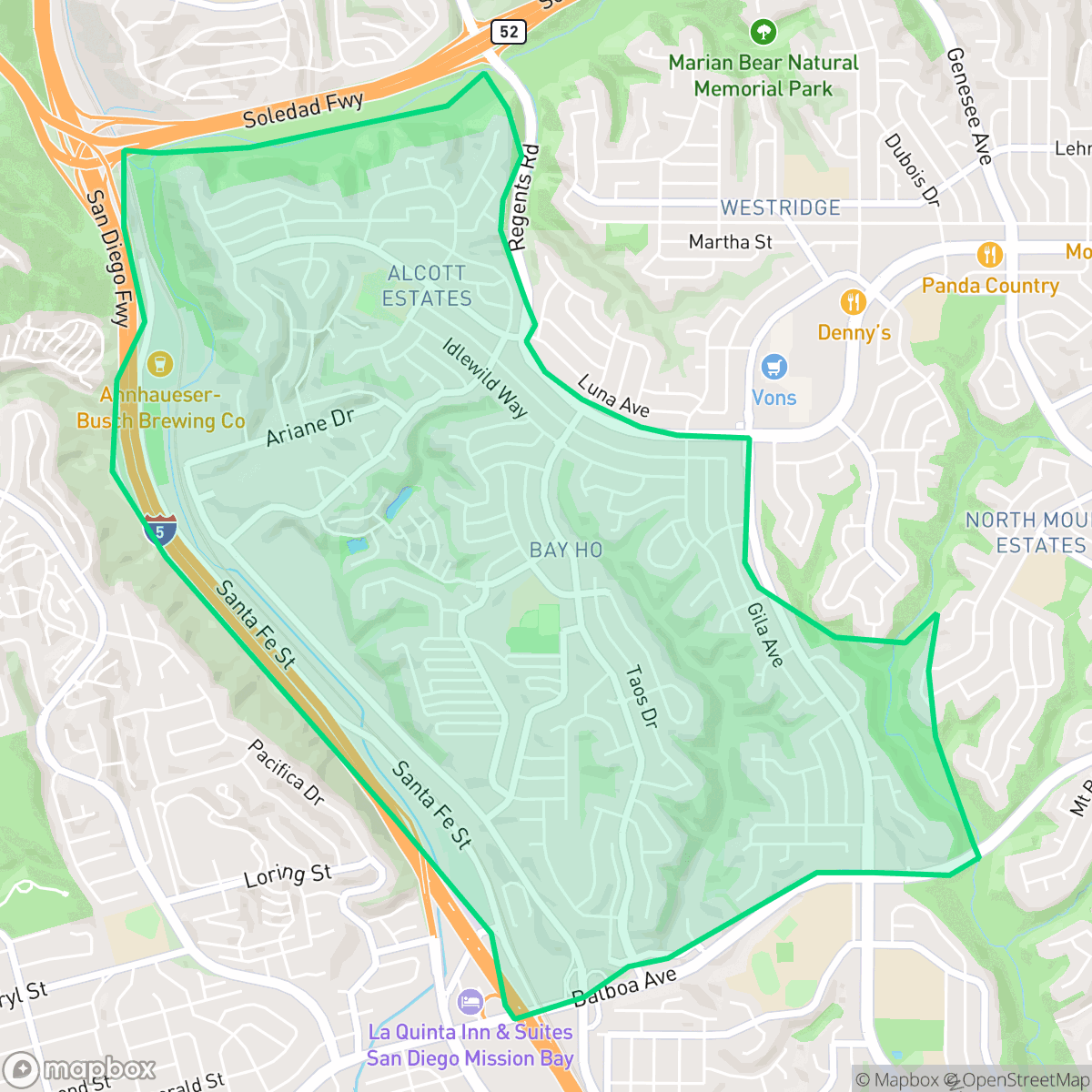
Tucked in the western hills of San Diego, Bay Ho originated as ranch land used for cattle grazing and dry farming before transitioning into a suburban neighborhood in 1954. Its unique name references its proximity to Mission Bay and the "high outlook" of its elevated terrain. Developed during the postwar boom, the enclave is characterized by mid-century ranch-style homes, quiet cul-de-sacs, and scenic canyon lots. Huerfano Avenue serves as the neighborhood's unofficial main drag, while Cadman Community Park provides local green space. Culturally, Bay Ho holds a notable place in retail history; the world's very first membership warehouse club, Price Club, was founded here in 1976 before later merging with Costco. Today, the neighborhood retains its relaxed, mid-century character alongside modern transit additions like the Blue Line Trolley.
The neighborhood is characterized by its elevated terrain and distinctive mid-century architecture, which includes many homes backing onto private canyon landscapes. It offers a high degree of walkability, with consistent sidewalks and well-maintained pedestrian routes that connect residential streets to local green spaces like Cadman Community Park. The area maintains a strong sense of privacy, with moderate home spacing and a lack of industrial development, making it a quiet retreat from the busier urban centers nearby. According to iHuus data, the community remains a stable, low-density environment that prioritizes residential comfort over commercial density.
Prospective residents should consider that the neighborhood experiences moderate noise levels primarily due to road traffic. While the area boasts high health insurance coverage and a desirable visual aesthetic, it faces specific challenges regarding fire safety and a complex local school district environment. It is best suited for families or individuals who prioritize a stable, low-density environment with easy access to outdoor recreation and are comfortable with the trade-offs of a suburban, car-oriented lifestyle in a hilly coastal region.
Neighborhood Scores Across 15 Qualities
Residential spacing provides more separation than the San Diego average, with many homes featuring moderate setbacks and direct access to private open-space canyons. According to iHuus data, the neighborhood offers a balanced mix of detached housing and buffered lot lines.
Continuous sidewalks and clear pedestrian crossings are available on most streets. This level of accessibility is roughly in line with the San Diego average.
Large homes with private pools and well-maintained landscaping characterize this area, which offers a higher level of visual appeal than the San Diego average. According to iHuus data, the neighborhood features prominent multi-car garages and complex rooflines throughout the residential blocks.
Abundant canyon trails, large greenbelts, and wide sidewalks provide ample space for pets. According to iHuus data, the area offers significantly more accessible walking paths and parkland than the San Diego average.
Low density residential layouts and prominent canyon topography provide more open space and greenery than typical San Diego neighborhoods. According to iHuus data, this area leans more toward a semi-rural character than the city average.
Low density and sparse commercial development create a tranquil environment, though most daily errands require a vehicle. According to iHuus data, the local activity level is lower than the San Diego average.
Frequent noise from nearby freeways and transit corridors creates a disruptive acoustic environment. This level of disturbance is slightly higher than the San Diego average, according to iHuus data.
Air quality in Bay Ho fluctuates between acceptable and unhealthy levels on certain days. According to iHuus data, these conditions are slightly below the San Diego city average, which may cause occasional concern for sensitive groups.
Residential and recreational uses dominate the area with an absence of warehouses or heavy industrial facilities. According to iHuus data, this neighborhood is slightly cleaner of industrial zones than the San Diego average.
Health insurance access is widespread among residents, appearing significantly higher than the San Diego average according to iHuus data.
Political leanings in this area are strongly liberal, though slightly less so than the broader San Diego average according to iHuus data.
Residents will find a balanced mix of young professionals, families, and older adults; according to iHuus data, this demographic spread is more varied than the typical San Diego profile.
Flood risk in this area is higher than the San Diego average, though a detailed study from FEMA is currently unavailable. Residents should remain aware of potential vulnerabilities due to the undetermined nature of the local flood studies.
Fire risk in this area is significantly higher than the San Diego average. According to iHuus data, the neighborhood faces extreme wildfire threats that require maximum protection measures.
Address-Level Insights for Bay Ho


iHuus Neighborhood Intelligence Insights
Get address-level neighborhood insights for Bay Ho
- Street-level scores — see how individual blocks compare, not just neighborhood averages
- Micro-zone boundaries — identify quiet pockets, flood boundaries, and walkable clusters before you visit
- 15 dimensions in full — walkability, noise, air quality, school quality, insurance coverage, population age profile, urban/rural index, and more
- Boundary risk alerts — know if your address sits near a block boundary where scores drop, the kind of detail no listing will ever mention
- School insights — individual school ratings and insights, not just district-level data
- Compare before you commit — side-by-side data across neighborhoods, down to block precision
No credit card required
Compare with Any Neighborhood
| Dimension | Bay Ho | Adams North |
|---|---|---|
| 🚶 Walkabilityavg 8.58 | ||
| 🔊 Acoustic Comfortavg 3.33 | ||
| 🤫 Privacy Indexavg 4.87 | ||
| 🎨 Visual Appealavg 6.85 | ||
| 🐕 Dog Friendlinessavg 6.91 | ||
| 🗺️ Urban-Rural Indexavg 6.6 | ||
| ✨ Neighborhood Vibeavg 5.12 | ||
| 🏥 Health Insurance Coverageavg 7.53 | ||
| 🌿 Air Qualityavg 6.36 | ||
| 🏭 Industrial Proximityavg 9.12 | ||
| 🌊 Flood Safetyavg 4.2 | ||
| 🗳️ Ideological Leanavg 8.51 | ||
| 👥 Population Age Profileavg 4.8 | ||
| 🔥 Fire Safetyavg 0.61 | ||
| 🏫 School Quality |
Bay Ho Rankings
School Districts Serving Bay Ho
School Insights for Bay Ho
Below average outcomes; significant attendance and academic challenges.
School Insights
See what's really behind every school rating near Bay Ho
- Individual school ratings — each school's own score with outcome context, not just a district average
- Enrollment & class size data — student-to-teacher ratio and how it compares to the state average
- Full demographics breakdown — ethnicity and gender composition for every school in the enrollment zone
- Every school in the district — all schools within the enrollment boundary ranked by rating, not just the closest one
- Grade levels & benchmarks — elementary through high school, with below/above state-average flags
No credit card required