Balboa Park, San Diego
Updated · 7,922 residents
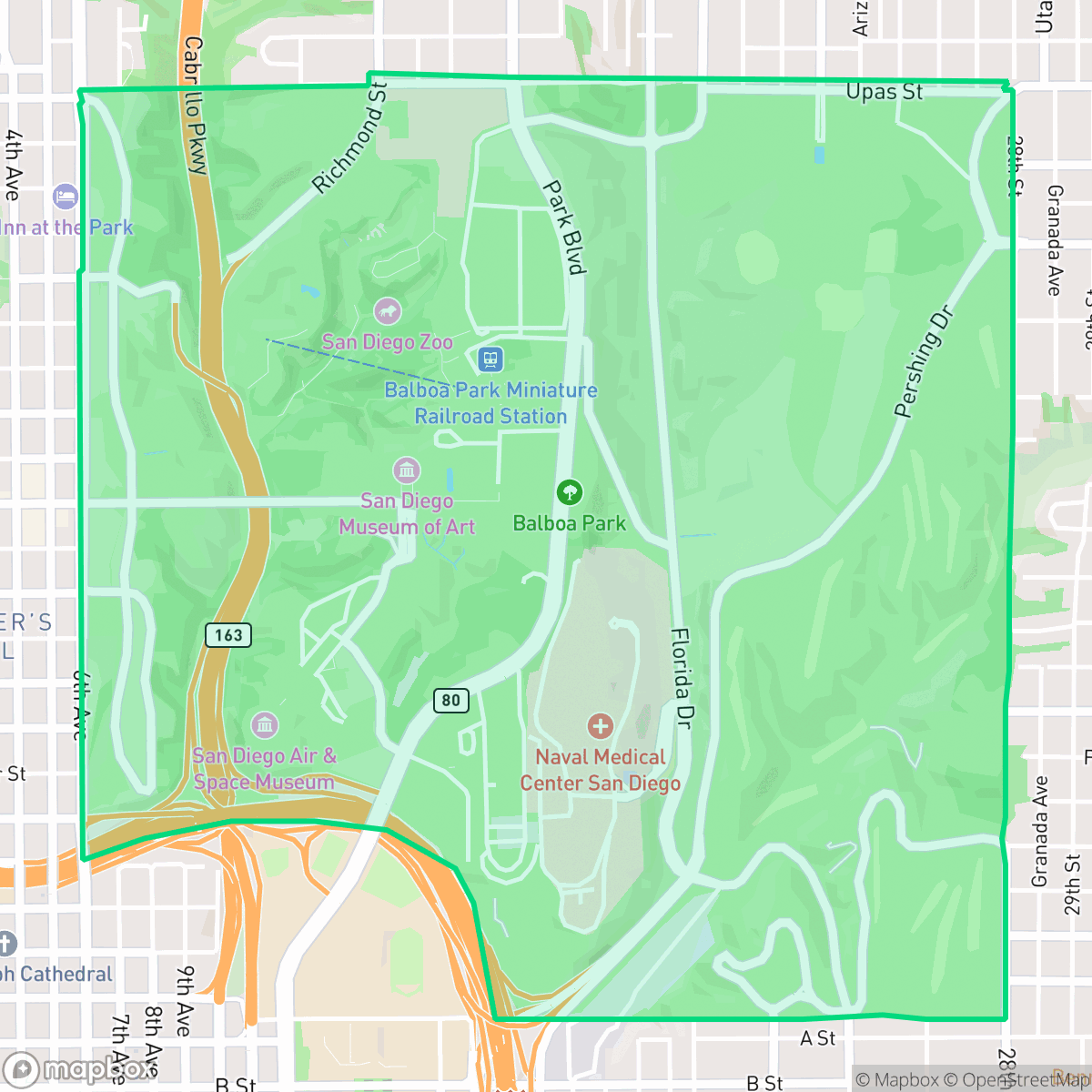
Balboa Park is a highly walkable urban neighborhood defined by its immediate proximity to one of the nation's largest cultural and recreational parks. Residents enjoy exceptional access to green space and pet-friendly trails, though they experience a dense living environment with significant road noise.
Key Highlights
About Balboa Park
Originally set aside as a 1,400-acre public land preserve in 1868, San Diego’s Balboa Park—initially known as "City Park"—was transformed from a scrub-filled mesa into a world-renowned cultural oasis. Renowned horticulturist Kate Sessions leased land here in 1892, introducing lush, diverse flora. The park’s signature aesthetic was defined by the 1915 Panama-California Exposition, for which lead architect Bertram Goodhue introduced the highly ornamental Spanish Colonial Revival style to the United States. This architectural legacy is preserved along El Prado, a central promenade lined with landmarks like the California Tower and the iconic lath Botanical Building. A second world's fair, the 1935 California Pacific International Exposition, added Pueblo and Mayan-inspired structures. Declared a National Historic Landmark District in 1977, Balboa Park remains a vibrant cultural epicenter housing museums, the Old Globe Theatre, and the world-famous San Diego Zoo.
The neighborhood functions as a dense urban grid, characterized by a mix of historic homes and modern multi-story apartment buildings. It is exceptionally well-connected for pedestrians, allowing for easy access to the numerous museums, theaters, and the world-renowned zoo located within the adjacent parkland. According to iHuus data, the area maintains a high level of health insurance coverage among its residents, reflecting a stable professional population. While the architectural landscape is varied, the area prioritizes recreational access over private outdoor space, making it a hub for those who value an active, outdoor-oriented lifestyle.
Prospective residents should consider the trade-offs of living in such a central location, particularly regarding acoustic comfort and fire safety. The area experiences elevated noise levels from surrounding road traffic, and the high-density nature of the housing results in limited personal privacy. While the neighborhood offers an ideal environment for dog owners and those seeking walkability, families should note that local school ratings remain low. Overall, the area is best suited for individuals who prioritize proximity to cultural amenities and public green space over quiet, low-density living.
Neighborhood Scores Across 15 Qualities
Residential structures are often closely spaced with minimal buffers between neighbors, resulting in a lower level of privacy than the San Diego average. According to iHuus data, many homes feature narrow gaps or shared walls characteristic of high-density urban layouts.
Wide, consistent sidewalks and frequent crosswalks make navigating the neighborhood on foot very easy. According to iHuus data, the connectivity and pedestrian infrastructure here are significantly higher than the San Diego average.
A mix of historic architecture and luxury amenities characterizes the area. According to iHuus data, the visual landscape is slightly below the city average for San Diego.
Extensive access to Balboa Park, adjacent golf courses, and canyon trails provides significantly more open space for pets than the San Diego average. Large greenbelts and wooded paths are readily available for walking and exercise throughout the area.
Residential streets and green spaces are found in roughly equal measure, offering a more balanced landscape than the more densely urbanized San Diego average. This area features a blend of low-rise apartment blocks, single-family homes, and significant proximity to large regional parkland.
Active social hubs and diverse dining options create a more vibrant atmosphere than the city average. While some blocks remain quiet and suburban, the area features a significant concentration of local landmarks and eateries.
Frequent noise from nearby major freeways and transit corridors persists throughout the area. According to iHuus data, acoustic comfort in this neighborhood is slightly below the San Diego average.
Air quality in this area fluctuates between acceptable and unhealthy levels, presenting occasional concerns for sensitive groups. This rating is slightly below the San Diego city average according to iHuus data.
Industrial warehouses and hazardous facilities are entirely absent from this area. This neighborhood maintains a cleaner, more residential environment than the San Diego average according to iHuus data.
Health insurance enrollment among Balboa Park residents is slightly below the San Diego average. According to iHuus data, a significant portion of the local population maintains coverage, though access levels are lower than in many other parts of the city.
Voting patterns and census indicators reflect a highly progressive political landscape, notably more liberal than the San Diego average. According to iHuus data, this area maintains a distinctively left-leaning ideological profile.
Residents live alongside a balanced mix of young adults, families, and older individuals. This age distribution is roughly in line with the average across San Diego.
Flood safety in this area is significantly higher than the San Diego average, though some residual risk remains due to proximity to a 500-year floodplain. According to iHuus data, properties are generally situated in a much more secure position regarding heavy precipitation events compared to much of the city.
Wildfire vulnerability is a significant concern in this area, with risk levels notably higher than the San Diego average. According to iHuus data, the proximity to dense vegetation necessitates enhanced seasonal mitigation and preparedness.
Address-Level Insights for Balboa Park


iHuus Neighborhood Intelligence Insights
Get address-level neighborhood insights for Balboa Park
- Street-level scores — see how individual blocks compare, not just neighborhood averages
- Micro-zone boundaries — identify quiet pockets, flood boundaries, and walkable clusters before you visit
- 15 dimensions in full — walkability, noise, air quality, school quality, insurance coverage, population age profile, urban/rural index, and more
- Boundary risk alerts — know if your address sits near a block boundary where scores drop, the kind of detail no listing will ever mention
- School insights — individual school ratings and insights, not just district-level data
- Compare before you commit — side-by-side data across neighborhoods, down to block precision
No credit card required
Compare with Any Neighborhood
| Dimension | Balboa Park | Adams North |
|---|---|---|
| 🚶 Walkabilityavg 8.58 | ||
| 🔊 Acoustic Comfortavg 3.33 | ||
| 🤫 Privacy Indexavg 4.87 | ||
| 🎨 Visual Appealavg 6.85 | ||
| 🐕 Dog Friendlinessavg 6.91 | ||
| 🗺️ Urban-Rural Indexavg 6.6 | ||
| ✨ Neighborhood Vibeavg 5.12 | ||
| 🏥 Health Insurance Coverageavg 7.53 | ||
| 🌿 Air Qualityavg 6.36 | ||
| 🏭 Industrial Proximityavg 9.12 | ||
| 🌊 Flood Safetyavg 4.2 | ||
| 🗳️ Ideological Leanavg 8.51 | ||
| 👥 Population Age Profileavg 4.8 | ||
| 🔥 Fire Safetyavg 0.61 | ||
| 🏫 School Quality |
Balboa Park Rankings
School Districts Serving Balboa Park
School Insights for Balboa Park
Below average outcomes; significant attendance and academic challenges.
School Insights
See what's really behind every school rating near Balboa Park
- Individual school ratings — each school's own score with outcome context, not just a district average
- Enrollment & class size data — student-to-teacher ratio and how it compares to the state average
- Full demographics breakdown — ethnicity and gender composition for every school in the enrollment zone
- Every school in the district — all schools within the enrollment boundary ranked by rating, not just the closest one
- Grade levels & benchmarks — elementary through high school, with below/above state-average flags
No credit card required