Azalea-Hollywood Park, San Diego
Updated · 3,573 residents
Azalea-Hollywood Park is a quiet, canyon-focused community in San Diego that balances residential seclusion with a strong progressive local identity. While the area offers unique artistic landmarks and green spaces, residents should be aware of significant noise levels from nearby highway traffic and limited walkability.
Key Highlights
About Azalea-Hollywood Park
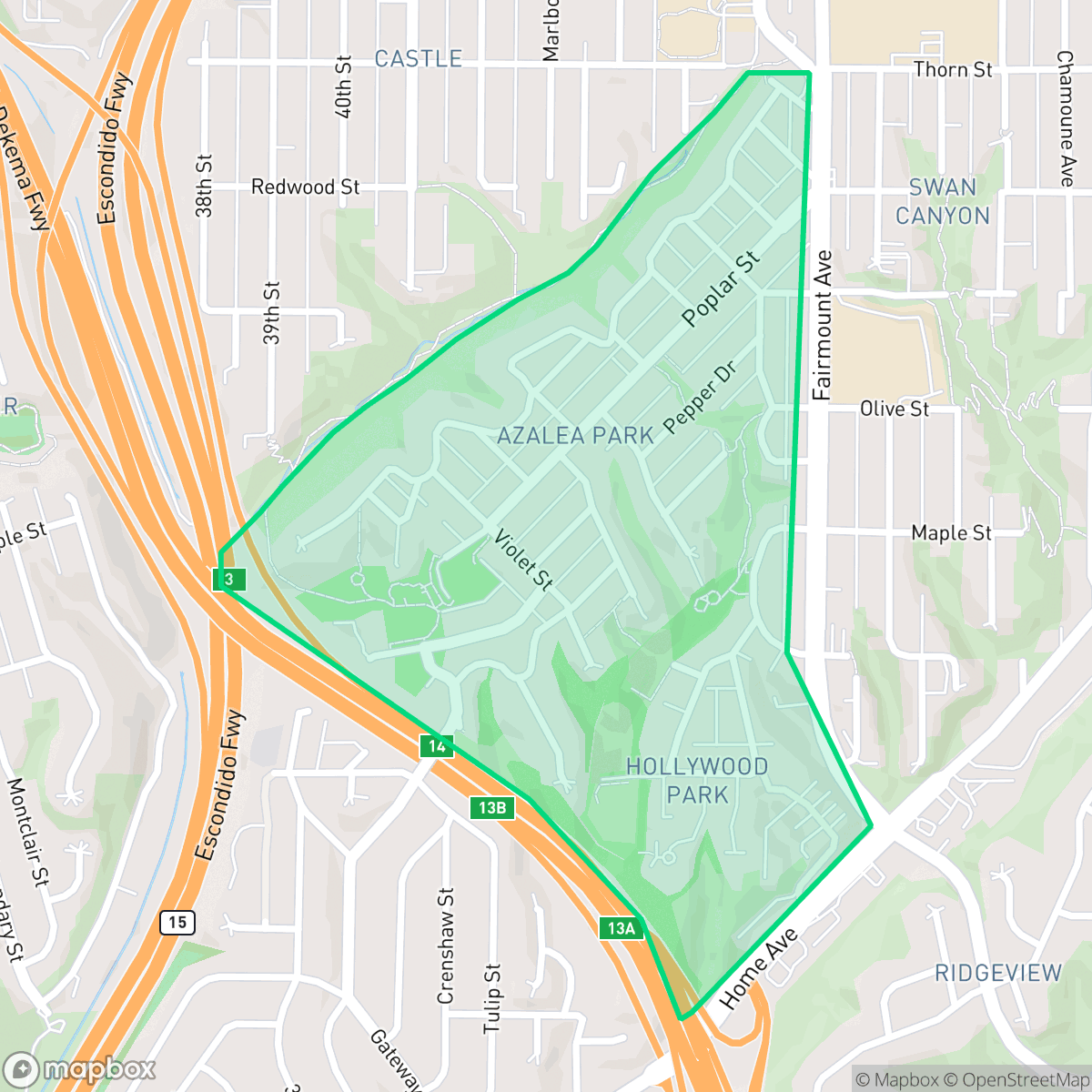
Located in San Diego’s City Heights area, the Azalea-Hollywood Park neighborhood is a secluded canyon community defined by its natural topography, including Manzanita and Hollywood Canyons. Originally subdivided as part of Lexington Park, the area features streets named after flowers (such as Violet and Shamrock) adorned with custom hand-painted signs. In 1994, resident activist Linda Pennington spearheaded a highly successful grassroots campaign to recruit San Diego’s LGBTQ+ community to the neighborhood, sparking a wave of revitalization. Today, the area has blossomed into the Azalea Park Arts District (APAD). Signature local landmarks include the Manzanita Gathering Place—a creative canyon-side refuge featuring resident-made mosaic tile columns—and the whimsical, volunteer-maintained Water Conservation Garden at Azalea Community Park, which showcases drought-resistant plants and recycled art installations.
The neighborhood is a residential enclave in City Heights, defined by its canyon-side geography and a distinct identity fostered by long-standing arts initiatives. According to iHuus data, the area maintains a strong progressive ideological lean, reflecting the community-driven spirit that revitalized the district decades ago. The physical landscape is characterized by quiet, low-industrial streets that contrast with the density of surrounding urban areas, offering a sense of seclusion and access to natural canyon environments.
Prospective residents should consider the trade-offs of living in this location, particularly regarding acoustic comfort, as road traffic noise is a notable factor. While the neighborhood provides a peaceful atmosphere, walkability is lower than the city average, often requiring vehicle use for daily errands. Additionally, the area is served by a school district currently navigating significant budget and operational transitions. It is best suited for individuals who prioritize a tight-knit, community-oriented environment and proximity to nature over high-density urban convenience.
Neighborhood Scores Across 15 Qualities
Housing density is consistent with the city average, featuring a mix of closely packed homes and some multi-unit clusters. While some properties share property lines with minimal buffers, other areas maintain moderate spacing between neighbors according to iHuus data.
Pedestrian navigation is easy due to a dense street grid with sidewalks and safe crossings. This area offers a level of walkability that is slightly above the San Diego average, according to iHuus data.
Uniform tract housing and small yards define the landscape, offering a functional but plain visual environment that is less diverse than the San Diego average. Residential lots feature consistent rooflines and limited private greenery or luxury amenities.
Large school fields and green canyons offer decent space for pet exercise, though the availability of public park space is below the city average. Walking routes feature some green verges, but many areas consist mainly of private yards with narrower sidewalks.
Residential layouts vary from dense, low-rise suburban grids to areas featuring more open land and scattered homes. This balance of urban and open space is very similar to the broader San Diego area according to iHuus data.
Residential blocks offer a steady suburban pace with occasional social hubs and local dining, though the level of activity is roughly consistent with the city average. Most residents will find a mix of green space and quiet streets, though many essential businesses are not within immediate walking distance.
Frequent noise from nearby freeways and rail lines is common in this area. According to iHuus data, acoustic comfort levels are slightly lower than the San Diego average.
Air quality levels here fluctuate between acceptable and unhealthy, appearing slightly lower than the San Diego average. Sensitive individuals may notice occasional concerns during certain periods according to iHuus data.
Residential and light commercial uses define this area, with no warehouses or heavy industrial hazards detected. According to iHuus data, this absence of industrial activity is even more pronounced here than in the rest of San Diego.
Health insurance access is below the San Diego average, with fewer residents covered than is typical for the city. According to iHuus data, this indicates a higher proportion of uninsured individuals living in the area.
Voting patterns and census indicators show a notably more liberal political leaning than the San Diego average, according to iHuus data.
Residents live alongside a diverse mix of young adults, families, and older populations. This demographic spread is slightly lower than the San Diego average, according to iHuus data.
Frequent flood risk exists here due to its location within a designated floodplain. According to iHuus data, this area carries a significantly higher risk of flooding than the San Diego average.
Address-Level Insights for Azalea-Hollywood Park


iHuus Neighborhood Intelligence Insights
Get address-level neighborhood insights for Azalea-Hollywood Park
- Street-level scores — see how individual blocks compare, not just neighborhood averages
- Micro-zone boundaries — identify quiet pockets, flood boundaries, and walkable clusters before you visit
- 15 dimensions in full — walkability, noise, air quality, school quality, insurance coverage, population age profile, urban/rural index, and more
- Boundary risk alerts — know if your address sits near a block boundary where scores drop, the kind of detail no listing will ever mention
- School insights — individual school ratings and insights, not just district-level data
- Compare before you commit — side-by-side data across neighborhoods, down to block precision
No credit card required
Compare with Any Neighborhood
| Dimension | Azalea-Hollywood Park | Adams North |
|---|---|---|
| 🚶 Walkabilityavg 8.58 | ||
| 🔊 Acoustic Comfortavg 3.33 | ||
| 🤫 Privacy Indexavg 4.87 | ||
| 🎨 Visual Appealavg 6.85 | ||
| 🐕 Dog Friendlinessavg 6.91 | ||
| 🗺️ Urban-Rural Indexavg 6.6 | ||
| ✨ Neighborhood Vibeavg 5.12 | ||
| 🏥 Health Insurance Coverageavg 7.53 | ||
| 🌿 Air Qualityavg 6.36 | ||
| 🏭 Industrial Proximityavg 9.12 | ||
| 🌊 Flood Safetyavg 4.2 | ||
| 🗳️ Ideological Leanavg 8.51 | ||
| 👥 Population Age Profileavg 4.8 | ||
| 🔥 Fire Safetyavg 0.61 | ||
| 🏫 School Quality |
Azalea-Hollywood Park Rankings
School Districts Serving Azalea-Hollywood Park
School Insights for Azalea-Hollywood Park
Below average outcomes; significant attendance and academic challenges.
School Insights
See what's really behind every school rating near Azalea-Hollywood Park
- Individual school ratings — each school's own score with outcome context, not just a district average
- Enrollment & class size data — student-to-teacher ratio and how it compares to the state average
- Full demographics breakdown — ethnicity and gender composition for every school in the enrollment zone
- Every school in the district — all schools within the enrollment boundary ranked by rating, not just the closest one
- Grade levels & benchmarks — elementary through high school, with below/above state-average flags
No credit card required