Asian Pacific Thematic Historic District, San Diego
Updated · 458 residents
The Asian Pacific Thematic Historic District is a dense, high-energy urban enclave defined by its rich multicultural heritage and exceptional walkability. Residents enjoy immediate access to downtown dining and entertainment, though the area is characterized by limited green space and significant noise levels from nearby traffic and rail lines.
Key Highlights
About Asian Pacific Thematic Historic District
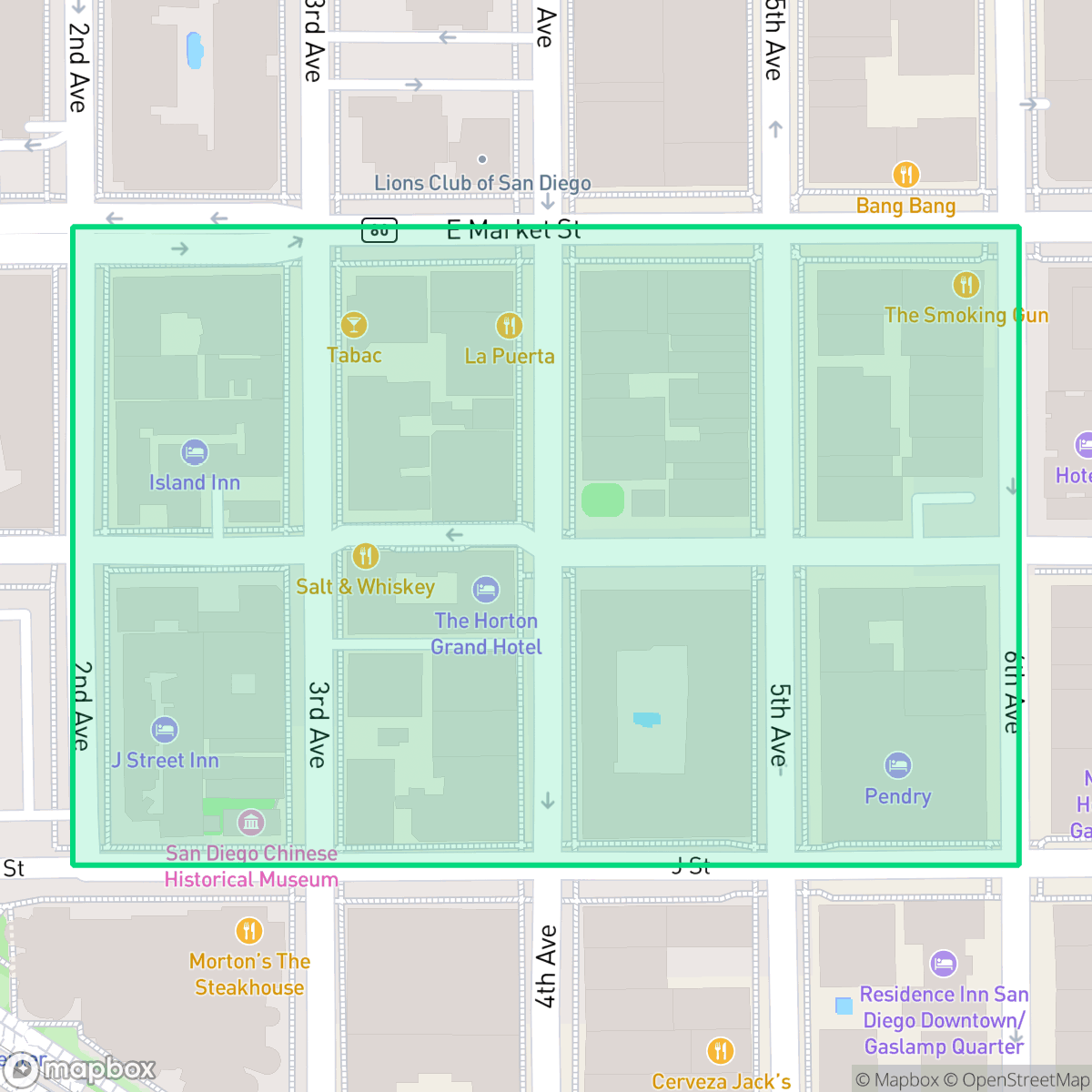
San Diego’s Asian Pacific Thematic Historic District, spanning an eight-block area bounded by Market, J, Second, and Sixth streets, originated in the 1860s when Chinese abalone fishermen first settled the area. Over the next century, it evolved into a vibrant, multi-ethnic neighborhood encompassing Chinatown, "Nihonmachi" (Japantown), and a Filipino Quarter. Officially designated by the City of San Diego in 1987, the district preserves 22 contributing historic structures built between 1883 and 1930. Many of these buildings showcase unique ethnic adaptations of American architecture, featuring clay tile roofs and overhanging balconies. Key landmarks defining the district’s cultural heritage include the San Diego Chinese Historical Museum—housed in a restored 1928 Chinese Mission building—the Dr. Sun Yat-Sen Memorial Gate, and the Chinese Consolidated Benevolent Association.
This neighborhood functions as a vertical urban core, where modern high-rise living integrates with the remnants of San Diego's early immigrant history. The environment is dominated by a concrete-heavy landscape that prioritizes pedestrian connectivity, allowing residents to reach the waterfront and major social hubs with ease. While the area offers a vibrant lifestyle with proximity to popular venues like Petco Park and diverse culinary options, the trade-off is a lack of private outdoor space and a high-density environment that lacks the quiet atmosphere of suburban residential zones. Air quality and acoustic comfort are heavily influenced by the adjacent rail yard and heavy road traffic, making it a better fit for those who prioritize city-center accessibility over tranquility.
Prospective residents should be prepared for a fast-paced, urban lifestyle where privacy is limited by shared-wall architecture and zero lot lines. The district is particularly well-suited for young professionals and those who thrive in high-energy, transit-oriented environments. While the neighborhood lacks significant parks, its central location provides a strategic home base for exploring the broader downtown San Diego area, provided one is comfortable with the noise profiles inherent to such a dense, central location.
Neighborhood Scores Across 15 Qualities
High-density urban living and shared walls in residential complexes create much lower privacy levels than the San Diego average. According to iHuus data, close proximity between buildings and zero lot lines are characteristic of this area.
Extensive sidewalk networks, waterfront promenades, and pedestrian-priority crossings make navigating this district on foot exceptionally easy. According to iHuus data, the infrastructure here provides a more seamless walking experience than the typical San Diego neighborhood.
Visual interest is somewhat limited by a functional mix of modern high-density structures and standard urban architecture. This area presents a more utilitarian appearance than much of the city.
Dense urban blocks and concrete surfaces dominate the area, leaving very little accessible green space for dogs. According to iHuus data, pet owners must rely on nearby landmarks like Petco Park or the Embarcadero for significant relief from the lack of local parks.
Extensive asphalt coverage and high-rise building density create a highly built-up environment. This area features significantly more vertical density and less greenery than the San Diego average, according to iHuus data.
Constant movement and a dense concentration of diverse dining and social hubs create a vibrant atmosphere. This level of activity and commercial pull is significantly higher than the San Diego average, according to iHuus data.
Frequent disturbances from nearby railroad tracks and heavy freeway traffic characterize the area. Acoustic levels are slightly higher than the San Diego average, according to iHuus data.
Air quality fluctuates between acceptable and unhealthy levels, appearing slightly lower than the San Diego average. Sensitive individuals may experience occasional concerns during certain periods according to iHuus data.
Heavy industrial activity is largely absent from the urban center, though a large rail yard to the south introduces some noise and traffic. This level of industrial proximity is slightly higher than the San Diego average, according to iHuus data.
Health insurance accessibility is significantly lower than the San Diego average, according to iHuus data. Residents may face challenges accessing employer-sponsored or private coverage within this district.
Voting patterns and census indicators reflect a predominantly liberal political leaning that is more pronounced than the San Diego average, according to iHuus data.
Residents encounter a balanced mix of young adults, families, and older individuals, representing a more varied age distribution than the San Diego average.
Residual flood risk exists within the area, though safety levels remain significantly higher than the San Diego average according to iHuus data.
Address-Level Insights for Asian Pacific Thematic Historic District


iHuus Neighborhood Intelligence Insights
Get address-level neighborhood insights for Asian Pacific Thematic Historic District
- Street-level scores — see how individual blocks compare, not just neighborhood averages
- Micro-zone boundaries — identify quiet pockets, flood boundaries, and walkable clusters before you visit
- 15 dimensions in full — walkability, noise, air quality, school quality, insurance coverage, population age profile, urban/rural index, and more
- Boundary risk alerts — know if your address sits near a block boundary where scores drop, the kind of detail no listing will ever mention
- School insights — individual school ratings and insights, not just district-level data
- Compare before you commit — side-by-side data across neighborhoods, down to block precision
No credit card required
Compare with Any Neighborhood
| Dimension | Asian Pacific Thematic Historic District | Adams North |
|---|---|---|
| 🚶 Walkabilityavg 8.58 | ||
| 🔊 Acoustic Comfortavg 3.33 | ||
| 🤫 Privacy Indexavg 4.87 | ||
| 🎨 Visual Appealavg 6.85 | ||
| 🐕 Dog Friendlinessavg 6.91 | ||
| 🗺️ Urban-Rural Indexavg 6.6 | ||
| ✨ Neighborhood Vibeavg 5.12 | ||
| 🏥 Health Insurance Coverageavg 7.53 | ||
| 🌿 Air Qualityavg 6.36 | ||
| 🏭 Industrial Proximityavg 9.12 | ||
| 🌊 Flood Safetyavg 4.2 | ||
| 🗳️ Ideological Leanavg 8.51 | ||
| 👥 Population Age Profileavg 4.8 | ||
| 🔥 Fire Safetyavg 0.61 | ||
| 🏫 School Quality |
Asian Pacific Thematic Historic District Rankings
School Districts Serving Asian Pacific Thematic Historic District
School Insights for Asian Pacific Thematic Historic District
Below average outcomes; significant attendance and academic challenges.
School Insights
See what's really behind every school rating near Asian Pacific Thematic Historic District
- Individual school ratings — each school's own score with outcome context, not just a district average
- Enrollment & class size data — student-to-teacher ratio and how it compares to the state average
- Full demographics breakdown — ethnicity and gender composition for every school in the enrollment zone
- Every school in the district — all schools within the enrollment boundary ranked by rating, not just the closest one
- Grade levels & benchmarks — elementary through high school, with below/above state-average flags
No credit card required