Allied Gardens, San Diego
Updated · 9,914 residents
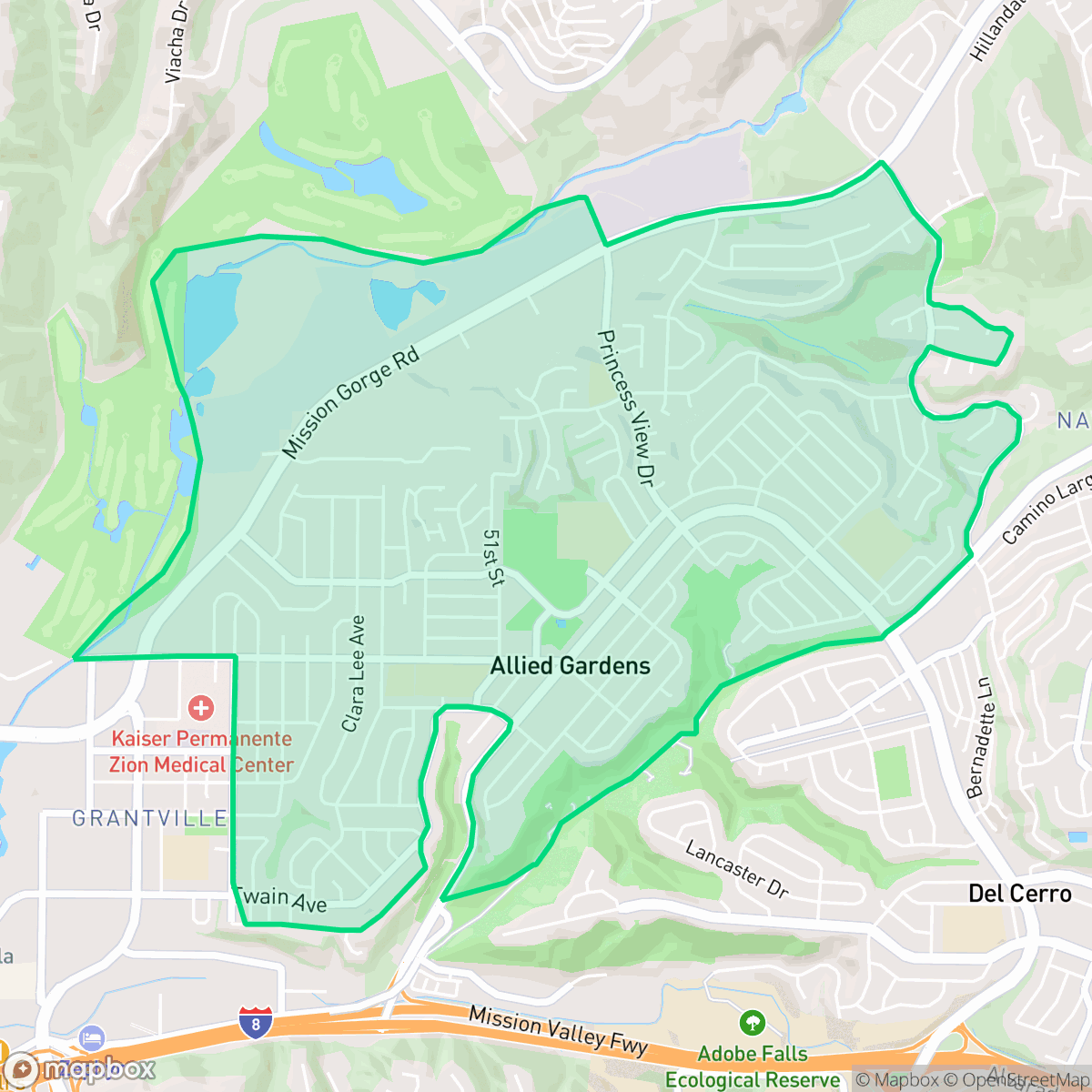
Allied Gardens is a well-established suburban neighborhood defined by its mature residential tracts and accessible community hubs. Residents benefit from a highly walkable street network and proximity to local parks, though the area experiences moderate noise levels due to surrounding road traffic.
Key Highlights
About Allied Gardens
Established in 1955, Allied Gardens was developed by Louis L. Kelton and Walter Bollenbacher of Allied Contractors, who purchased 1,000 acres of the Waring estate to meet San Diego’s post-World War II housing demand. The neighborhood was initially built out with Minimal Traditional tract homes. A central community hub, the Allied Gardens Recreation Center, was constructed in 1961 on land previously occupied by two massive Marietta Broadcasting Company radio towers. Today, the neighborhood's commercial activity centers along Waring Road, marked by local landmarks like "The Triangle"—a community space at Waring Road and Zion Avenue featuring a historic street clock and flagpole—and long-standing neighborhood staples such as Pal Joey’s cocktail lounge.
The neighborhood maintains a distinct suburban character, blending single-family homes with well-maintained landscaping and private outdoor spaces. It offers high accessibility, featuring a comprehensive sidewalk network that connects residential streets to local commercial activity along Waring Road. The community is supported by a variety of educational institutions, including highly rated options like Lewis Middle, and benefits from nearby canyon trails that provide residents with convenient access to outdoor recreation.
Prospective residents should note that the area presents a balance between suburban tranquility and light industrial proximity. While the environment is generally quiet, road traffic contributes to moderate noise levels, and the presence of nearby logistics hubs reflects the practical, mixed-use nature of the region. It is well-suited for families and professionals seeking a stable environment with high rates of health insurance coverage and a strong sense of community, provided they are comfortable with the trade-offs of an active, car-oriented suburban setting.
Neighborhood Scores Across 15 Qualities
Detached homes feature small yards with moderate spacing between neighbors. This level of separation is higher than the San Diego average according to iHuus data.
Low-traffic cul-de-sacs and a comprehensive sidewalk network make much of the area easy to navigate on foot. According to iHuus data, walkability in this neighborhood is largely in line with the San Diego average.
Large, well-maintained homes and private amenities like pools contribute to a visual landscape that is more upscale than the San Diego average. According to iHuus data, the area features wide driveways and expansive residential lots.
Connected green spaces and natural canyon trails in the southeast quadrant provide ample opportunities for exercise. According to iHuus data, the area offers more accessible, traffic-safe paths for pets than the San Diego average.
Open green spaces and undeveloped terrain provide a more spacious feel than typical San Diego neighborhoods. This area offers a blend of residential tracts and significant open land, according to iHuus data.
Most areas feature a low-density, car-dependent atmosphere with limited local services within walking distance. This subdued pace of activity is below the San Diego average, as the neighborhood consists primarily of quiet residential streets and light industrial zones.
Frequent noise from nearby transit corridors and flight paths is common here. This level of acoustic disturbance is slightly higher than the San Diego average, according to iHuus data.
Air quality levels fluctuate between acceptable and unhealthy, presenting occasional concerns for sensitive groups. This neighborhood's air quality is slightly lower than the San Diego average, according to iHuus data.
Significant logistics hubs and active quarry operations on the western and northern edges introduce notable noise and heavy truck traffic. While much of the area remains quiet and residential, these industrial pockets create more industrial proximity than the San Diego average.
Health insurance enrollment is exceptionally high among residents, significantly outpacing the San Diego average according to iHuus data.
Political leanings in this area align closely with the broader San Diego metropolitan area, characterized by a liberal majority and a small conservative presence.
Residents live among a diverse age range of young professionals, families, and seniors. This demographic spread is slightly more balanced than the broader San Diego average, according to iHuus data.
Properties in this area are situated within a designated floodplain, which may necessitate the purchase of flood insurance. According to iHuus data, the risk level in Allied Gardens is higher than the average for the city of San Diego.
Extreme fire hazards exist within the area, representing a significantly higher risk level than the San Diego average. Residents should prioritize maximum protection measures and wildfire preparedness according to iHuus data.
Address-Level Insights for Allied Gardens


iHuus Neighborhood Intelligence Insights
Get address-level neighborhood insights for Allied Gardens
- Street-level scores — see how individual blocks compare, not just neighborhood averages
- Micro-zone boundaries — identify quiet pockets, flood boundaries, and walkable clusters before you visit
- 15 dimensions in full — walkability, noise, air quality, school quality, insurance coverage, population age profile, urban/rural index, and more
- Boundary risk alerts — know if your address sits near a block boundary where scores drop, the kind of detail no listing will ever mention
- School insights — individual school ratings and insights, not just district-level data
- Compare before you commit — side-by-side data across neighborhoods, down to block precision
No credit card required
Compare with Any Neighborhood
| Dimension | Allied Gardens | Adams North |
|---|---|---|
| 🚶 Walkabilityavg 8.58 | ||
| 🔊 Acoustic Comfortavg 3.33 | ||
| 🤫 Privacy Indexavg 4.87 | ||
| 🎨 Visual Appealavg 6.85 | ||
| 🐕 Dog Friendlinessavg 6.91 | ||
| 🗺️ Urban-Rural Indexavg 6.6 | ||
| ✨ Neighborhood Vibeavg 5.12 | ||
| 🏥 Health Insurance Coverageavg 7.53 | ||
| 🌿 Air Qualityavg 6.36 | ||
| 🏭 Industrial Proximityavg 9.12 | ||
| 🌊 Flood Safetyavg 4.2 | ||
| 🗳️ Ideological Leanavg 8.51 | ||
| 👥 Population Age Profileavg 4.8 | ||
| 🔥 Fire Safetyavg 0.61 | ||
| 🏫 School Quality |
Allied Gardens Rankings
School Districts Serving Allied Gardens
School Insights for Allied Gardens
Below average outcomes; significant attendance and academic challenges.
School Insights
See what's really behind every school rating near Allied Gardens
- Individual school ratings — each school's own score with outcome context, not just a district average
- Enrollment & class size data — student-to-teacher ratio and how it compares to the state average
- Full demographics breakdown — ethnicity and gender composition for every school in the enrollment zone
- Every school in the district — all schools within the enrollment boundary ranked by rating, not just the closest one
- Grade levels & benchmarks — elementary through high school, with below/above state-average flags
No credit card required