Adams North, San Diego
Updated · 6,422 residents
Adams North is a dense, community-focused enclave defined by its historic Craftsman architecture and immediate access to rugged canyon trails. While residents benefit from a vibrant local scene and high rates of health insurance coverage, the neighborhood experiences significant road traffic noise and requires vigilance regarding fire safety.
Key Highlights
About Adams North
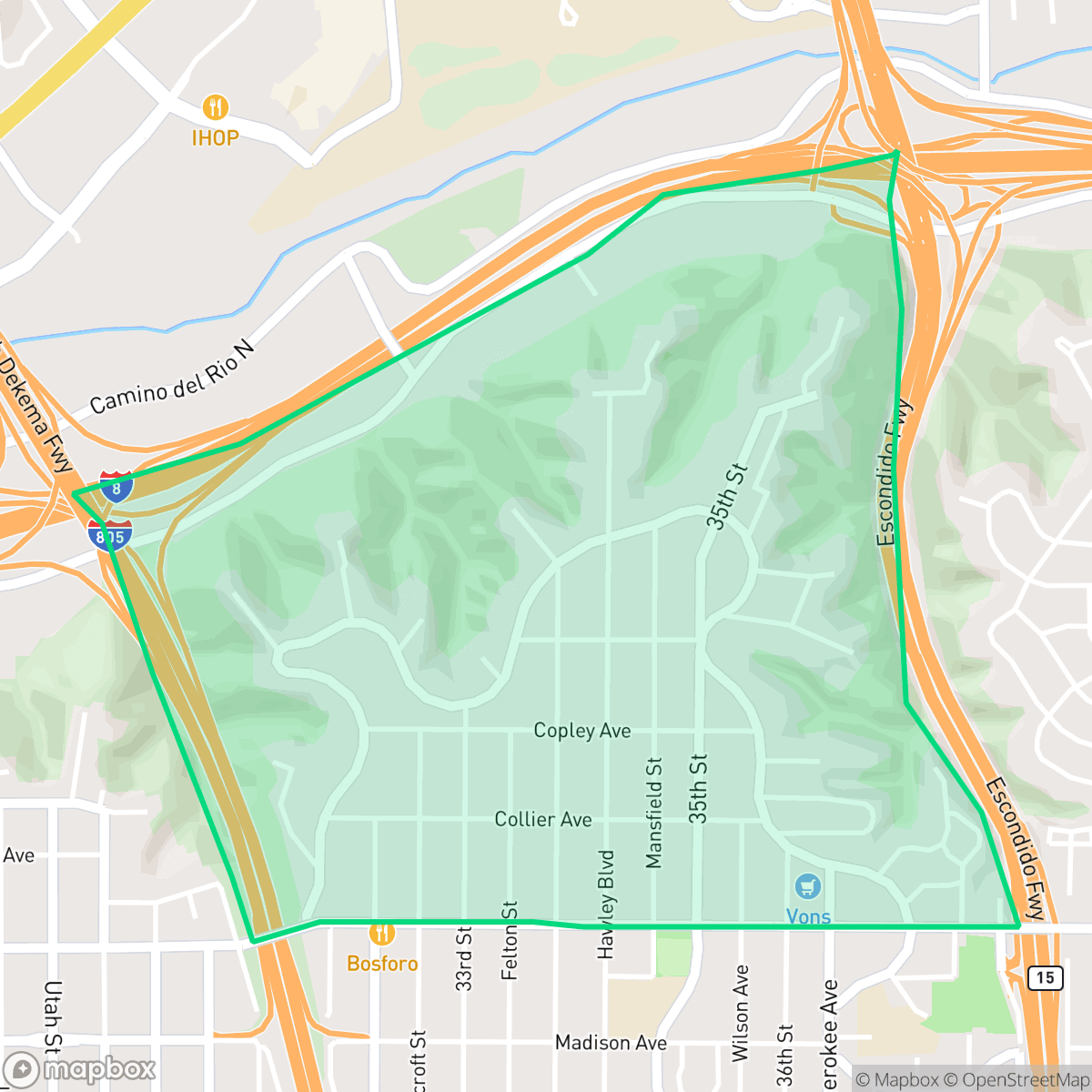
Adams North is a historic residential sub-neighborhood of Normal Heights in San Diego, California, bounded by the steep slopes of Mission Valley to the north and the vibrant Adams Avenue commercial corridor to the south. Developed primarily in the early-to-mid 20th century, the neighborhood is characterized by its well-preserved Craftsman bungalows and single-family homes, many of which date prior to 1939. Following a devastating canyon fire in 1985, Adams North underwent targeted urban design planning to guide its reconstruction and preserve its architectural character. Today, the neighborhood is known for its strong community identity, scenic lookouts like the North Mountain View Mini Park, and its pedestrian-friendly access to popular local businesses along Adams Avenue, such as the Blind Lady Ale House.
The neighborhood functions as a dense residential hub where the urban grid meets steep canyon terrain. Data from iHuus indicates a strong community identity and a highly progressive ideological lean among residents. While the area provides excellent access to local leisure spots along the nearby commercial corridor, the proximity to major thoroughfares results in elevated noise levels averaging 69 decibels. The landscape is characterized by tightly packed single-family homes, which creates a close-knit environment at the expense of significant private outdoor space. Living here involves balancing the benefits of a central San Diego location with specific environmental trade-offs. The area is well-suited for those who value pedestrian access to local businesses and proximity to nature, though prospective residents should consider the low fire safety rating associated with the surrounding canyons. Families should be aware that the local school district currently faces operational challenges, including budget constraints and labor instability. Despite these factors, the area remains a popular choice for those seeking an established, historic character within a lively urban setting.
Neighborhood Scores Across 15 Qualities
Residential structures feature mixed spacing with some houses situated close to property lines. This level of density is slightly higher than the San Diego average, according to iHuus data.
Pedestrians benefit from a well-defined sidewalk grid and safe crossings throughout residential and commercial blocks. While very accessible, the walkability is slightly lower than the San Diego average.
Residential scenery varies from affluent pockets with large homes and private pools to denser areas featuring multi-family structures. This visual variety is slightly below the San Diego average according to iHuus data.
Nearby canyon trails and a central public park offer good walking opportunities, though some dense residential pockets lack wide sidewalks or easy park access. Overall, pet-friendly features in Adams North are below the San Diego average.
Residential streets and green spaces are distributed in nearly equal measure, creating a suburban feel that is slightly less urbanized than the San Diego average. This landscape transitions from dense residential grids to rugged canyon terrain according to iHuus data.
Frequent social activity and a notable concentration of local dining and coffee shops make this area more active than the San Diego average. While many pockets feature diverse eateries and galleries, some parts of the neighborhood remain primarily car-dependent.
Continuous sound from nearby railroad tracks and major freeways characterizes this area. According to iHuus data, acoustic comfort is slightly below the San Diego average.
Air quality levels fluctuate between acceptable and unhealthy, presenting occasional concerns for sensitive groups. This status is slightly lower than the San Diego city average, according to iHuus data.
Industrial activity and heavy manufacturing are absent from this area, which consists entirely of residential and light commercial uses. This lack of industrial presence is consistent with the rest of San Diego.
Health insurance accessibility remains relatively high for residents, though it sits slightly below the San Diego city average according to iHuus data.
Voting patterns and census indicators reflect a highly liberal political leaning that is more pronounced than the San Diego average, according to iHuus data.
Residents experience a balanced demographic spread of young professionals, families, and older adults. This age distribution is largely in line with the typical profile found across San Diego.
Properties within this area are located inside a designated floodplain, which indicates a higher vulnerability to flooding than much of San Diego. According to iHuus data, residents should anticipate the potential necessity of flood insurance.
Extreme fire hazards are present in this area, representing a level of risk that is slightly higher than the San Diego average. Residents should prioritize maximum protection measures and remain vigilant regarding local safety protocols.
Address-Level Insights for Adams North


iHuus Neighborhood Intelligence Insights
Get address-level neighborhood insights for Adams North
- Street-level scores — see how individual blocks compare, not just neighborhood averages
- Micro-zone boundaries — identify quiet pockets, flood boundaries, and walkable clusters before you visit
- 15 dimensions in full — walkability, noise, air quality, school quality, insurance coverage, population age profile, urban/rural index, and more
- Boundary risk alerts — know if your address sits near a block boundary where scores drop, the kind of detail no listing will ever mention
- School insights — individual school ratings and insights, not just district-level data
- Compare before you commit — side-by-side data across neighborhoods, down to block precision
No credit card required
Compare with Any Neighborhood
| Dimension | Adams North | Allied Gardens |
|---|---|---|
| 🚶 Walkabilityavg 8.58 | ||
| 🔊 Acoustic Comfortavg 3.33 | ||
| 🤫 Privacy Indexavg 4.87 | ||
| 🎨 Visual Appealavg 6.85 | ||
| 🐕 Dog Friendlinessavg 6.91 | ||
| 🗺️ Urban-Rural Indexavg 6.6 | ||
| ✨ Neighborhood Vibeavg 5.12 | ||
| 🏥 Health Insurance Coverageavg 7.53 | ||
| 🌿 Air Qualityavg 6.36 | ||
| 🏭 Industrial Proximityavg 9.12 | ||
| 🌊 Flood Safetyavg 4.2 | ||
| 🗳️ Ideological Leanavg 8.51 | ||
| 👥 Population Age Profileavg 4.8 | ||
| 🔥 Fire Safetyavg 0.61 | ||
| 🏫 School Quality |
Adams North Rankings
School Districts Serving Adams North
School Insights for Adams North
Below average outcomes; significant attendance and academic challenges.
School Insights
See what's really behind every school rating near Adams North
- Individual school ratings — each school's own score with outcome context, not just a district average
- Enrollment & class size data — student-to-teacher ratio and how it compares to the state average
- Full demographics breakdown — ethnicity and gender composition for every school in the enrollment zone
- Every school in the district — all schools within the enrollment boundary ranked by rating, not just the closest one
- Grade levels & benchmarks — elementary through high school, with below/above state-average flags
No credit card required