Z'berg Park, Sacramento
Updated · 2,861 residents
Z'berg Park is a highly walkable suburban enclave in Sacramento characterized by its lush green spaces and mid-century residential architecture. While the neighborhood offers residents excellent access to local amenities and high levels of health insurance coverage, it faces challenges with significant road traffic noise and concerns regarding the local school district's fiscal stability.
Key Highlights
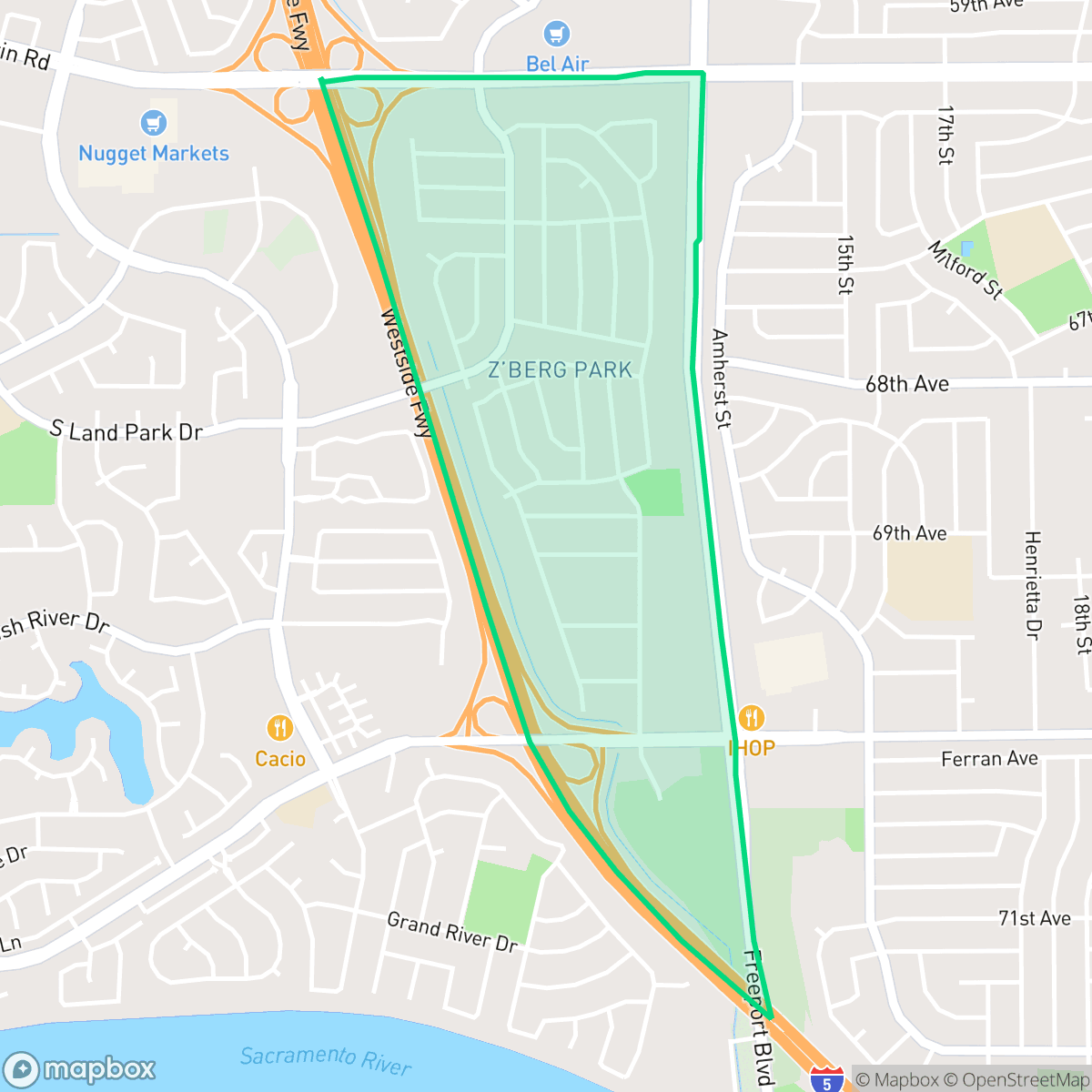
About Z'berg Park
Located in the southwestern "Pocket Area" of Sacramento, the Z'berg Park neighborhood is named after Edwin L. Z'berg (1926–1975), a prominent California State Assemblyman and pioneering environmental legislator. Historically agricultural with scattered farmhouses, the region was annexed by the city of Sacramento in 1959. Following annexation, the neighborhood transitioned from rural land into a suburban residential enclave, with a significant wave of construction occurring between the 1940s and 1980s. Today, Z'berg Park is characterized by its mid-to-late 20th-century single-family housing stock and townhomes. The neighborhood’s central public space and namesake, Edwin L. Z'berg Park, serves as a key recreational hub for the local community.
The area maintains a distinct suburban character defined by its proximity to the Sacramento River and a high visual appeal. Residents enjoy a layout that supports pedestrian activity, with various social and leisure spots integrated into the residential fabric. The neighborhood benefits from minimal industrial proximity, fostering a community-focused atmosphere that prioritizes residential living over commercial density.
Prospective residents should consider the trade-offs associated with living in this part of Sacramento. While the neighborhood provides a strong sense of community and excellent health coverage, the acoustic environment is impacted by consistent road traffic noise. Furthermore, families with school-aged children should be aware of the fiscal instability within the Sacramento City Unified School District, which currently faces significant budgetary constraints and administrative challenges.
Neighborhood Scores Across 15 Qualities
Housing density is largely consistent with the Sacramento average, featuring a mix of closely placed homes and shared-wall structures. Some areas offer moderate buffers between neighbors, though certain pockets present more compact suburban layouts.
Pedestrian infrastructure is excellent due to wide sidewalks on both sides of major roads and clear paths through park areas. According to iHuus data, the neighborhood offers superior walkability compared to the Sacramento average.
Upscale amenities and private backyard pools contribute to a visual landscape that is slightly more attractive than the Sacramento average. Residents can expect a mix of larger homes and well-maintained properties according to iHuus data.
Expansive greenbelts and proximity to a large park with lake access provide ample space for pets. According to iHuus data, the abundance of connected trails and grass verges makes this area slightly more dog friendly than the Sacramento average.
Low-density residential development and scattered single-family homes characterize this area. This level of openness is roughly consistent with the broader Sacramento area.
A mix of quiet residential pockets and active social nodes provides a more active atmosphere than much of Sacramento. While some blocks offer easy access to local dining and services, other areas remain primarily residential or industrial with limited amenities.
Constant noise from nearby airport runways and heavy rail infrastructure makes this area significantly louder than the Sacramento average. Residents should expect persistent acoustic disruption throughout the day.
Air quality levels in Z'berg Park are comparable to the rest of Sacramento, though residents may experience occasional periods of unhealthy air that could affect sensitive groups.
Industrial activity is virtually non-existent here, making the area significantly cleaner of warehouses and heavy manufacturing than the Sacramento average. According to iHuus data, the landscape is composed entirely of residential and light commercial uses with no detectable industrial hazards.
Health insurance access among residents is notably higher than the Sacramento average, according to iHuus data.
Voting patterns and census indicators show a deeply liberal political leaning that is consistent with the broader Sacramento area. According to iHuus data, the neighborhood reflects a very high concentration of liberal-leaning residents.
Residents live alongside a balanced mix of young professionals, families, and older adults. This demographic spread is slightly more varied than the Sacramento average, according to iHuus data.
Residual flood risk exists due to the area's location within a 500-year floodplain, though safety levels remain above the Sacramento average according to iHuus data.
Address-Level Insights for Z'berg Park


iHuus Neighborhood Intelligence Insights
Get address-level neighborhood insights for Z'berg Park
- Street-level scores — see how individual blocks compare, not just neighborhood averages
- Micro-zone boundaries — identify quiet pockets, flood boundaries, and walkable clusters before you visit
- 15 dimensions in full — walkability, noise, air quality, school quality, insurance coverage, population age profile, urban/rural index, and more
- Boundary risk alerts — know if your address sits near a block boundary where scores drop, the kind of detail no listing will ever mention
- School insights — individual school ratings and insights, not just district-level data
- Compare before you commit — side-by-side data across neighborhoods, down to block precision
No credit card required
Compare with Any Neighborhood
| Dimension | Z'berg Park | Airport |
|---|---|---|
| 🚶 Walkabilityavg 8.5 | ||
| 🔊 Acoustic Comfortavg 3.22 | ||
| 🤫 Privacy Indexavg 5.34 | ||
| 🎨 Visual Appealavg 6.3 | ||
| 🐕 Dog Friendlinessavg 6.98 | ||
| 🗺️ Urban-Rural Indexavg 6.57 | ||
| ✨ Neighborhood Vibeavg 4.66 | ||
| 🏥 Health Insurance Coverageavg 7.4 | ||
| 🌿 Air Qualityavg 6.12 | ||
| 🏭 Industrial Proximityavg 8.32 | ||
| 🌊 Flood Safetyavg 6.04 | ||
| 🗳️ Ideological Leanavg 9.49 | ||
| 👥 Population Age Profileavg 4.75 | ||
| 🔥 Fire Safetyavg 0 | ||
| 🏫 School Quality |
Z'berg Park Rankings
School Districts Serving Z'berg Park
School Insights for Z'berg Park
Below average outcomes; significant attendance and academic challenges.
School Insights
See what's really behind every school rating near Z'berg Park
- Individual school ratings — each school's own score with outcome context, not just a district average
- Enrollment & class size data — student-to-teacher ratio and how it compares to the state average
- Full demographics breakdown — ethnicity and gender composition for every school in the enrollment zone
- Every school in the district — all schools within the enrollment boundary ranked by rating, not just the closest one
- Grade levels & benchmarks — elementary through high school, with below/above state-average flags
No credit card required