Woodlake, Sacramento
Updated · 1,262 residents
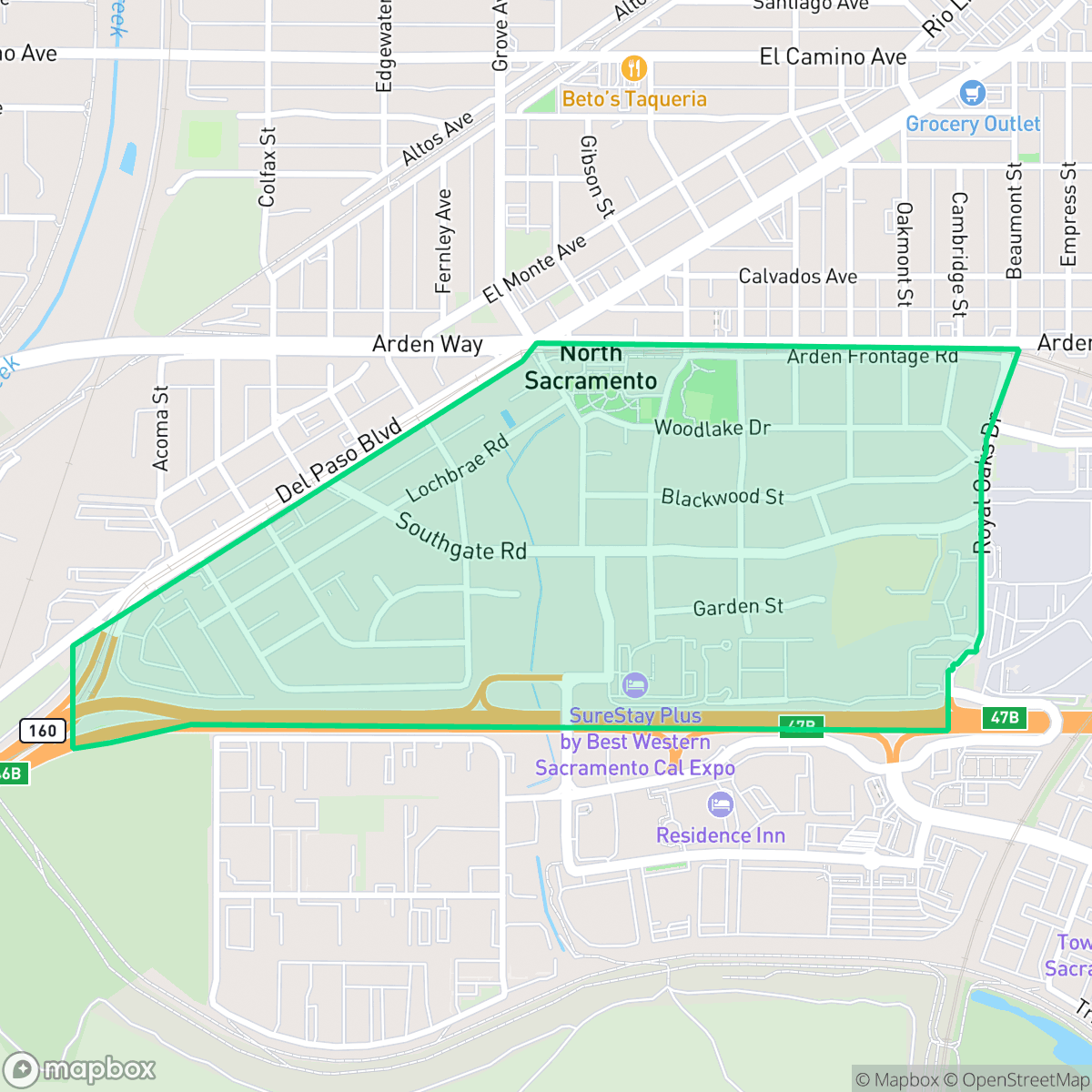
Woodlake is a distinctive Sacramento neighborhood defined by its winding, English-inspired streets and eclectic early 20th-century architecture. While the area offers a walkable suburban atmosphere, residents contend with significant road traffic noise and limited local amenities.
Key Highlights
About Woodlake
Developed in 1923 by the North Sacramento Land Company, Woodlake was carved out of Rancho Del Paso, former pasture lands owned by horse breeder James Ben Ali Haggin. Billed as "Sacramento’s Pasadena," the neighborhood was designed with winding, country-style streets named after English locales like Oxford and Canterbury, deliberately contrasting with the city’s standard grid. To maintain exclusivity, developers mandated that no two homes could be alike. This resulted in an eclectic mix of early 20th-century architecture, including Tudor, Elizabethan, Spanish Colonial, and Mission Revival styles, with many fairy-tale-style homes designed by architect Arthur R. Widdowson. Originally part of the independent city of North Sacramento before its 1964 annexation, Woodlake retains a close-knit identity, highlighted by a unique local tradition where every new resident is welcomed with a cast-iron skillet.
Woodlake functions as a unique enclave within Sacramento, characterized by its non-grid street layout and diverse architectural styles that stand out from the surrounding city. The area maintains a blend of residential life and light commercial activity, with proximity to major transit corridors that provide convenience but also contribute to persistent ambient noise levels. According to iHuus data, the neighborhood maintains a moderate level of visual appeal and walkability, though the commercial landscape remains sparse, consisting primarily of a few chain establishments and green spaces.
The area faces challenges regarding acoustic comfort due to high road traffic volume, which consistently impacts the living environment. Prospective residents should note that the local school district, Twin Rivers Unified, is currently navigating a period of academic and administrative transition. While the neighborhood benefits from favorable flood safety ratings, the overall fire safety profile requires attention. It is best suited for individuals who value a historic, close-knit identity and are comfortable with the trade-offs of a mixed-use suburban environment near major city arteries.
Neighborhood Scores Across 15 Qualities
Residential lots feature a mixed spacing with some buffer between neighbors, offering a slightly higher sense of privacy than the Sacramento average. According to iHuus data, houses are positioned within a typical suburban density.
Continuous sidewalks and clear crosswalks make navigating the neighborhood on foot efficient. This level of accessibility is very similar to the average found throughout Sacramento.
Modest yards and rectangular rooflines characterize the area, presenting a more uniform visual landscape than the Sacramento average. According to iHuus data, the neighborhood consists primarily of traditional tract housing with limited luxury architectural features.
Access to a public park with green space and baseball fields supports pet owners, though the lack of wide grassy verges on many residential streets makes this area slightly below the Sacramento average.
Open land and scattered greenery provide a sense of space that is slightly more suburban than the Sacramento average. Residents will find a mix of single-family homes alongside some light industrial and warehouse zones.
Local activity levels are slightly above the Sacramento average, offering a balanced mix of residential life and accessible services. While some blocks feature social hubs and cafes, other areas remain quiet and low-density near industrial corridors.
Frequent noise from nearby major freeways and railroad tracks characterizes this area. According to iHuus data, acoustic comfort in Woodlake is lower than the Sacramento city average.
Air quality levels are generally acceptable, though sensitive groups may encounter occasional periods of concern. According to iHuus data, the air quality in Woodlake is roughly in line with the Sacramento city average.
Residential pockets exist alongside active commercial zones and logistics hubs featuring visible loading docks and truck parking. This level of industrial proximity is lower than the Sacramento average, suggesting fewer heavy warehouse operations than many other parts of the city.
Health insurance access among Woodlake residents is notably lower than the Sacramento average, according to iHuus data. This indicates a higher proportion of uninsured individuals residing within the neighborhood.
Voting patterns and census indicators show a predominantly liberal political leaning that is slightly more pronounced than the Sacramento city average.
Residents live alongside a balanced mix of young adults, families, and older individuals. This demographic spread is largely consistent with the broader Sacramento area, according to iHuus data.
Residual flood risk exists within this area as it sits within a 500-year floodplain, though safety levels remain above the Sacramento average according to iHuus data.
Address-Level Insights for Woodlake


iHuus Neighborhood Intelligence Insights
Get address-level neighborhood insights for Woodlake
- Street-level scores — see how individual blocks compare, not just neighborhood averages
- Micro-zone boundaries — identify quiet pockets, flood boundaries, and walkable clusters before you visit
- 15 dimensions in full — walkability, noise, air quality, school quality, insurance coverage, population age profile, urban/rural index, and more
- Boundary risk alerts — know if your address sits near a block boundary where scores drop, the kind of detail no listing will ever mention
- School insights — individual school ratings and insights, not just district-level data
- Compare before you commit — side-by-side data across neighborhoods, down to block precision
No credit card required
Compare with Any Neighborhood
| Dimension | Woodlake | Airport |
|---|---|---|
| 🚶 Walkabilityavg 8.5 | ||
| 🔊 Acoustic Comfortavg 3.22 | ||
| 🤫 Privacy Indexavg 5.34 | ||
| 🎨 Visual Appealavg 6.3 | ||
| 🐕 Dog Friendlinessavg 6.98 | ||
| 🗺️ Urban-Rural Indexavg 6.57 | ||
| ✨ Neighborhood Vibeavg 4.66 | ||
| 🏥 Health Insurance Coverageavg 7.4 | ||
| 🌿 Air Qualityavg 6.12 | ||
| 🏭 Industrial Proximityavg 8.32 | ||
| 🌊 Flood Safetyavg 6.04 | ||
| 🗳️ Ideological Leanavg 9.49 | ||
| 👥 Population Age Profileavg 4.75 | ||
| 🔥 Fire Safetyavg 0 | ||
| 🏫 School Quality |
Woodlake Rankings
School Districts Serving Woodlake
School Insights for Woodlake
Below average outcomes; significant attendance and academic challenges.
School Insights
See what's really behind every school rating near Woodlake
- Individual school ratings — each school's own score with outcome context, not just a district average
- Enrollment & class size data — student-to-teacher ratio and how it compares to the state average
- Full demographics breakdown — ethnicity and gender composition for every school in the enrollment zone
- Every school in the district — all schools within the enrollment boundary ranked by rating, not just the closest one
- Grade levels & benchmarks — elementary through high school, with below/above state-average flags
No credit card required