West Tahoe Park, Sacramento
Updated · 1,759 residents
West Tahoe Park is a quiet, residential enclave in Sacramento defined by its consistent grid-based street layout and mid-century architectural style. While the area offers high walkability and a lack of industrial encroachment, residents should anticipate significant noise levels primarily caused by local road traffic.
Key Highlights
About West Tahoe Park
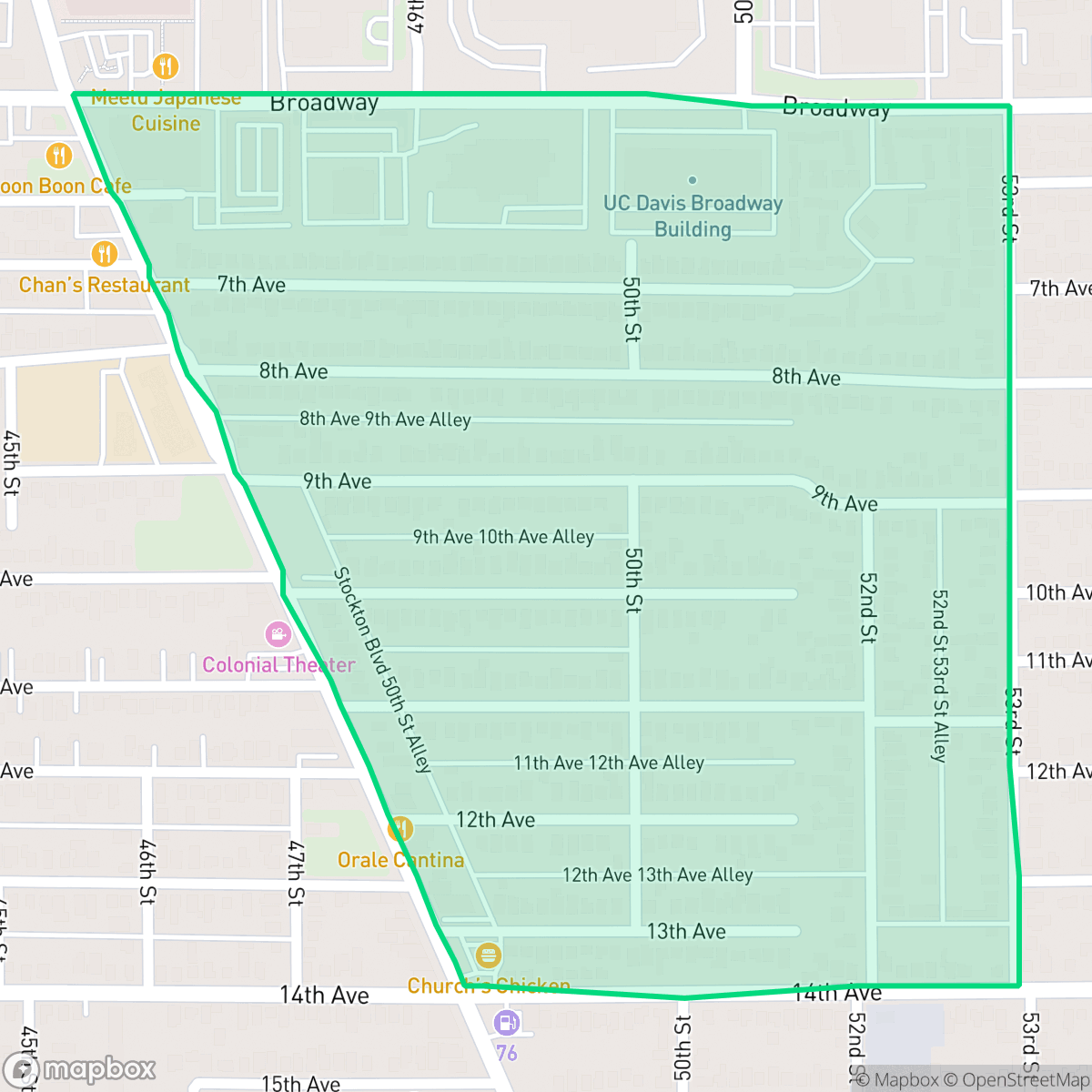
West Tahoe Park is an officially recognized neighborhood in Sacramento, California, bordered by Broadway, 14th Avenue, Stockton Boulevard, and 53rd Street. Originally considered part of Tahoe Park proper, the area was commonly referred to as West Tahoe Park before the City of Sacramento officially designated it as a separate neighborhood in approximately 2005. The neighborhood's residential landscape is characterized by well-established housing stock primarily built between 1940 and 1969, consisting of compact cottages and mid-century modern ranch-style homes. Developed during the mid-20th century post-World War II suburban expansion, West Tahoe Park maintains a distinct, diverse residential character adjacent to the broader Tahoe Park community.
The neighborhood features a dense suburban fabric with consistent sidewalks and low-rise, single-family homes. According to iHuus data, the area is entirely residential and light commercial, completely avoiding heavy industrial or warehouse presence. Residents benefit from high rates of health insurance coverage and a strong sense of community alignment, as indicated by local ideological trends. The residential environment maintains a steady, quiet rhythm, though the uniform housing stock and small lot sizes contribute to a moderate level of privacy.
The primary livability challenge in the area involves acoustic comfort, as average noise levels reach 64 decibels due to consistent road traffic. While the grid layout supports pedestrian activity, the neighborhood offers limited amenities for pet owners, with few dedicated green spaces beyond small school-adjacent parks. Prospective residents should also consider that the area falls within the Sacramento City Unified School District, which currently faces significant fiscal instability and administrative challenges that may impact local educational services.
Neighborhood Scores Across 15 Qualities
Residential spacing is comparable to the Sacramento average, featuring a mix of suburban layouts with some distance between neighbors. According to iHuus data, some homes are situated closely together with narrow gaps between structures.
A grid layout with consistent sidewalks and marked crosswalks makes navigating the area on foot easy. This level of pedestrian accessibility is roughly comparable to the Sacramento average.
Standard tract housing with uniform rooflines and small yards defines the local landscape. This area offers a consistent visual appearance that is slightly below the Sacramento average according to iHuus data.
Private backyards are the primary feature for pet owners, as street-side verges are narrow and local park access is limited. According to iHuus data, the availability of continuous green spaces for walking is below the Sacramento average.
Residential lots transition between denser suburban clusters and scattered homes near open land. This balance of built environment and greenery is largely consistent with the Sacramento average, according to iHuus data.
Residential streets and green spaces provide a serene atmosphere, though activity levels are slightly lower than the Sacramento average. While select dining and park options exist, most daily errands will require a vehicle due to the limited density of walkable businesses.
Frequent noise from nearby railroad tracks and major freeways characterizes this area. According to iHuus data, acoustic disturbances in West Tahoe Park are slightly more prevalent than the Sacramento average.
Air quality in this area fluctuates between acceptable and unhealthy levels, appearing roughly in line with the Sacramento average. Sensitive individuals should remain aware of occasional periods of concern, according to iHuus data.
Heavy industry and large warehouses are entirely absent from this area, making it more residential in character than the Sacramento average. According to iHuus data, the neighborhood consists solely of residential and light commercial zones with no detected industrial hazards.
Health insurance accessibility is consistent with the Sacramento average. According to iHuus data, the majority of residents in this area maintain active coverage.
Voting patterns and census indicators show a predominantly liberal leaning that is even more pronounced than the Sacramento average, according to iHuus data.
Residents live alongside a diverse range of age groups, including young professionals, families, and seniors. This demographic distribution is slightly more varied than the typical profile found across Sacramento.
Residual flood risk exists within the area due to its location in a 500-year floodplain, though safety levels remain higher than the Sacramento city average according to iHuus data.
Address-Level Insights for West Tahoe Park


iHuus Neighborhood Intelligence Insights
Get address-level neighborhood insights for West Tahoe Park
- Street-level scores — see how individual blocks compare, not just neighborhood averages
- Micro-zone boundaries — identify quiet pockets, flood boundaries, and walkable clusters before you visit
- 15 dimensions in full — walkability, noise, air quality, school quality, insurance coverage, population age profile, urban/rural index, and more
- Boundary risk alerts — know if your address sits near a block boundary where scores drop, the kind of detail no listing will ever mention
- School insights — individual school ratings and insights, not just district-level data
- Compare before you commit — side-by-side data across neighborhoods, down to block precision
No credit card required
Compare with Any Neighborhood
| Dimension | West Tahoe Park | Airport |
|---|---|---|
| 🚶 Walkabilityavg 8.5 | ||
| 🔊 Acoustic Comfortavg 3.22 | ||
| 🤫 Privacy Indexavg 5.34 | ||
| 🎨 Visual Appealavg 6.3 | ||
| 🐕 Dog Friendlinessavg 6.98 | ||
| 🗺️ Urban-Rural Indexavg 6.57 | ||
| ✨ Neighborhood Vibeavg 4.66 | ||
| 🏥 Health Insurance Coverageavg 7.4 | ||
| 🌿 Air Qualityavg 6.12 | ||
| 🏭 Industrial Proximityavg 8.32 | ||
| 🌊 Flood Safetyavg 6.04 | ||
| 🗳️ Ideological Leanavg 9.49 | ||
| 👥 Population Age Profileavg 4.75 | ||
| 🔥 Fire Safetyavg 0 | ||
| 🏫 School Quality |
West Tahoe Park Rankings
School Districts Serving West Tahoe Park
School Insights for West Tahoe Park
Below average outcomes; significant attendance and academic challenges.
School Insights
See what's really behind every school rating near West Tahoe Park
- Individual school ratings — each school's own score with outcome context, not just a district average
- Enrollment & class size data — student-to-teacher ratio and how it compares to the state average
- Full demographics breakdown — ethnicity and gender composition for every school in the enrollment zone
- Every school in the district — all schools within the enrollment boundary ranked by rating, not just the closest one
- Grade levels & benchmarks — elementary through high school, with below/above state-average flags
No credit card required