West Del Paso Heights, Sacramento
Updated · 3,486 residents
West Del Paso Heights is a quiet, suburban neighborhood characterized by its historic Craftsman bungalows and modest ranch-style homes. While the area features a consistent grid layout, residents experience significant road traffic noise and proximity to industrial zones.
Key Highlights
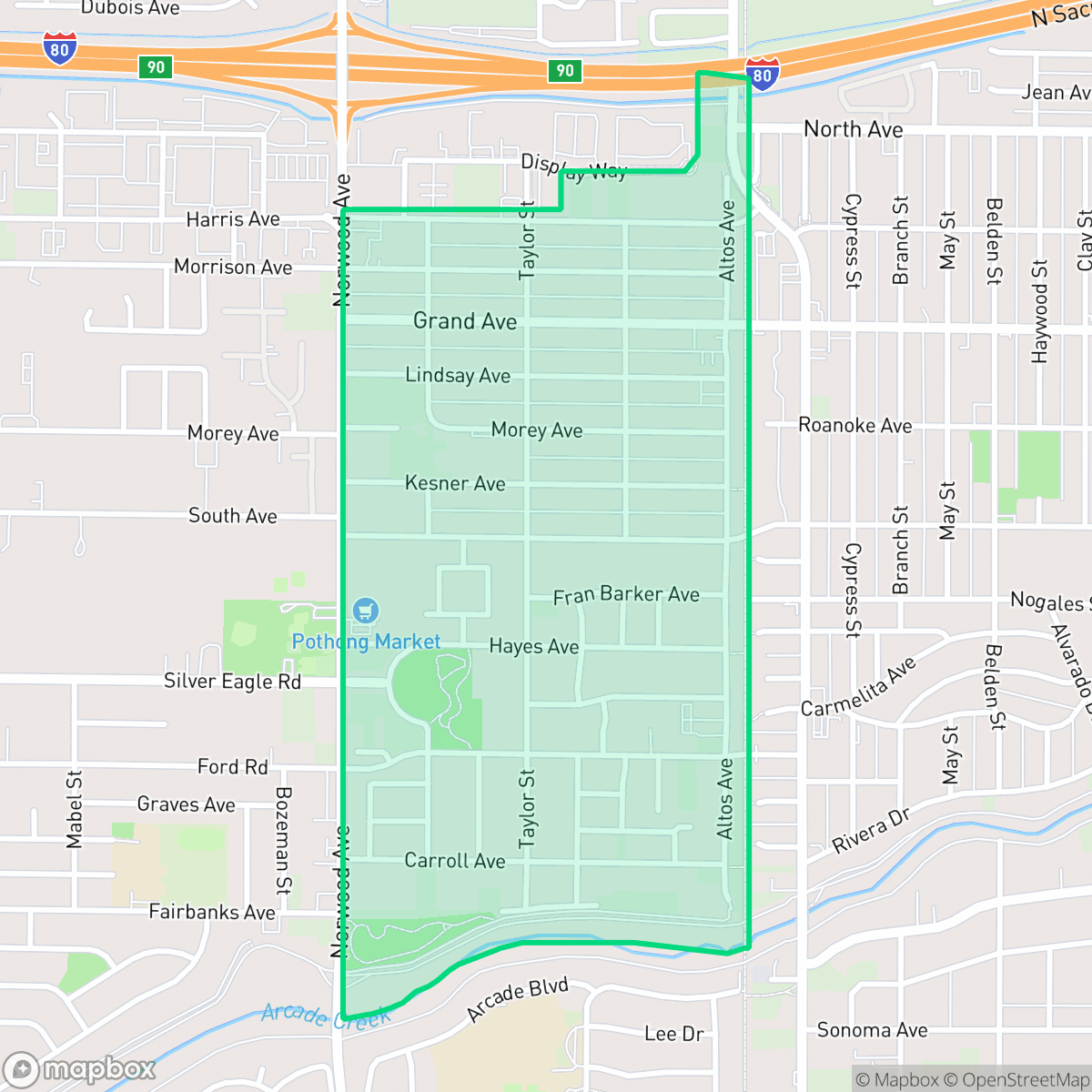
About West Del Paso Heights
Originally part of the 1844 Rancho Del Paso land grant, West Del Paso Heights was established in 1911 when the City of Sacramento purchased 828 acres of a former thoroughbred horse-breeding farm to create the subdivision. Incorporated into the City of North Sacramento in 1924, the neighborhood developed primarily between the 1920s and 1950s. This era left a distinct architectural legacy of classic Craftsman bungalows and modest ranch-style single-family homes typically built on 50-foot-wide lots. Today, the neighborhood's historic character is reinforced by its proximity to the Del Paso Boulevard commercial corridor and the Sacramento Northern Bike Trail, which traces the route of the historic Sacramento Northern Railroad.
The neighborhood features a mix of residential streets and light industrial zones, particularly in its northwest quadrant. It maintains a dense suburban feel with houses situated on compact lots, which limits private outdoor space. The area is notable for its proximity to major transit routes, though this convenience comes with elevated noise levels from nearby highway traffic. Prospective residents should consider that the neighborhood offers limited access to large public parks and has a quiet, low-key atmosphere with few commercial amenities within walking distance. While the area benefits from strong flood safety ratings, families should note that local schools in the Robla and Twin Rivers districts currently face challenges with academic performance and staffing stability. It is best suited for those seeking an established community with easy access to regional transit corridors.
Neighborhood Scores Across 15 Qualities
Residential spacing is consistent with the city average, featuring a mix of detached homes and denser apartment structures. According to iHuus data, neighbors are often positioned in relatively close proximity with limited buffers between properties.
Sidewalk networks and park trails facilitate safe pedestrian movement, though proximity to industrial zones and a major highway slightly lowers the overall comfort compared to the Sacramento average.
Standard tract housing with modest lots and uniform rooflines defines the area. According to iHuus data, the visual variety is slightly lower than the Sacramento average due to a lack of diverse architectural features or large private yards.
Access to canal corridors and a central public park provides ample space for pet exercise. While overall amenities are slightly below the Sacramento average, the wide green parkways and river-adjacent belts offer safe, connected paths for dogs.
Low-density residential layouts and frequent open green spaces define the area. This landscape is largely consistent with the typical suburban density found across Sacramento.
Suburban streets and light industrial areas define this low-activity setting, which offers fewer social hubs than the Sacramento average. Most local dining and community services are concentrated near specific parks or along car-dependent corridors.
Frequent noise from the nearby freeway and railroad tracks impacts the area. This level of acoustic disturbance is slightly higher than the Sacramento average, according to iHuus data.
Air quality in this area fluctuates between acceptable and unhealthy levels, which may cause occasional concern for sensitive groups. According to iHuus data, these conditions are largely in line with the Sacramento city average.
Residential life is largely uninterrupted by heavy industry, though some warehouse and truck storage facilities are present in the northwest quadrant. This lack of significant industrial activity is slightly better than the Sacramento average, according to iHuus data.
Health insurance access among residents is consistent with the Sacramento average. According to iHuus data, a majority of the population is covered by health plans.
Voting patterns and census indicators show a predominantly liberal leaning that is slightly higher than the Sacramento average.
A diverse range of age groups, including young adults, families, and seniors, resides here. According to iHuus data, the population distribution is slightly more skewed toward specific age cohorts than the Sacramento average.
Flood risk in this area is consistent with the Sacramento average. According to iHuus data, the specific risk level remains undetermined as detailed studies for this location are not yet complete.
Address-Level Insights for West Del Paso Heights


iHuus Neighborhood Intelligence Insights
Get address-level neighborhood insights for West Del Paso Heights
- Street-level scores — see how individual blocks compare, not just neighborhood averages
- Micro-zone boundaries — identify quiet pockets, flood boundaries, and walkable clusters before you visit
- 15 dimensions in full — walkability, noise, air quality, school quality, insurance coverage, population age profile, urban/rural index, and more
- Boundary risk alerts — know if your address sits near a block boundary where scores drop, the kind of detail no listing will ever mention
- School insights — individual school ratings and insights, not just district-level data
- Compare before you commit — side-by-side data across neighborhoods, down to block precision
No credit card required
Compare with Any Neighborhood
| Dimension | West Del Paso Heights | Airport |
|---|---|---|
| 🚶 Walkabilityavg 8.5 | ||
| 🔊 Acoustic Comfortavg 3.22 | ||
| 🤫 Privacy Indexavg 5.34 | ||
| 🎨 Visual Appealavg 6.3 | ||
| 🐕 Dog Friendlinessavg 6.98 | ||
| 🗺️ Urban-Rural Indexavg 6.57 | ||
| ✨ Neighborhood Vibeavg 4.66 | ||
| 🏥 Health Insurance Coverageavg 7.4 | ||
| 🌿 Air Qualityavg 6.12 | ||
| 🏭 Industrial Proximityavg 8.32 | ||
| 🌊 Flood Safetyavg 6.04 | ||
| 🗳️ Ideological Leanavg 9.49 | ||
| 👥 Population Age Profileavg 4.75 | ||
| 🔥 Fire Safetyavg 0 | ||
| 🏫 School Quality |
West Del Paso Heights Rankings
School Districts Serving West Del Paso Heights
School Insights for West Del Paso Heights
Below average outcomes; significant attendance and academic challenges.
School Insights
See what's really behind every school rating near West Del Paso Heights
- Individual school ratings — each school's own score with outcome context, not just a district average
- Enrollment & class size data — student-to-teacher ratio and how it compares to the state average
- Full demographics breakdown — ethnicity and gender composition for every school in the enrollment zone
- Every school in the district — all schools within the enrollment boundary ranked by rating, not just the closest one
- Grade levels & benchmarks — elementary through high school, with below/above state-average flags
No credit card required