Upper Land Park, Sacramento
Updated · 4,690 residents
Upper Land Park is a quiet, suburban-industrial transition area characterized by a mix of residential housing and commercial infrastructure. While it offers proximity to landmarks like the Sacramento City Cemetery, residents should note that the area experiences significant noise from nearby highway traffic.
Key Highlights
About Upper Land Park
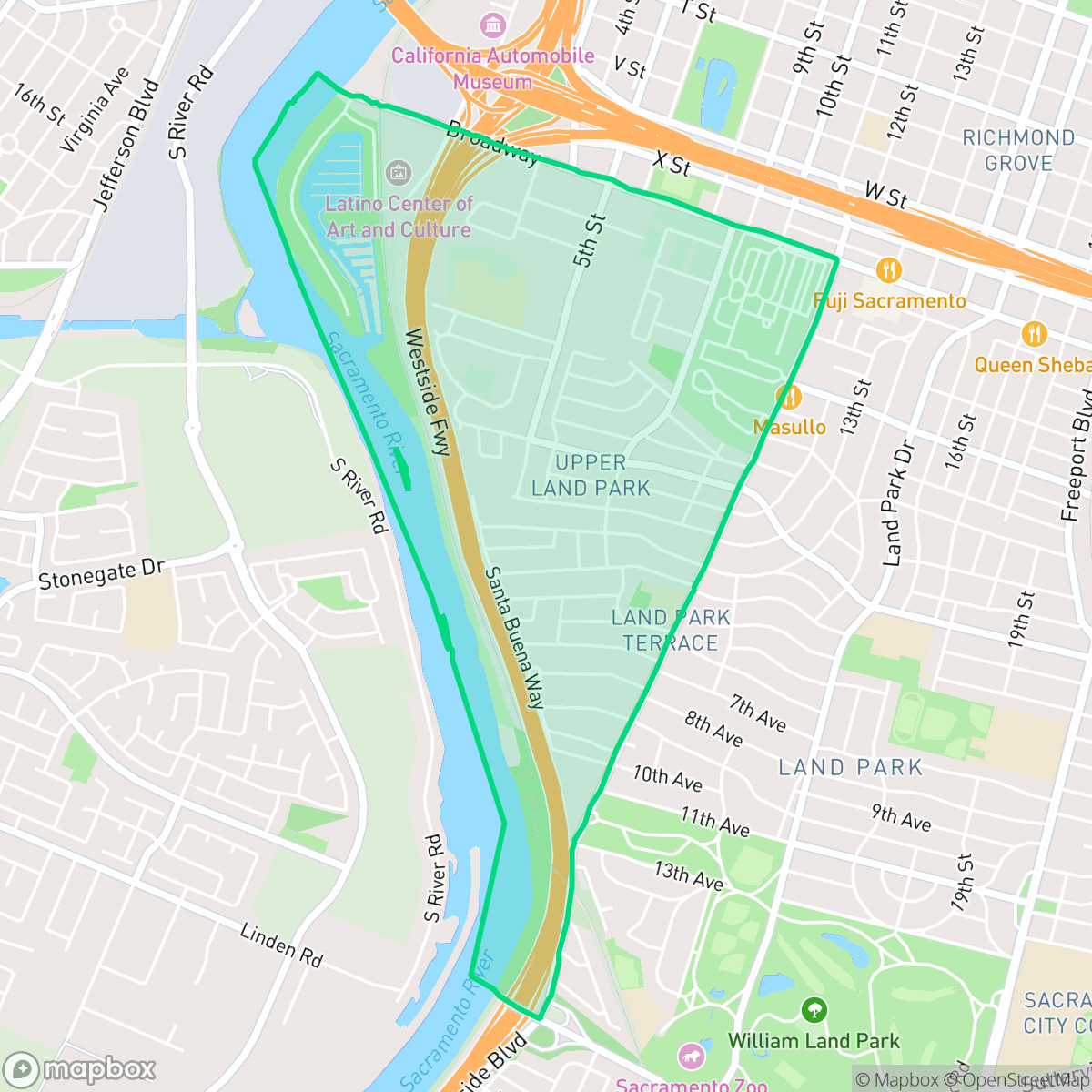
Upper Land Park, situated in Sacramento, California, is a historically diverse neighborhood bounded by Broadway, Swanston Drive, Riverside Boulevard, and Interstate 5. It is home to the historic Sacramento City Cemetery, established in 1849 as a Victorian-style "outdoor museum" and the final resting place of the city's early pioneers. The neighborhood contains the New Helvetia Historic District, which encompasses the mid-20th-century public housing complexes of Alder Grove and Marina Vista (Seavey Circle). This district is highly significant for its role in the city's history of affordable housing and civil rights advocacy. Historically characterized by industrial sites along the West Broadway corridor, the area has undergone significant modern transformation, notably through the development of The Mill at Broadway, which converted former industrial land into a vibrant, mixed-use residential community.
The area functions as a bridge between residential life and industrial utility, featuring a blend of single-family homes, apartment complexes, and large-scale commercial facilities. The landscape is marked by suburban streets interspersed with green spaces, providing a functional environment. According to iHuus data, the neighborhood maintains a balanced urban-rural profile that accommodates both local businesses and residents seeking a straightforward, utilitarian living space. Living here involves specific trade-offs, particularly regarding acoustic comfort, as road traffic from the adjacent highway creates a notable noise presence. While the neighborhood provides a dense sidewalk network for local movement, the overall walkability is occasionally interrupted by high-speed transit corridors. Families may find value in the proximity to top-rated educational options like Crocker/Riverside Elementary, though they should weigh this against the broader district-level challenges. This area is best suited for those who prioritize functional access to the city over a traditional, quiet suburban aesthetic.
Neighborhood Scores Across 15 Qualities
Residential buildings offer a moderate amount of separation with private yards providing a buffer between neighbors. This level of spacing is slightly higher than the average found across Sacramento.
Tree-lined streets offer a dense sidewalk network and clear pedestrian connectivity, though the high-speed western highway limits movement in certain areas. This level of walkability is slightly below the Sacramento average according to iHuus data.
Manicured landscapes and large homes with private pools contribute to a visual character that is slightly more polished than the Sacramento average. According to iHuus data, many properties feature complex architectural details and spacious driveways.
Abundant green spaces, wide grassy verges, and proximity to large school fields provide excellent walking opportunities. This area offers more accessible outdoor space for pets than the Sacramento average, according to iHuus data.
Open land and scattered greenery are interspersed with suburban residential grids and industrial infrastructure, making the area slightly more open than the typical Sacramento landscape. This transition zone features a blend of mature tree canopies and low-density pockets alongside larger-scale transportation and industrial facilities.
Residential life here is largely tranquil and spread out, with a landscape dominated by low-density housing and light industrial zones. According to iHuus data, the area lacks the social energy of the city average, as most commercial activity is limited to essential services and occasional dining spots scattered near major transit corridors.
Frequent sounds from nearby freeways and railroad tracks characterize the area. While this level of disturbance is slightly higher than the Sacramento average, iHuus data indicates it remains relatively comparable to other central city districts.
Air quality remains mostly clean with only rare instances of elevated readings. According to iHuus data, the air quality in this area is slightly better than the Sacramento average.
Industrial presence is minimal throughout the area, though some sections contain wastewater treatment facilities and large chemical storage tanks. This level of industrial activity is slightly higher than the average seen across Sacramento.
Health insurance access is exceptionally high for residents in this area. According to iHuus data, coverage rates in Upper Land Park are significantly above the Sacramento average.
Voting patterns and census indicators show a predominantly liberal political lean, which is consistent with the broader Sacramento area according to iHuus data.
Residents live alongside a balanced mix of young professionals, families, and older adults. According to iHuus data, this demographic distribution is largely consistent with the broader Sacramento area.
Flood risk in this area is relatively low, although some residual risk exists within the 500-year floodplain. This level of safety is notably higher than the Sacramento city average, according to iHuus data.
Address-Level Insights for Upper Land Park


iHuus Neighborhood Intelligence Insights
Get address-level neighborhood insights for Upper Land Park
- Street-level scores — see how individual blocks compare, not just neighborhood averages
- Micro-zone boundaries — identify quiet pockets, flood boundaries, and walkable clusters before you visit
- 15 dimensions in full — walkability, noise, air quality, school quality, insurance coverage, population age profile, urban/rural index, and more
- Boundary risk alerts — know if your address sits near a block boundary where scores drop, the kind of detail no listing will ever mention
- School insights — individual school ratings and insights, not just district-level data
- Compare before you commit — side-by-side data across neighborhoods, down to block precision
No credit card required
Compare with Any Neighborhood
| Dimension | Upper Land Park | Airport |
|---|---|---|
| 🚶 Walkabilityavg 8.5 | ||
| 🔊 Acoustic Comfortavg 3.22 | ||
| 🤫 Privacy Indexavg 5.34 | ||
| 🎨 Visual Appealavg 6.3 | ||
| 🐕 Dog Friendlinessavg 6.98 | ||
| 🗺️ Urban-Rural Indexavg 6.57 | ||
| ✨ Neighborhood Vibeavg 4.66 | ||
| 🏥 Health Insurance Coverageavg 7.4 | ||
| 🌿 Air Qualityavg 6.12 | ||
| 🏭 Industrial Proximityavg 8.32 | ||
| 🌊 Flood Safetyavg 6.04 | ||
| 🗳️ Ideological Leanavg 9.49 | ||
| 👥 Population Age Profileavg 4.75 | ||
| 🔥 Fire Safetyavg 0 | ||
| 🏫 School Quality |
Upper Land Park Rankings
School Districts Serving Upper Land Park
School Insights for Upper Land Park
Below average outcomes; significant attendance and academic challenges.
School Insights
See what's really behind every school rating near Upper Land Park
- Individual school ratings — each school's own score with outcome context, not just a district average
- Enrollment & class size data — student-to-teacher ratio and how it compares to the state average
- Full demographics breakdown — ethnicity and gender composition for every school in the enrollment zone
- Every school in the district — all schools within the enrollment boundary ranked by rating, not just the closest one
- Grade levels & benchmarks — elementary through high school, with below/above state-average flags
No credit card required