Tahoe Park East, Sacramento
Updated · 1,323 residents
Tahoe Park East is a highly walkable residential enclave defined by its mid-century character and proximity to local dining hubs. While the area offers convenient access to transit and social amenities, residents should expect notable noise levels from nearby highway traffic.
Key Highlights
About Tahoe Park East
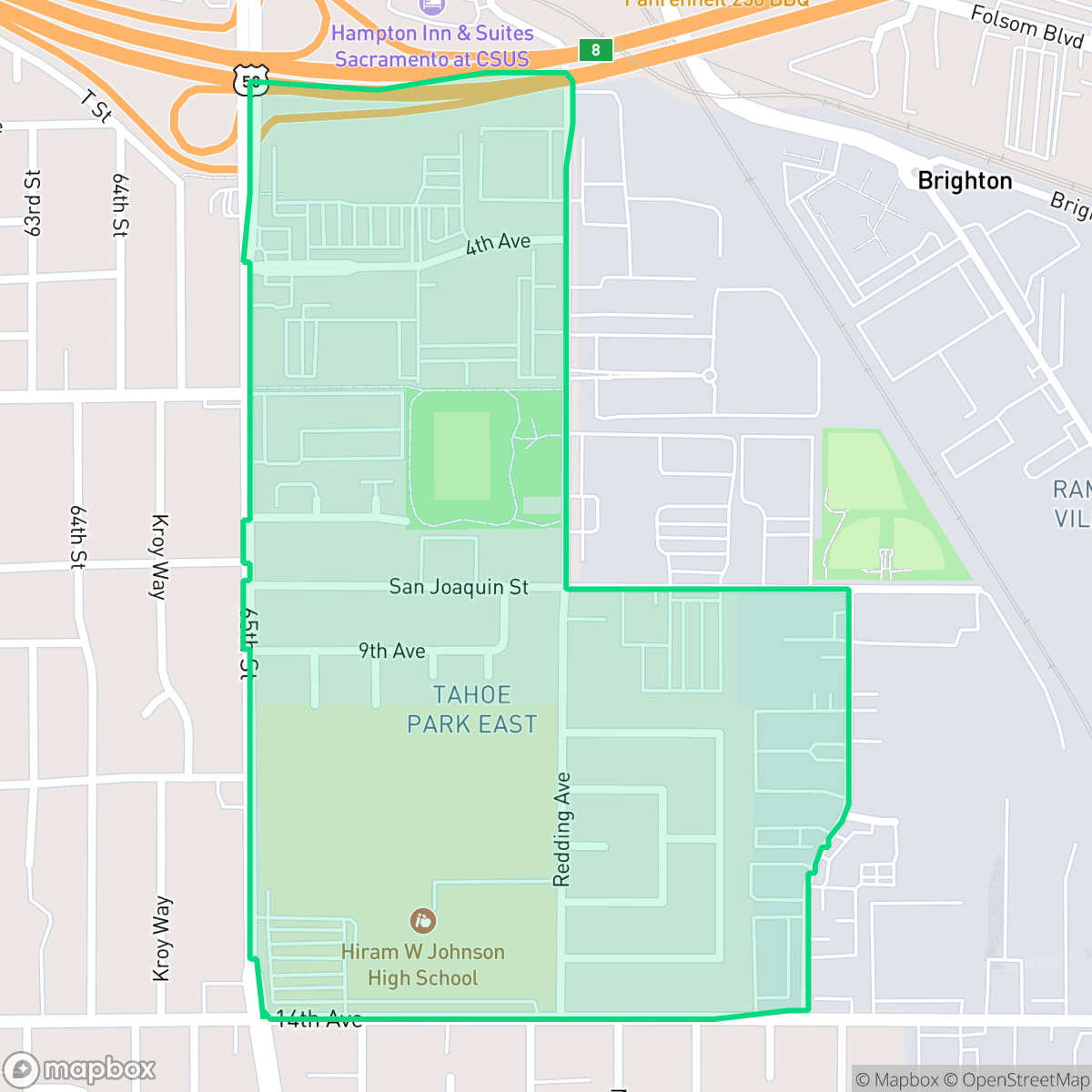
Tahoe Park East is an officially recognized neighborhood in Sacramento, California, representing the youngest section of the broader Tahoe Park community. The area was officially added to the city in 1958 through the annexation of land northeast of 14th Avenue and 65th Street. Geographically, the neighborhood is bordered by 65th Street to the west, Highway 50 and the Tahoe Tallac Little League Park to the north, Business Drive to the east, and 14th Avenue to the south. Reflecting the mid-century suburban expansion of post-World War II Sacramento, the neighborhood's housing stock features a mix of compact cottages and mid-century modern ranch-style homes. Today, it remains a distinct, primarily residential enclave adjacent to major transit corridors and local green spaces.
The neighborhood functions as a vibrant, mixed-use community where residential streets meet light commercial corridors. Local spots like the Altar Room, Kansai Ramen, and Thai Street Bistro provide accessible social hubs, contributing to a lively atmosphere that distinguishes the area from quieter suburban pockets. The layout encourages high pedestrian activity, making it easy for residents to navigate the local grid without a vehicle.
Prospective residents should weigh the benefits of urban convenience against the reality of acoustic conditions, as road traffic remains a significant factor in the local soundscape. The area features a high rate of health insurance coverage and a strong progressive ideological lean among the population. Families should be aware that the local school district currently faces significant fiscal challenges, which may impact educational resources in the immediate vicinity.
Neighborhood Scores Across 15 Qualities
Homes feature consistent spacing with some buffers between neighbors, offering a slightly higher sense of privacy than the Sacramento average. Backyard shared fencing is common throughout the area according to iHuus data.
Pedestrian travel is easy due to continuous sidewalks on both sides of most streets and well-marked crosswalks at major intersections. This level of accessibility is notably higher than the Sacramento average.
Standard tract housing with uniform rooflines and small yards defines the local landscape. This area features slightly less visual variety than the Sacramento average, according to iHuus data.
Wide green verges and several public parks provide safe, accessible spaces for pets. This level of accessibility for dog owners is roughly in line with the Sacramento average, according to iHuus data.
Residential pockets feature a standard suburban layout of single-family homes and local commercial zones, though the area contains a notable presence of industrial yards and multi-family complexes. This landscape sits largely in line with the typical urban-rural balance found throughout Sacramento.
Suburban streets and light industrial zones provide a steady but subdued atmosphere, sitting slightly below the Sacramento average for activity levels. While local dining and service hubs offer occasional social interaction, the area functions primarily as a quiet residential and warehouse landscape.
Frequent noise from nearby freeway and railroad activity is common in this area. According to iHuus data, acoustic levels are slightly higher than the Sacramento average.
Air quality levels are generally acceptable, though sensitive groups may encounter occasional periods of concern. According to iHuus data, these conditions are largely consistent with the average levels found across Sacramento.
Residential and light commercial uses dominate the area, resulting in a lack of heavy industrial activity. While the neighborhood is slightly more exposed to industrial-related traffic than the Sacramento average, there are no significant warehouses or heavy equipment yards present.
Health insurance accessibility is strong in this area; according to iHuus data, coverage rates among residents are higher than the Sacramento city average.
Voting patterns and census indicators in Tahoe Park East reflect a predominantly liberal leaning, which is slightly more pronounced than the Sacramento city average according to iHuus data.
Residents live among a diverse mix of young adults, families, and older adults. This demographic spread is largely consistent with the average seen across Sacramento.
Residual flood risk exists within this area as it sits within a 500-year floodplain, though the safety level remains notably higher than the Sacramento city average according to iHuus data.
Address-Level Insights for Tahoe Park East


iHuus Neighborhood Intelligence Insights
Get address-level neighborhood insights for Tahoe Park East
- Street-level scores — see how individual blocks compare, not just neighborhood averages
- Micro-zone boundaries — identify quiet pockets, flood boundaries, and walkable clusters before you visit
- 15 dimensions in full — walkability, noise, air quality, school quality, insurance coverage, population age profile, urban/rural index, and more
- Boundary risk alerts — know if your address sits near a block boundary where scores drop, the kind of detail no listing will ever mention
- School insights — individual school ratings and insights, not just district-level data
- Compare before you commit — side-by-side data across neighborhoods, down to block precision
No credit card required
Compare with Any Neighborhood
| Dimension | Tahoe Park East | Airport |
|---|---|---|
| 🚶 Walkabilityavg 8.5 | ||
| 🔊 Acoustic Comfortavg 3.22 | ||
| 🤫 Privacy Indexavg 5.34 | ||
| 🎨 Visual Appealavg 6.3 | ||
| 🐕 Dog Friendlinessavg 6.98 | ||
| 🗺️ Urban-Rural Indexavg 6.57 | ||
| ✨ Neighborhood Vibeavg 4.66 | ||
| 🏥 Health Insurance Coverageavg 7.4 | ||
| 🌿 Air Qualityavg 6.12 | ||
| 🏭 Industrial Proximityavg 8.32 | ||
| 🌊 Flood Safetyavg 6.04 | ||
| 🗳️ Ideological Leanavg 9.49 | ||
| 👥 Population Age Profileavg 4.75 | ||
| 🔥 Fire Safetyavg 0 | ||
| 🏫 School Quality |
Tahoe Park East Rankings
School Districts Serving Tahoe Park East
School Insights for Tahoe Park East
Below average outcomes; significant attendance and academic challenges.
School Insights
See what's really behind every school rating near Tahoe Park East
- Individual school ratings — each school's own score with outcome context, not just a district average
- Enrollment & class size data — student-to-teacher ratio and how it compares to the state average
- Full demographics breakdown — ethnicity and gender composition for every school in the enrollment zone
- Every school in the district — all schools within the enrollment boundary ranked by rating, not just the closest one
- Grade levels & benchmarks — elementary through high school, with below/above state-average flags
No credit card required