Southside Park, Sacramento
Updated · 2,455 residents
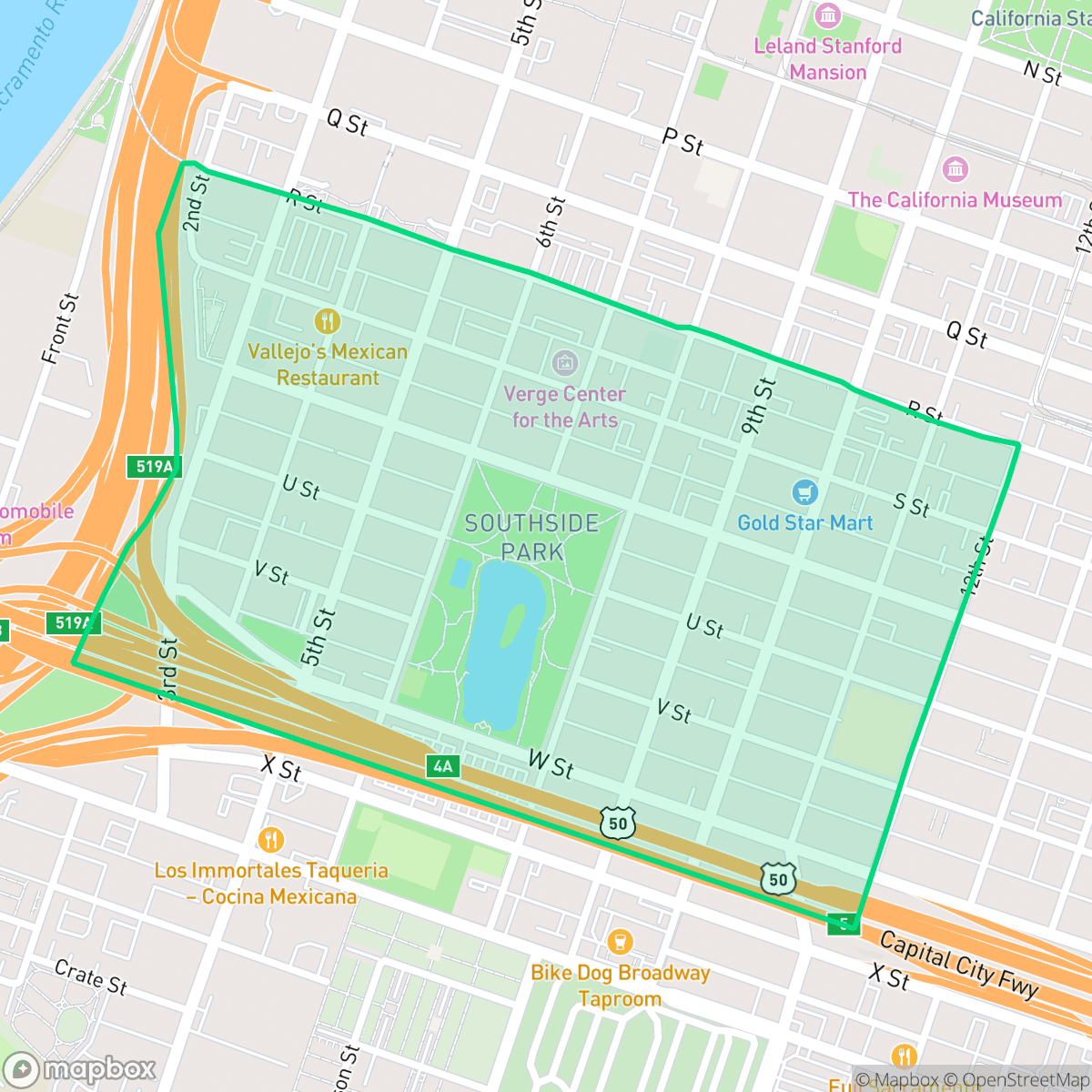
Southside Park is a highly walkable neighborhood defined by its namesake 26-acre green space and a vibrant mix of local eateries. While the area offers excellent access to urban amenities and high-quality air, residents should note that the proximity to major roadways results in significant traffic noise.
Key Highlights
About Southside Park
Originally a low-lying slough inhabited by the Valley Nisenan, the Southside Park neighborhood in Sacramento developed around the turn of the 20th century after the construction of the Y Street levee. At its center, the 26-acre Southside Park was designed by Rudolf Herold, George Randle, and John McLaren, opening in 1913. The surrounding neighborhood quickly grew with Craftsman and Classical Revival homes, attracting a highly diverse population of Portuguese, Italian, Black, Asian, and Latino residents, earning it the nickname "League of Nations". A vital hub of social and cultural history, the park served as the final destination for Cesar Chavez’s landmark 1966 United Farm Workers march from Delano. Today, this heritage is celebrated by the historic Our Lady of Guadalupe Church and the iconic 110-foot Southside Park Mural, which honors the neighborhood’s deep Chicano and Mexican roots.
The area functions as a dense, pedestrian-friendly enclave within Sacramento, characterized by a mix of historic residential architecture and modern commercial hubs. Residents benefit from exceptional walkability, allowing easy access to popular local spots like Camellia Coffee Roasters and Binchoyaki. The presence of the large central park provides a significant recreational anchor, contributing to a high dog-friendliness score according to iHuus data. The housing stock consists of a standard urban mix, ranging from small single-family residences to various apartment complexes. Prospective residents should consider the trade-offs associated with central urban living in this location. While air quality remains high and industrial proximity is low, the neighborhood experiences significant acoustic challenges due to its proximity to major traffic arteries, resulting in elevated noise levels. Educational options are mixed; while the district faces broader fiscal instability, the local William Land Elementary maintains a high performance rating. This area is well-suited for those who prioritize immediate access to urban conveniences and outdoor leisure over a quiet, secluded environment.
Neighborhood Scores Across 15 Qualities
Varying levels of separation exist between properties, ranging from closely packed multi-family units to residential houses with small buffers. This level of privacy is roughly in line with the Sacramento average, according to iHuus data.
Pedestrian infrastructure is exceptional in this area, featuring a dense grid of sidewalks and dedicated crossings that are more accessible than the Sacramento average. Residents benefit from well-maintained paths on both sides of most streets and specialized bridges for navigating highway boundaries.
Typical urban housing structures characterize this area, consisting of apartment complexes and single-family homes with modest yards. This visual landscape is slightly below the Sacramento city average for visual variety.
Extensive access to Southside Park and nearby riverside green spaces provides ample room for outdoor activities. Wide paths and tree-lined streets offer more pet-friendly walking environments than the Sacramento average.
Residential streets and green spaces are balanced with commercial blocks and infrastructure. This area features a more suburban layout than the typical Sacramento urban core, according to iHuus data.
Diverse local destinations, including art galleries, cafes, and unique dining, create a high-energy atmosphere that is significantly more active than the Sacramento average. This lively environment offers a blend of mid-rise urban density and accessible green spaces according to iHuus data.
Frequent loud disturbances from nearby airport runways and heavy rail lines characterize the area. This level of acoustic disruption is significantly higher than the Sacramento average, according to iHuus data.
Air quality in Southside Park is notably cleaner than the Sacramento average, with sensor data from iHuus indicating mostly fresh air and infrequent periods of poor ventilation.
Residential and commercial spaces dominate this area with no detectable warehouses or heavy industrial facilities. According to iHuus data, this neighborhood offers a cleaner landscape than the Sacramento average, though some freeway noise is present near certain borders.
Health insurance access among residents is below the Sacramento city average, according to iHuus data.
Voting patterns and census indicators reflect a deeply liberal political identity that is even more pronounced than the Sacramento average, according to iHuus data.
Residents live alongside a balanced variety of young professionals, families, and seniors. This demographic spread is slightly more diverse than the typical Sacramento profile, according to iHuus data.
Flood safety levels are notably higher than the Sacramento average, though some residual risk remains due to the area's location within a 500-year floodplain. According to iHuus data, residents may encounter minor flood risks during extreme weather events.
Address-Level Insights for Southside Park


iHuus Neighborhood Intelligence Insights
Get address-level neighborhood insights for Southside Park
- Street-level scores — see how individual blocks compare, not just neighborhood averages
- Micro-zone boundaries — identify quiet pockets, flood boundaries, and walkable clusters before you visit
- 15 dimensions in full — walkability, noise, air quality, school quality, insurance coverage, population age profile, urban/rural index, and more
- Boundary risk alerts — know if your address sits near a block boundary where scores drop, the kind of detail no listing will ever mention
- School insights — individual school ratings and insights, not just district-level data
- Compare before you commit — side-by-side data across neighborhoods, down to block precision
No credit card required
Compare with Any Neighborhood
| Dimension | Southside Park | Airport |
|---|---|---|
| 🚶 Walkabilityavg 8.5 | ||
| 🔊 Acoustic Comfortavg 3.22 | ||
| 🤫 Privacy Indexavg 5.34 | ||
| 🎨 Visual Appealavg 6.3 | ||
| 🐕 Dog Friendlinessavg 6.98 | ||
| 🗺️ Urban-Rural Indexavg 6.57 | ||
| ✨ Neighborhood Vibeavg 4.66 | ||
| 🏥 Health Insurance Coverageavg 7.4 | ||
| 🌿 Air Qualityavg 6.12 | ||
| 🏭 Industrial Proximityavg 8.32 | ||
| 🌊 Flood Safetyavg 6.04 | ||
| 🗳️ Ideological Leanavg 9.49 | ||
| 👥 Population Age Profileavg 4.75 | ||
| 🔥 Fire Safetyavg 0 | ||
| 🏫 School Quality |
Southside Park Rankings
School Districts Serving Southside Park
School Insights for Southside Park
Below average outcomes; significant attendance and academic challenges.
School Insights
See what's really behind every school rating near Southside Park
- Individual school ratings — each school's own score with outcome context, not just a district average
- Enrollment & class size data — student-to-teacher ratio and how it compares to the state average
- Full demographics breakdown — ethnicity and gender composition for every school in the enrollment zone
- Every school in the district — all schools within the enrollment boundary ranked by rating, not just the closest one
- Grade levels & benchmarks — elementary through high school, with below/above state-average flags
No credit card required