Southeast Village, Sacramento
Updated · 5,523 residents
Southeast Village is a culturally diverse residential community in southeastern Sacramento defined by its established suburban tract housing and strong local school presence. While the area offers a pedestrian-friendly layout with consistent sidewalks, residents should be aware of elevated road noise levels and the proximity of industrial environmental sites.
Key Highlights
About Southeast Village
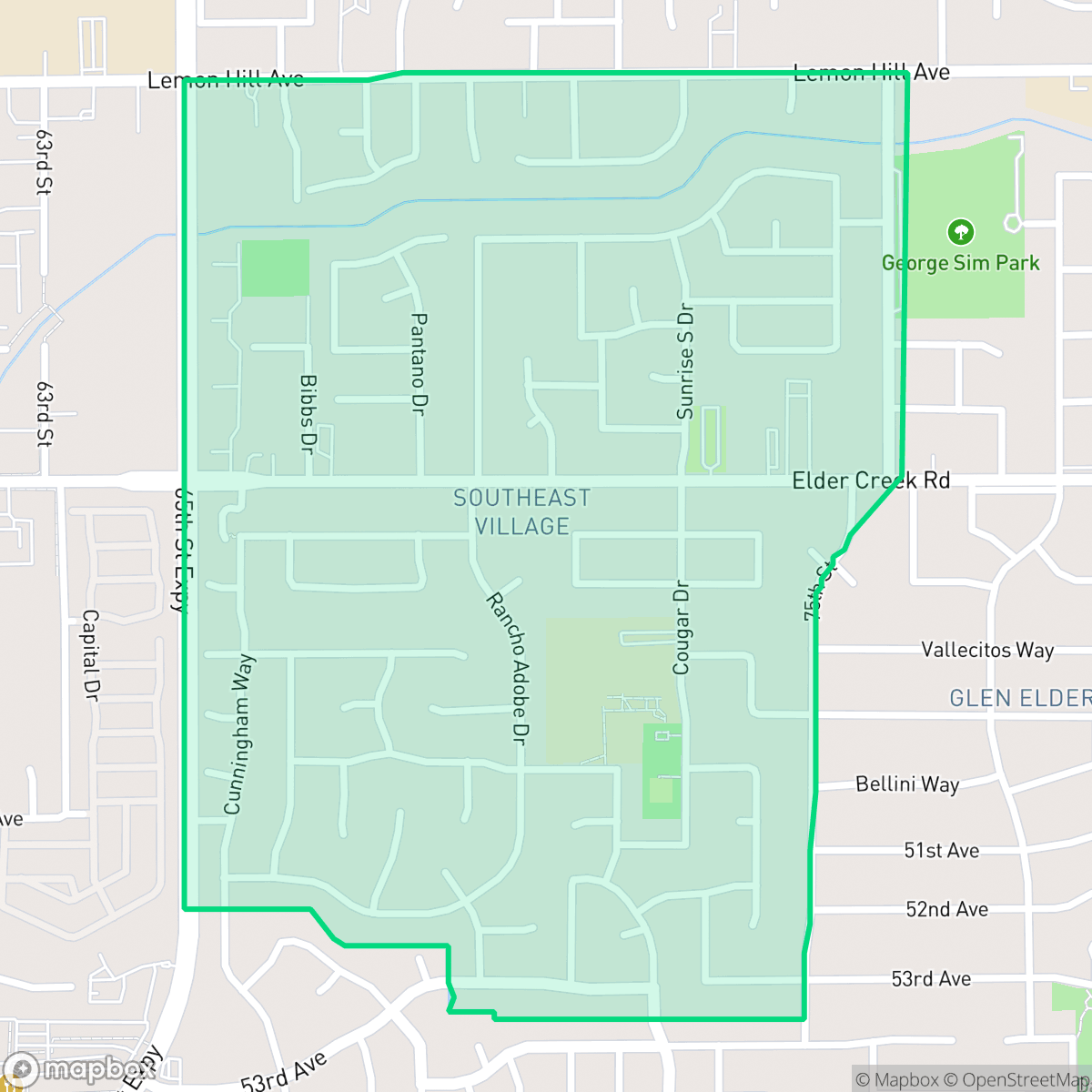
Located in southeastern Sacramento, Southeast Village is a primarily residential neighborhood bounded by Lemon Hill Avenue and the 65th Street Expressway, and bisected by Morrison Creek. The area’s most prominent historical landmark is the Elder Creek Cemetery, established in 1864. This pioneer cemetery holds early local figures, including horticulturist James Rutter, whose award-winning cultivation of Flame Tokay grapes helped establish the region's historic fruit-growing industry. While many of the neighborhood's single-family homes were built between 1940 and 1999, Southeast Village has evolved into a culturally rich community. Today, it features a highly diverse population, with nearly half of its residents identifying with Asian ancestry, particularly Vietnamese, which remains a prominent language spoken in many local households.
This neighborhood serves as a settled suburban enclave characterized by established single-family homes and a central elementary school. The landscape is marked by a mix of residential streets and accessible green space, fostering a sense of community among its diverse population. With high rates of health insurance coverage and a stable, family-oriented demographic, the area provides a consistent living environment for those seeking a traditional suburban lifestyle within the Sacramento region.
Prospective residents should weigh the benefits of a walkable, low-traffic street network against specific environmental considerations. The area experiences significant road noise due to its location, and potential buyers should investigate local groundwater and soil conditions given the nearby industrial history. It is best suited for families and individuals who prioritize school access and a stable residential atmosphere over total acoustic seclusion.
Neighborhood Scores Across 15 Qualities
Residential spacing varies between detached homes with modest yards and more densely packed shared-wall structures. According to iHuus data, this level of privacy is slightly higher than the Sacramento average.
Residential streets feature consistent sidewalks and safe crossings, though large commercial blocks can increase walking distances. While pedestrian infrastructure is reliable, the ease of navigating on foot is slightly below the Sacramento city average.
Standard tract housing and high-density apartments define the area, offering a functional but less varied skyline than the Sacramento average. Most properties feature uniform rooflines and small yards, according to iHuus data.
Available walking areas include central school fields, drainage canal corridors, and various grassy verges. While these public spaces provide some relief, the area offers fewer accessible green spaces for pets than the Sacramento average according to iHuus data.
Residential layouts vary from low-density single-family homes near open fields to denser suburban pockets with apartment complexes. This balance of open land and developed housing is roughly in line with the Sacramento average, according to iHuus data.
A variety of social hubs and diverse dining options provide a livelier atmosphere than much of Sacramento. While local amenities and green spaces are accessible, the area remains largely car-dependent due to its industrial and suburban layout.
Frequent noise from nearby freeways and railroad tracks characterizes the area. According to iHuus data, acoustic comfort levels are slightly lower than the Sacramento average.
Air quality levels are generally acceptable, though periods of unhealthy air may occur. According to iHuus data, the air quality in this area is roughly in line with the Sacramento city average.
Residential and retail areas exist alongside commercial zones and large warehouses, making industrial proximity lower than the Sacramento average. Residents should be aware of nearby heavy industrial activity and a nearby Superfund site that may impact soil and groundwater quality, according to iHuus data.
Health insurance access among residents is below the Sacramento average, according to iHuus data.
Voting patterns and census indicators show a deeply liberal political leaning that is consistent with the rest of Sacramento. According to iHuus data, the area's ideological profile closely mirrors the city average.
A balanced mix of young adults, families, and older residents characterizes this area. This demographic distribution is largely consistent with the broader Sacramento average, according to iHuus data.
Flood risk in this area is slightly higher than the Sacramento average due to an undetermined status in official FEMA studies. Residents should remain aware that detailed flood mapping for this specific neighborhood has not yet been completed.
Address-Level Insights for Southeast Village


iHuus Neighborhood Intelligence Insights
Get address-level neighborhood insights for Southeast Village
- Street-level scores — see how individual blocks compare, not just neighborhood averages
- Micro-zone boundaries — identify quiet pockets, flood boundaries, and walkable clusters before you visit
- 15 dimensions in full — walkability, noise, air quality, school quality, insurance coverage, population age profile, urban/rural index, and more
- Boundary risk alerts — know if your address sits near a block boundary where scores drop, the kind of detail no listing will ever mention
- School insights — individual school ratings and insights, not just district-level data
- Compare before you commit — side-by-side data across neighborhoods, down to block precision
No credit card required
Compare with Any Neighborhood
| Dimension | Southeast Village | Airport |
|---|---|---|
| 🚶 Walkabilityavg 8.5 | ||
| 🔊 Acoustic Comfortavg 3.22 | ||
| 🤫 Privacy Indexavg 5.34 | ||
| 🎨 Visual Appealavg 6.3 | ||
| 🐕 Dog Friendlinessavg 6.98 | ||
| 🗺️ Urban-Rural Indexavg 6.57 | ||
| ✨ Neighborhood Vibeavg 4.66 | ||
| 🏥 Health Insurance Coverageavg 7.4 | ||
| 🌿 Air Qualityavg 6.12 | ||
| 🏭 Industrial Proximityavg 8.32 | ||
| 🌊 Flood Safetyavg 6.04 | ||
| 🗳️ Ideological Leanavg 9.49 | ||
| 👥 Population Age Profileavg 4.75 | ||
| 🔥 Fire Safetyavg 0 | ||
| 🏫 School Quality |
Southeast Village Rankings
School Districts Serving Southeast Village
School Insights for Southeast Village
Below average outcomes; significant attendance and academic challenges.
School Insights
See what's really behind every school rating near Southeast Village
- Individual school ratings — each school's own score with outcome context, not just a district average
- Enrollment & class size data — student-to-teacher ratio and how it compares to the state average
- Full demographics breakdown — ethnicity and gender composition for every school in the enrollment zone
- Every school in the district — all schools within the enrollment boundary ranked by rating, not just the closest one
- Grade levels & benchmarks — elementary through high school, with below/above state-average flags
No credit card required