South Oak Park, Sacramento
Updated · 5,567 residents
South Oak Park is a quiet, grid-based neighborhood characterized by its dense, single-family housing and proximity to the emerging Aggie Square technology corridor. Residents benefit from high walkability across the residential grid, though the area experiences notable ambient noise from nearby highway traffic.
Key Highlights
About South Oak Park
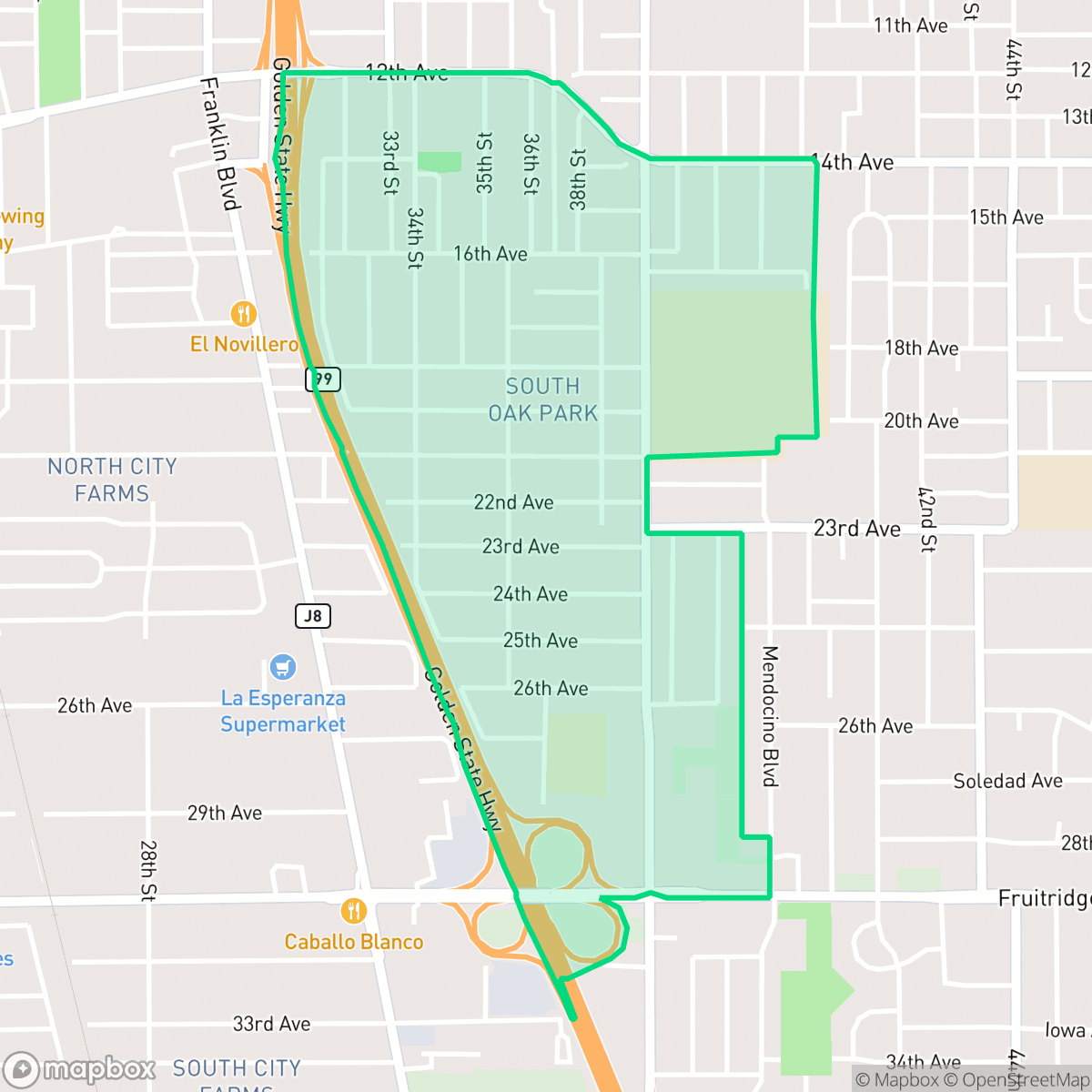
Separated from North Oak Park by Fifth Avenue and McClatchy Park, South Oak Park in Sacramento has a distinct history tracing back to the early 20th century. While the broader area was established as Sacramento’s first suburb in 1887, South Oak Park developed with its own character, featuring architectural remnants like a weathered 1910 farmhouse on Seventh Avenue and the 19th-century "Rancho Luna" estate on 23rd Avenue. The neighborhood historically housed a diverse, working-class population shaped by mid-century redlining and the construction of Highway 99. In 2014, residents established the South Oak Park Community Association (SOPCA) to advocate for the area. Today, the neighborhood is undergoing a major transformation driven by the development of UC Davis’s 25-acre Aggie Square research and technology campus along its border.
The area maintains a consistent suburban feel with a dense residential grid that supports pedestrian activity. While the neighborhood is primarily composed of single-family homes, the structures are closely packed with narrow side yards, resulting in limited privacy between properties. According to iHuus data, the environment is relatively quiet in terms of aviation or rail noise, though the proximity to major roadways creates a constant ambient sound level of approximately 61 decibels. The neighborhood remains largely residential and institutional, offering a practical location for those working at the nearby UC Davis Aggie Square campus.
Prospective residents should consider that the neighborhood is served by the Sacramento City Unified School District, which currently faces significant fiscal and administrative challenges. The area remains a sparse environment with few local amenities or public parks, making it best suited for individuals prioritizing proximity to emerging employment hubs over expansive private outdoor space or a highly active commercial scene. According to iHuus, the neighborhood offers a functional, transit-accessible environment for those who prefer a traditional suburban layout.
Neighborhood Scores Across 15 Qualities
Housing density is consistent with the city average, featuring a mix of single-family homes with small backyard buffers and some closely packed structures. According to iHuus data, residents may experience limited side yard spacing in certain areas of the neighborhood.
Sidewalks and crosswalks are widely available across most residential streets, though some major roads lack dedicated buffers. This connectivity is slightly below the Sacramento average according to iHuus data.
Uniform tract housing and small yards characterize the area, which offers slightly less visual variety than the Sacramento average. According to iHuus data, the landscape consists primarily of boxy roof geometries and modest residential lots.
Public green space is primarily centered around a single large sports complex, which offers fewer walking options than the Sacramento average. Street verges are notably narrow, though many properties feature private fenced backyards for pets.
Residential patterns consist of a medium-density suburban grid featuring single-family homes and multi-family complexes. This landscape is largely consistent with the broader Sacramento area.
A steady mix of residential streets and light industrial units provides a calm atmosphere that is nearly identical to the Sacramento average. While some areas near major highways offer walkable access to diverse dining, the overall density of commercial services remains moderate.
Frequent noise from nearby railroad tracks and major freeways characterizes the area. Acoustic levels are slightly more disruptive than the Sacramento average, according to iHuus data.
Air quality levels are generally acceptable, though residents may experience occasional periods of concern during certain seasons. This neighborhood maintains a level of air quality that is largely consistent with the Sacramento average, according to iHuus data.
Industrial facilities and large warehouses are absent from the neighborhood, making the area even more residential than the Sacramento average. While some sections near major highways may experience higher traffic noise, the area remains free of heavy industrial hazards according to iHuus data.
Health insurance access among residents is lower than the Sacramento average, according to iHuus data. This indicates a higher proportion of uninsured individuals living in the area compared to much of the city.
Voting patterns and census indicators reflect a deeply liberal community that is even more pronounced than the Sacramento average, according to iHuus data.
A varied range of age groups, including young adults, families, and older residents, resides here. This demographic distribution is slightly lower than the Sacramento average according to iHuus data.
Residual flood risk exists within the area, though the neighborhood maintains a higher level of safety than the Sacramento average according to iHuus data.
Address-Level Insights for South Oak Park


iHuus Neighborhood Intelligence Insights
Get address-level neighborhood insights for South Oak Park
- Street-level scores — see how individual blocks compare, not just neighborhood averages
- Micro-zone boundaries — identify quiet pockets, flood boundaries, and walkable clusters before you visit
- 15 dimensions in full — walkability, noise, air quality, school quality, insurance coverage, population age profile, urban/rural index, and more
- Boundary risk alerts — know if your address sits near a block boundary where scores drop, the kind of detail no listing will ever mention
- School insights — individual school ratings and insights, not just district-level data
- Compare before you commit — side-by-side data across neighborhoods, down to block precision
No credit card required
Compare with Any Neighborhood
| Dimension | South Oak Park | Airport |
|---|---|---|
| 🚶 Walkabilityavg 8.5 | ||
| 🔊 Acoustic Comfortavg 3.22 | ||
| 🤫 Privacy Indexavg 5.34 | ||
| 🎨 Visual Appealavg 6.3 | ||
| 🐕 Dog Friendlinessavg 6.98 | ||
| 🗺️ Urban-Rural Indexavg 6.57 | ||
| ✨ Neighborhood Vibeavg 4.66 | ||
| 🏥 Health Insurance Coverageavg 7.4 | ||
| 🌿 Air Qualityavg 6.12 | ||
| 🏭 Industrial Proximityavg 8.32 | ||
| 🌊 Flood Safetyavg 6.04 | ||
| 🗳️ Ideological Leanavg 9.49 | ||
| 👥 Population Age Profileavg 4.75 | ||
| 🔥 Fire Safetyavg 0 | ||
| 🏫 School Quality |
South Oak Park Rankings
School Districts Serving South Oak Park
School Insights for South Oak Park
Below average outcomes; significant attendance and academic challenges.
School Insights
See what's really behind every school rating near South Oak Park
- Individual school ratings — each school's own score with outcome context, not just a district average
- Enrollment & class size data — student-to-teacher ratio and how it compares to the state average
- Full demographics breakdown — ethnicity and gender composition for every school in the enrollment zone
- Every school in the district — all schools within the enrollment boundary ranked by rating, not just the closest one
- Grade levels & benchmarks — elementary through high school, with below/above state-average flags
No credit card required