South Land Park, Sacramento
Updated · 14,602 residents
South Land Park is a quiet, tree-lined residential community in Sacramento known for its established suburban feel and mid-century modern aesthetic. The area offers a blend of single-family homes and apartment complexes with consistent sidewalk access, though residents should anticipate moderate noise levels from nearby highway traffic.
Key Highlights
About South Land Park
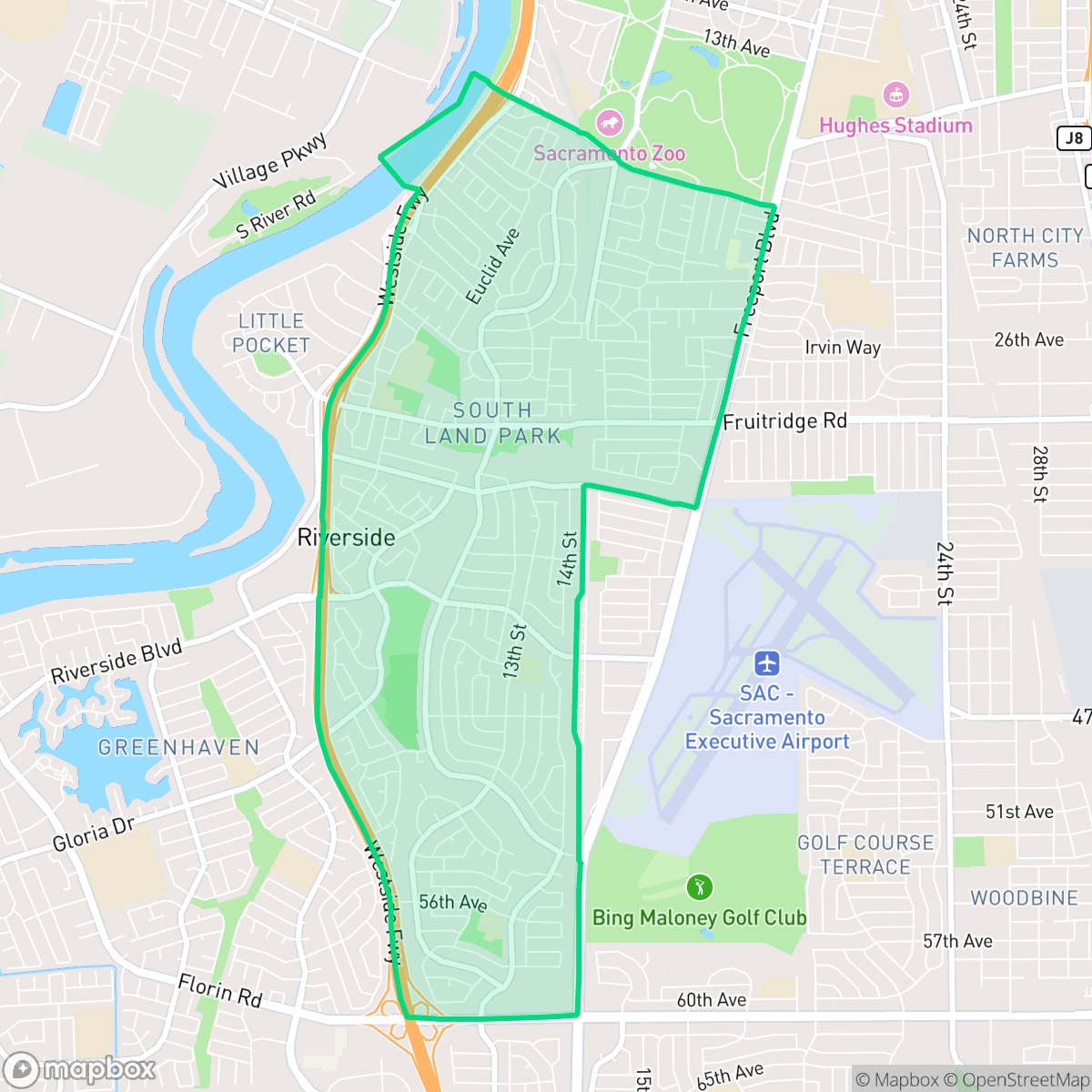
Developed primarily in the 1950s and 1960s, South Land Park in Sacramento is celebrated for its rich mid-century modern architectural heritage. The neighborhood features a prominent collection of California ranch homes, custom residences designed by modernist architect Carter Sparks, and a historic enclave of homes built by developer Joseph Eichler in the South Land Park Hills subsection. Constructed between 1955 and 1956, this tract was designated as the South Land Park Hills Eichler Homes Historic District, representing Sacramento's first historic district dedicated to mid-century modern design. The neighborhood also encompasses the site of Sutterville, a historic 19th-century settlement. Today, South Land Park maintains its distinct mid-century character alongside local landmarks like the 'Little Pocket' riverfront area and longtime neighborhood businesses such as Kobasic's Candies.
The neighborhood functions as a classic suburban enclave characterized by a significant tree canopy and a mix of single-family residences and multi-unit apartment complexes. It offers a relatively quiet atmosphere, punctuated by local parks like Joseph Reichmuth Park and various community-oriented amenities such as the Park Terrace Swim and Tennis Club. According to iHuus data, the area maintains a balanced urban-rural index, providing a stable living environment that integrates residential life with accessible local services and dining options.
Prospective residents should consider that the area is largely car-dependent, with daily life often requiring travel beyond the immediate vicinity for comprehensive services. While the neighborhood boasts high health insurance coverage and a strong sense of community, acoustic comfort is impacted by its proximity to major roadways. Educational options are varied, with local elementary schools like Pony Express and Sutterville providing solid ratings, though the broader district landscape remains complex due to ongoing administrative and fiscal challenges.
Neighborhood Scores Across 15 Qualities
Residential spacing varies between detached homes with moderate buffers and denser apartment clusters with shared walls. According to iHuus data, privacy levels here are slightly higher than the Sacramento average.
Connected sidewalks and a pedestrian bridge over major arterial roads facilitate easy movement throughout the area. Most residential paths lead directly to a central commercial plaza, providing a level of accessibility that is slightly above the Sacramento average.
Large homes and frequent upscale amenities contribute to a visual environment that is more polished than the Sacramento average. According to iHuus data, the area features various private and shared pools alongside established residential tracts.
Access to riverside trails, open grass fields, and wide sidewalk verges makes this area slightly more dog friendly than the Sacramento average. Large public parks and connected green spaces provide safe, traffic-free routes for walking pets.
Residential areas consist of established suburban grids with significant tree canopy and a mix of single-family homes and multi-unit complexes. This environment is slightly more suburban than the Sacramento average, according to iHuus data.
Residential blocks and green spaces dominate the landscape, offering a more subdued atmosphere than the Sacramento average. While some pockets provide walkable access to local cafes and dining, much of the area is characterized by low-density housing and light industrial units.
Frequent acoustic disturbances from nearby freeway and railroad corridors characterize this area. According to iHuus data, noise levels are notably higher than the Sacramento average.
Air quality in this area fluctuates between acceptable and unhealthy levels, which may cause occasional concern for sensitive groups. This level of pollution is roughly in line with the average found across Sacramento.
Large wastewater and utility facilities are located on the edges of the neighborhood, though the area remains largely residential and comparable to the city average for industrial proximity. According to iHuus data, most streets are quiet and free from heavy industrial activity.
Health insurance enrollment rates in South Land Park are higher than the Sacramento average, according to iHuus data. This indicates a relatively high level of access to medical coverage among local residents.
Voting patterns and census indicators reflect a predominantly liberal political leaning that is slightly more pronounced than the Sacramento average.
Residents live alongside a balanced mix of young adults, families, and older populations. This demographic distribution is slightly more varied than the Sacramento average, according to iHuus data.
Flood risk in this area is higher than the Sacramento average due to its location within a 500-year floodplain. Residents should be aware of some residual flood risk according to iHuus data.
Address-Level Insights for South Land Park


iHuus Neighborhood Intelligence Insights
Get address-level neighborhood insights for South Land Park
- Street-level scores — see how individual blocks compare, not just neighborhood averages
- Micro-zone boundaries — identify quiet pockets, flood boundaries, and walkable clusters before you visit
- 15 dimensions in full — walkability, noise, air quality, school quality, insurance coverage, population age profile, urban/rural index, and more
- Boundary risk alerts — know if your address sits near a block boundary where scores drop, the kind of detail no listing will ever mention
- School insights — individual school ratings and insights, not just district-level data
- Compare before you commit — side-by-side data across neighborhoods, down to block precision
No credit card required
Compare with Any Neighborhood
| Dimension | South Land Park | Airport |
|---|---|---|
| 🚶 Walkabilityavg 8.5 | ||
| 🔊 Acoustic Comfortavg 3.22 | ||
| 🤫 Privacy Indexavg 5.34 | ||
| 🎨 Visual Appealavg 6.3 | ||
| 🐕 Dog Friendlinessavg 6.98 | ||
| 🗺️ Urban-Rural Indexavg 6.57 | ||
| ✨ Neighborhood Vibeavg 4.66 | ||
| 🏥 Health Insurance Coverageavg 7.4 | ||
| 🌿 Air Qualityavg 6.12 | ||
| 🏭 Industrial Proximityavg 8.32 | ||
| 🌊 Flood Safetyavg 6.04 | ||
| 🗳️ Ideological Leanavg 9.49 | ||
| 👥 Population Age Profileavg 4.75 | ||
| 🔥 Fire Safetyavg 0 | ||
| 🏫 School Quality |
South Land Park Rankings
School Districts Serving South Land Park
School Insights for South Land Park
Below average outcomes; significant attendance and academic challenges.
School Insights
See what's really behind every school rating near South Land Park
- Individual school ratings — each school's own score with outcome context, not just a district average
- Enrollment & class size data — student-to-teacher ratio and how it compares to the state average
- Full demographics breakdown — ethnicity and gender composition for every school in the enrollment zone
- Every school in the district — all schools within the enrollment boundary ranked by rating, not just the closest one
- Grade levels & benchmarks — elementary through high school, with below/above state-average flags
No credit card required