South Hagginwood, Sacramento
Updated · 4,895 residents
South Hagginwood is a quiet, residential community in North Sacramento defined by its mature trees and a mix of early 20th-century bungalows and mid-century ranch homes. The area offers a low-density suburban environment with access to local parks and green corridors, though residents should expect moderate noise levels from nearby road traffic.
Key Highlights
About South Hagginwood
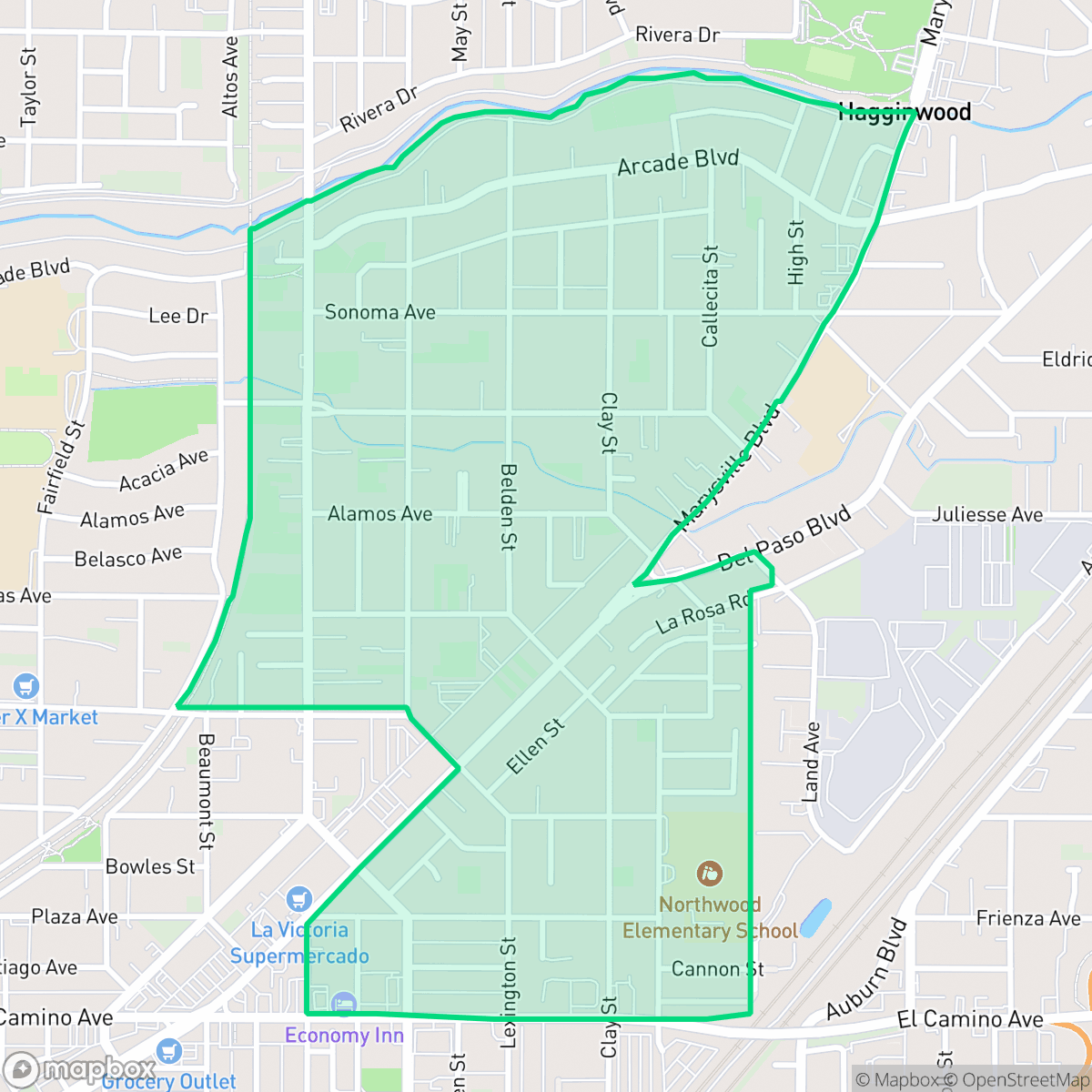
South Hagginwood, situated in North Sacramento, California, traces its origins to Rancho Del Paso, a massive 44,000-acre Mexican land grant acquired in 1859 by tycoon James Ben Ali Haggin, who developed it into the world's largest thoroughbred horse breeding nursery. Following the rancho's sale and subdivision in 1910, the North Sacramento Land Company began developing the district in 1911. Originally part of the independent city of North Sacramento, the area was annexed into the City of Sacramento during the 1960s. Today, South Hagginwood is an established, diverse residential community bounded by Arcade Creek and the Sacramento Northern bike trail. The neighborhood is characterized by its mature oak trees, oversized lots, and a distinct building stock featuring early 20th-century craftsman bungalows alongside mid-century ranch-style homes.
The neighborhood maintains a consistent suburban rhythm, characterized by a grid-like street layout and a blend of single-family residences. While it provides a peaceful residential setting, the eastern edge of the area borders industrial warehouse zones, which creates a distinct contrast to the quiet, tree-lined streets found throughout the interior. Residents benefit from accessible green spaces, including Richardson Village Park and nearby canal corridors, which offer recreational utility despite the relatively compact nature of the private lots.
Living in this area involves balancing the benefits of a low-density environment with certain logistical trade-offs. The neighborhood experiences moderate acoustic impact from road traffic, and the local school system, managed by the Twin Rivers Unified School District, currently faces significant academic and staffing challenges. Prospective residents will find a community that prioritizes a traditional residential feel over modern luxury amenities, making it a functional choice for those who value proximity to open space and established housing stock over high-density urban convenience.
Neighborhood Scores Across 15 Qualities
Homes are positioned with moderate spacing and limited vegetation buffers between neighbors. According to iHuus data, this level of separation provides slightly more privacy than the Sacramento average.
Pedestrian movement is supported by a grid layout with sidewalks and safe crossings, though some areas feature narrow or interrupted paths. While highly accessible via local trails and parks, the walkability level is slightly below the Sacramento city average.
Standard tract housing with uniform rooflines and modest lots defines the area. According to iHuus data, the visual variety is slightly below the Sacramento average.
Access to walking space for pets is slightly below the Sacramento average. While certain areas feature wide green parkways and canal trails, other sections of the neighborhood have narrow sidewalks and limited dedicated public park space.
Residential pockets of single-family homes sit alongside industrial warehouses and rail yards. This landscape offers a blend of low-density housing and open space that is roughly comparable to the Sacramento average.
A steady mix of residential streets, light industrial units, and local dining establishments provides a calm atmosphere that is roughly in line with the city average. Residents can access various local services and parks on foot, though some areas near major freight corridors are notably more subdued.
Steady hum from nearby busy streets creates a consistent level of ambient noise. This acoustic environment is notably more active than the Sacramento city average.
Air quality fluctuates between acceptable and unhealthy levels, presenting occasional concerns for sensitive groups. According to iHuus data, these conditions are largely consistent with the average found throughout Sacramento.
Residential life is largely undisturbed by heavy industry, as the area consists primarily of housing and light commercial pockets. While some warehouse activity and rail corridors exist on the eastern edges, the neighborhood maintains an industrial profile very similar to the Sacramento average.
Health insurance coverage among residents is relatively high, though it sits slightly below the Sacramento city average according to iHuus data.
Voting patterns and census indicators show a predominantly liberal political leaning, which is consistent with the broader Sacramento area according to iHuus data.
Residents live alongside a balanced mix of young adults, families, and older individuals. According to iHuus data, this demographic spread is slightly less varied than the broader Sacramento area.
Residual flood risk exists within the area as part of a 500-year floodplain, though safety levels are slightly higher than the Sacramento city average according to iHuus data.
Address-Level Insights for South Hagginwood


iHuus Neighborhood Intelligence Insights
Get address-level neighborhood insights for South Hagginwood
- Street-level scores — see how individual blocks compare, not just neighborhood averages
- Micro-zone boundaries — identify quiet pockets, flood boundaries, and walkable clusters before you visit
- 15 dimensions in full — walkability, noise, air quality, school quality, insurance coverage, population age profile, urban/rural index, and more
- Boundary risk alerts — know if your address sits near a block boundary where scores drop, the kind of detail no listing will ever mention
- School insights — individual school ratings and insights, not just district-level data
- Compare before you commit — side-by-side data across neighborhoods, down to block precision
No credit card required
Compare with Any Neighborhood
| Dimension | South Hagginwood | Airport |
|---|---|---|
| 🚶 Walkabilityavg 8.5 | ||
| 🔊 Acoustic Comfortavg 3.22 | ||
| 🤫 Privacy Indexavg 5.34 | ||
| 🎨 Visual Appealavg 6.3 | ||
| 🐕 Dog Friendlinessavg 6.98 | ||
| 🗺️ Urban-Rural Indexavg 6.57 | ||
| ✨ Neighborhood Vibeavg 4.66 | ||
| 🏥 Health Insurance Coverageavg 7.4 | ||
| 🌿 Air Qualityavg 6.12 | ||
| 🏭 Industrial Proximityavg 8.32 | ||
| 🌊 Flood Safetyavg 6.04 | ||
| 🗳️ Ideological Leanavg 9.49 | ||
| 👥 Population Age Profileavg 4.75 | ||
| 🔥 Fire Safetyavg 0 | ||
| 🏫 School Quality |
South Hagginwood Rankings
School Districts Serving South Hagginwood
School Insights for South Hagginwood
Below average outcomes; significant attendance and academic challenges.
School Insights
See what's really behind every school rating near South Hagginwood
- Individual school ratings — each school's own score with outcome context, not just a district average
- Enrollment & class size data — student-to-teacher ratio and how it compares to the state average
- Full demographics breakdown — ethnicity and gender composition for every school in the enrollment zone
- Every school in the district — all schools within the enrollment boundary ranked by rating, not just the closest one
- Grade levels & benchmarks — elementary through high school, with below/above state-average flags
No credit card required