Sierra Oaks, Sacramento
Updated · 2,522 residents
Sierra Oaks is a visually appealing, residential neighborhood known for its suburban layout and mature green spaces. It offers a quiet, dog-friendly environment with high levels of community health coverage, though residents should expect moderate noise levels from nearby road traffic.
Key Highlights
About Sierra Oaks
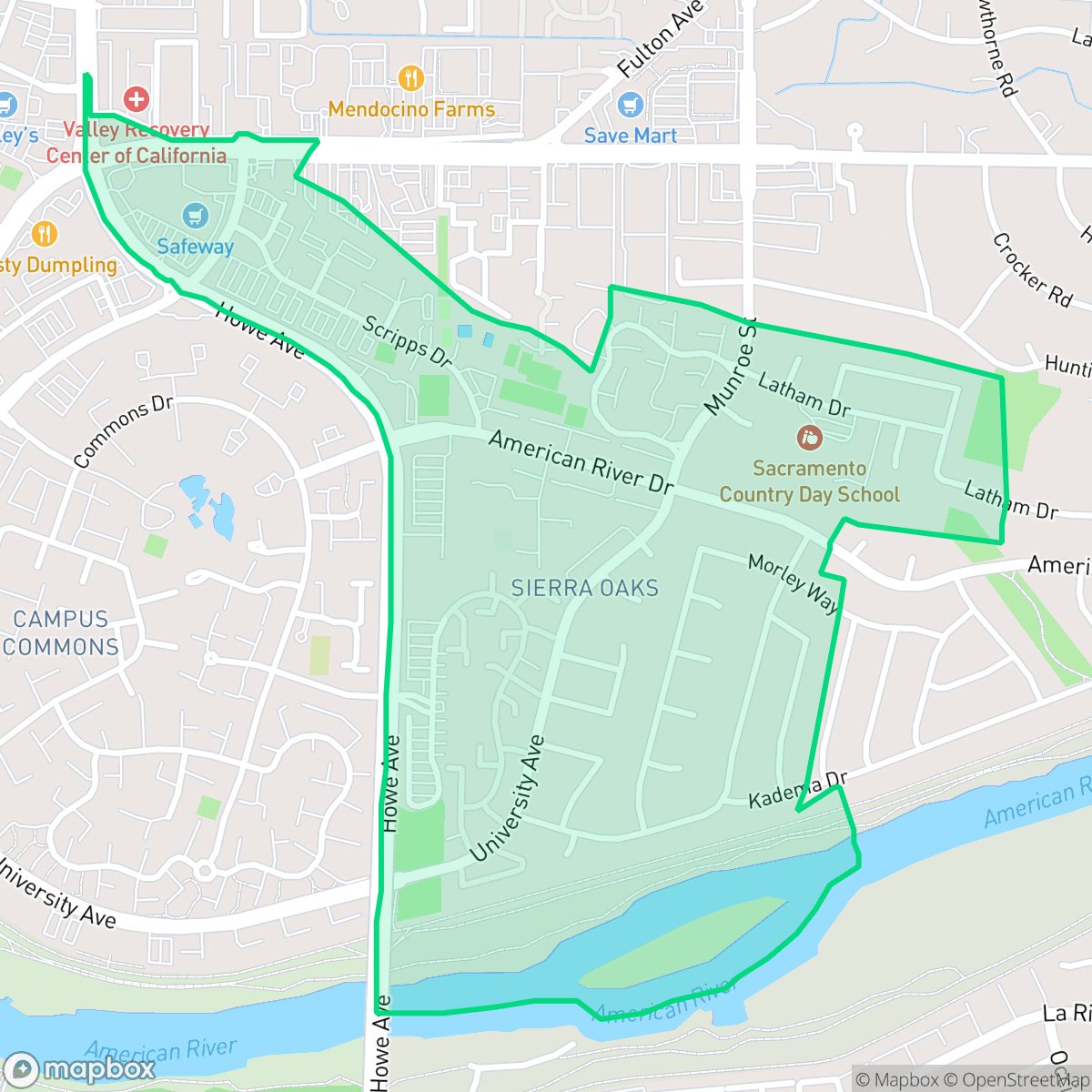
Established in 1929, Sierra Oaks was envisioned by developers Chris Jones, Wilbur Brand, and Frank "Squeaky" Williams as an experiment in "country" living outside Sacramento's city limits. At the time, the surrounding area consisted primarily of pasture and hop fields, and Fulton Avenue was still a dirt road. A prominent land planner from St. Louis was hired to design the prestigious suburb, which featured unique building restrictions like 50-foot setbacks to preserve a rural feel. Many early homes were built in the Normandy style, with notable examples designed by Williams. Prominent local families soon relocated to the neighborhood's meandering, sidewalk-free streets. A historic Tudor-style building on Fair Oaks Boulevard, leased by the Richfield Oil Company as a combination gas station and country store, remains standing today as a local landmark.
The neighborhood maintains a distinct suburban character defined by its meandering, sidewalk-free streets and open green spaces such as Oak Meadow Park. It is primarily a residential enclave that balances a quiet atmosphere with a high level of visual appeal, making it a desirable location for those seeking established, scenic surroundings. According to iHuus data, the area benefits from exceptional health insurance coverage among its residents, reflecting a stable and well-supported community profile. While it remains largely removed from industrial activity, the neighborhood experiences moderate road traffic noise, which is a notable factor for prospective residents to consider.
Livability in the area is shaped by its proximity to various regional school districts, including San Juan Unified and Sacramento City Unified, which present a mix of academic performance levels and operational challenges. The neighborhood is particularly well-suited for individuals and families who prioritize a quiet, dog-friendly environment and appreciate the aesthetic value of its historic architectural roots. While its walkability is moderate, the overall design encourages a slower, more deliberate pace of life. Prospective residents should weigh the benefits of its established community and green spaces against the realities of local traffic patterns and the varying landscape of the surrounding school districts.
Neighborhood Scores Across 15 Qualities
Residential spacing provides a consistent buffer between properties, offering slightly more seclusion than the average Sacramento neighborhood according to iHuus data.
Pedestrian movement is easy due to safe crossings and sidewalks present along streets. According to iHuus data, the connectivity in this area is slightly above the Sacramento average.
Large residential properties and upscale amenities contribute to a visual environment that is more aesthetically pleasing than the Sacramento average, according to iHuus data.
Abundant large parks and accessible trail networks provide much more space for pets than the Sacramento average. According to iHuus data, the presence of nearby open spaces makes this an ideal area for dog owners.
Open land and woodland are frequent throughout the area, providing a landscape that is slightly more suburban-rural than the typical Sacramento setting. While much of the neighborhood features scattered homes amid fields, some pockets contain denser apartment complexes and commercial centers with more asphalt coverage.
Suburban streets and green spaces offer a mix of quiet residential blocks and lively pockets of dining and social hubs. This level of activity is slightly higher than the Sacramento average, providing accessible amenities without losing a sense of tranquility.
Frequent noise from nearby transit corridors and flight paths makes this area noisier than the Sacramento average. According to iHuus data, residents may experience consistent auditory disturbances from surrounding freeways and railroad activity.
Air quality levels in this area typically fluctuate between acceptable and unhealthy; according to iHuus data, these conditions are largely in line with the Sacramento average.
Industrial activity is virtually nonexistent here, offering a much cleaner environment than the Sacramento average. According to iHuus data, the area is free from heavy warehouses and hazardous sites, containing only minimal light utility infrastructure.
Health insurance access is exceptionally high among residents, significantly surpassing the Sacramento average according to iHuus data.
Voting patterns and census indicators in Sierra Oaks reflect a very liberal leaning, though this is slightly less pronounced than the Sacramento city average according to iHuus data.
Residents live alongside a broad mix of young adults, families, and seniors. According to iHuus data, this demographic variety is more balanced than the average found throughout Sacramento.
Flood safety levels in Sierra Oaks are slightly higher than the Sacramento average, though some residual risk remains due to its location within the 500-year floodplain. According to iHuus data, residents should remain aware of potential vulnerabilities during extreme weather events.
Address-Level Insights for Sierra Oaks


iHuus Neighborhood Intelligence Insights
Get address-level neighborhood insights for Sierra Oaks
- Street-level scores — see how individual blocks compare, not just neighborhood averages
- Micro-zone boundaries — identify quiet pockets, flood boundaries, and walkable clusters before you visit
- 15 dimensions in full — walkability, noise, air quality, school quality, insurance coverage, population age profile, urban/rural index, and more
- Boundary risk alerts — know if your address sits near a block boundary where scores drop, the kind of detail no listing will ever mention
- School insights — individual school ratings and insights, not just district-level data
- Compare before you commit — side-by-side data across neighborhoods, down to block precision
No credit card required
Compare with Any Neighborhood
| Dimension | Sierra Oaks | Airport |
|---|---|---|
| 🚶 Walkabilityavg 8.5 | ||
| 🔊 Acoustic Comfortavg 3.22 | ||
| 🤫 Privacy Indexavg 5.34 | ||
| 🎨 Visual Appealavg 6.3 | ||
| 🐕 Dog Friendlinessavg 6.98 | ||
| 🗺️ Urban-Rural Indexavg 6.57 | ||
| ✨ Neighborhood Vibeavg 4.66 | ||
| 🏥 Health Insurance Coverageavg 7.4 | ||
| 🌿 Air Qualityavg 6.12 | ||
| 🏭 Industrial Proximityavg 8.32 | ||
| 🌊 Flood Safetyavg 6.04 | ||
| 🗳️ Ideological Leanavg 9.49 | ||
| 👥 Population Age Profileavg 4.75 | ||
| 🔥 Fire Safetyavg 0 | ||
| 🏫 School Quality |
Sierra Oaks Rankings
School Districts Serving Sierra Oaks
School Insights for Sierra Oaks
Below average outcomes; significant attendance and academic challenges.
School Insights
See what's really behind every school rating near Sierra Oaks
- Individual school ratings — each school's own score with outcome context, not just a district average
- Enrollment & class size data — student-to-teacher ratio and how it compares to the state average
- Full demographics breakdown — ethnicity and gender composition for every school in the enrollment zone
- Every school in the district — all schools within the enrollment boundary ranked by rating, not just the closest one
- Grade levels & benchmarks — elementary through high school, with below/above state-average flags
No credit card required