SCC, Sacramento
Updated · 435 residents
The Sacramento City College neighborhood is a highly walkable and pet-friendly community defined by its academic atmosphere and established residential streets. While it offers excellent access to local amenities and social hubs, residents should be prepared for significant road noise and the current fiscal challenges facing the local school district.
Key Highlights
About SCC
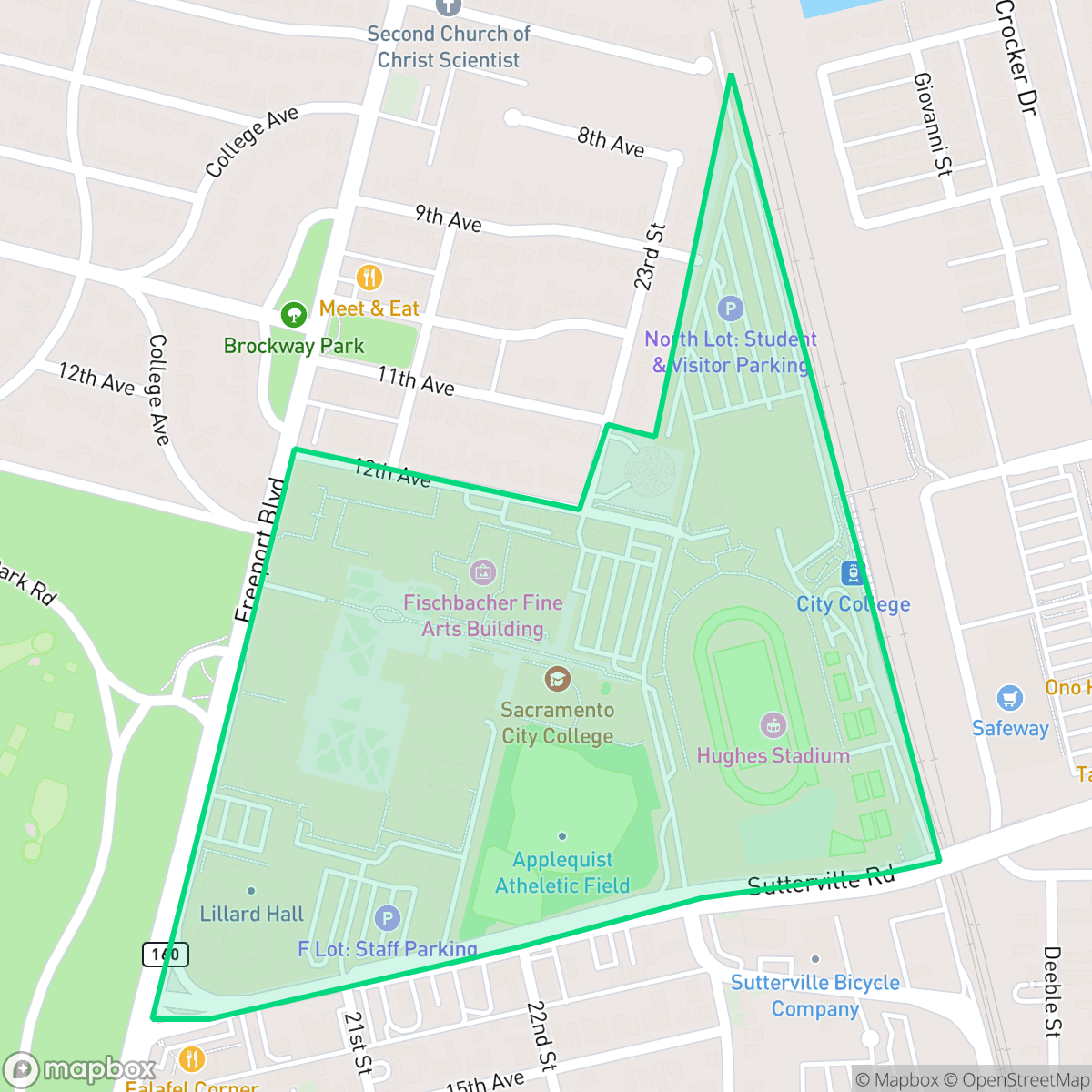
The Sacramento City College (SCC) neighborhood, located within the Land Park Community Plan Area of Sacramento, is anchored by its namesake institution. Originally part of John Sutter’s Mexican land grant, the area was later operated as a ranch by the Gay family until 1924, when it was acquired for the college. Founded in 1916 by Belle Cooledge—who later became Sacramento's first female mayor—the college settled at its permanent Freeport Boulevard and Sutterville Road campus in 1926. The neighborhood features historic campus landmarks, including the Harry J. Devine-designed library built in 1937 and the Charles C. Hughes Stadium, which famously hosted the 1967 Sacramento Pop Festival. Surrounded by tree-lined streets and well-established homes built primarily between 1940 and 1969, the SCC neighborhood retains a distinct academic and residential character.
The area serves as an academic hub, characterized by its immediate proximity to the college campus and a high degree of walkability that connects residents to local spots like the Gregory Kondos Gallery and various cafes. The neighborhood maintains a vibrant, social atmosphere that stands out relative to the city average, with a layout that supports a pedestrian lifestyle and high levels of dog friendliness for those living in the surrounding residential blocks.
Prospective residents should weigh the benefits of this central location against specific environmental and institutional factors. The area experiences notable noise levels primarily driven by road traffic, and the local school district is currently navigating significant fiscal and administrative instability. Additionally, while the neighborhood is free from industrial hazards, it faces elevated risks regarding fire safety, making it a better fit for those who prioritize academic proximity and walkability over quietude or top-tier public school performance.
Neighborhood Scores Across 15 Qualities
Residential spacing offers a balanced level of separation between neighbors. According to iHuus data, this degree of buffer is slightly higher than the Sacramento city average.
Pedestrian infrastructure is exceptional here, featuring wide sidewalks on both sides of the street and numerous frequent crossings. According to iHuus data, the area provides a much more accessible environment for walking than the typical Sacramento neighborhood.
Standard tract housing defines the area, featuring modest yards and uniform rooflines. This visual character is slightly below the Sacramento average.
Abundant parks and expansive trail systems provide significant opportunities for pet owners. Access to open space in this area is notably higher than the Sacramento average, according to iHuus data.
Open land and scattered homes among greenery create a landscape that is very similar to the broader Sacramento area. According to iHuus data, the area maintains a balance of residential pockets and natural spaces.
Social hubs and local eateries provide more activity than the typical Sacramento neighborhood, though some residential blocks remain quiet and suburban. According to iHuus data, the area features a notable concentration of cafes and galleries interspersed with calm, green spaces near the railway.
Frequent noise from nearby freeways and railroad tracks characterizes this area. According to iHuus data, acoustic comfort is significantly lower than the Sacramento average.
Air quality fluctuates between acceptable and unhealthy levels, mirroring the broader Sacramento area. Sensitive groups should monitor local conditions during periods of occasional concern.
Industrial activity and heavy warehouse facilities are entirely absent from this area. This neighborhood offers a more residential atmosphere than the Sacramento average, consisting primarily of quiet streets and open green spaces.
Health insurance accessibility is significantly higher than the Sacramento average, with a vast majority of residents maintaining coverage according to iHuus data.
Voting patterns and census indicators show a predominantly liberal leaning that is slightly more pronounced than the Sacramento average.
Residents live among a diverse age demographic that includes a wider spread of young adults, families, and seniors than is typically found across Sacramento. According to iHuus data, this creates a balanced population profile.
Flood safety levels in this area are notably higher than the Sacramento average, though some residual risk remains within the 500-year floodplain. According to iHuus data, properties here sit outside the most high-risk zones but are not entirely immune to seasonal flooding.
Address-Level Insights for SCC


iHuus Neighborhood Intelligence Insights
Get address-level neighborhood insights for SCC
- Street-level scores — see how individual blocks compare, not just neighborhood averages
- Micro-zone boundaries — identify quiet pockets, flood boundaries, and walkable clusters before you visit
- 15 dimensions in full — walkability, noise, air quality, school quality, insurance coverage, population age profile, urban/rural index, and more
- Boundary risk alerts — know if your address sits near a block boundary where scores drop, the kind of detail no listing will ever mention
- School insights — individual school ratings and insights, not just district-level data
- Compare before you commit — side-by-side data across neighborhoods, down to block precision
No credit card required
Compare with Any Neighborhood
| Dimension | SCC | Airport |
|---|---|---|
| 🚶 Walkabilityavg 8.5 | ||
| 🔊 Acoustic Comfortavg 3.22 | ||
| 🤫 Privacy Indexavg 5.34 | ||
| 🎨 Visual Appealavg 6.3 | ||
| 🐕 Dog Friendlinessavg 6.98 | ||
| 🗺️ Urban-Rural Indexavg 6.57 | ||
| ✨ Neighborhood Vibeavg 4.66 | ||
| 🏥 Health Insurance Coverageavg 7.4 | ||
| 🌿 Air Qualityavg 6.12 | ||
| 🏭 Industrial Proximityavg 8.32 | ||
| 🌊 Flood Safetyavg 6.04 | ||
| 🗳️ Ideological Leanavg 9.49 | ||
| 👥 Population Age Profileavg 4.75 | ||
| 🔥 Fire Safetyavg 0 | ||
| 🏫 School Quality |
SCC Rankings
School Districts Serving SCC
School Insights for SCC
Below average outcomes; significant attendance and academic challenges.
School Insights
See what's really behind every school rating near SCC
- Individual school ratings — each school's own score with outcome context, not just a district average
- Enrollment & class size data — student-to-teacher ratio and how it compares to the state average
- Full demographics breakdown — ethnicity and gender composition for every school in the enrollment zone
- Every school in the district — all schools within the enrollment boundary ranked by rating, not just the closest one
- Grade levels & benchmarks — elementary through high school, with below/above state-average flags
No credit card required