River Park, Sacramento
Updated · 3,751 residents
River Park is a quiet, tree-lined residential enclave defined by its mid-century ranch homes and peaceful atmosphere. The neighborhood offers high acoustic comfort and exceptional dog-friendliness, providing a serene environment that remains well-connected to the broader Sacramento area.
Key Highlights
About River Park
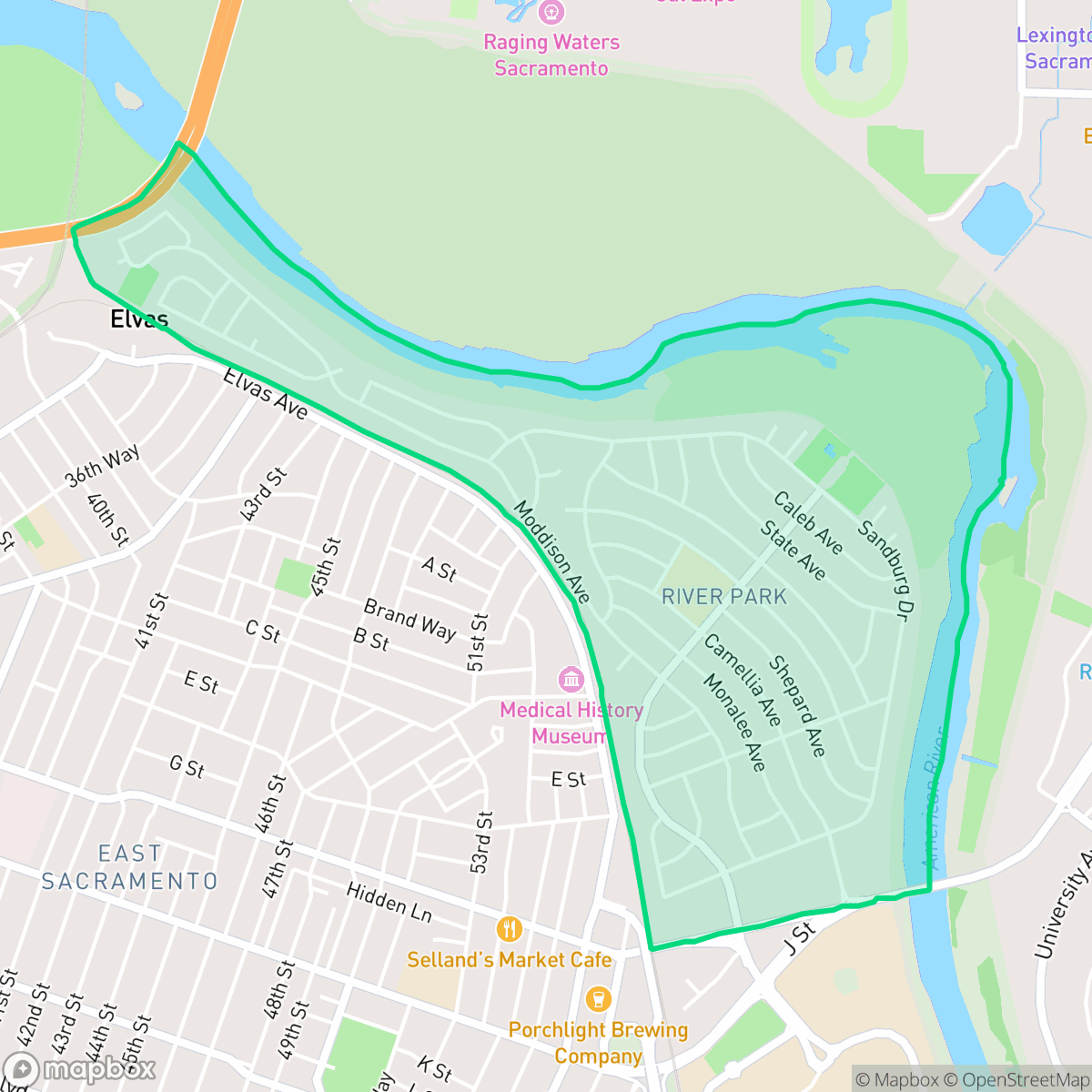
Bounded by a sweeping bend of the American River, Sacramento’s River Park neighborhood began in 1849 when A.P. Smith purchased land from John Sutter Jr. to establish Smith’s Pomological Gardens, a famous early California botanical resort. In 1946, developers Louis Carlson, John Sandburg, and the Moddison family successfully petitioned for annexation, transforming the area's agricultural ranches into a planned suburb. Developed primarily in the late 1940s and 1950s as the Orchard Terrace and River Park subdivisions, the neighborhood is characterized by mid-century single-family ranch-style homes and a mature tree canopy. Functioning as a quiet, peninsula-like cul-de-sac with only two entry points off H Street, River Park’s identity is defined by local landmarks like Caleb Greenwood Elementary School, Glenn Hall Park, Paradise Beach, and its proximity to Sacramento State University.
The neighborhood functions as a secluded peninsula, characterized by its mature tree canopy and a lack of through traffic that contributes to a notably quiet living environment. Residents benefit from high levels of acoustic comfort and a strong residential focus, with open green spaces and proximity to the American River providing ample recreational opportunities. According to iHuus data, the area maintains a high standard of health insurance coverage, reflecting its stable and established demographic profile.
While the area is highly rated for its visual appeal and pet-friendly environment, it features a lower degree of commercial activity, resulting in a quieter, less vibrant pace of life. Prospective residents should note that while the neighborhood is walkable, daily errands often require a vehicle due to the limited number of local businesses. It is an ideal setting for families and individuals seeking a tranquil, suburban lifestyle, particularly with the highly regarded Caleb Greenwood Elementary School serving as a central community anchor.
Neighborhood Scores Across 15 Qualities
Residential spacing offers more separation than the Sacramento average, though homes near the river and campus area sit closer together. Most properties maintain standard suburban setbacks and fenced backyards, according to iHuus data.
Extensive sidewalk networks and low-traffic residential streets with mature tree canopy make for pleasant pedestrian routes. Connectivity is slightly below the Sacramento average, though safe crossings and continuous paths remain widely available according to iHuus data.
Manicured landscapes and upscale amenities like private pools contribute to a visual environment that is more polished than the Sacramento average. Residential views vary between large, well-kept homes and more standardized apartment complexes with shared amenities.
Access to the American River trails and expansive green spaces provides much more space for pets than the Sacramento average. Wide residential parkways and connected trail systems offer safe, low traffic routes for walking dogs.
Frequent open land and river corridors provide a more natural setting than much of the city. According to iHuus data, this area features a mix of scattered homes and natural spaces that is slightly more rural than the Sacramento average.
Low-density residential streets and vast open spaces create a serene, tranquil environment. This area is notably more subdued than the Sacramento average, featuring a landscape defined by significant greenery and a limited presence of commercial activity.
Local traffic from nearby busy streets creates a consistent level of ambient noise. According to iHuus data, the acoustic environment in River Park is slightly more active than the Sacramento average.
Air quality levels fluctuate between acceptable and unhealthy, presenting occasional concerns for sensitive groups. According to iHuus data, these conditions are roughly in line with the Sacramento city average.
Residential life is largely undisturbed by heavy industrial facilities or warehouses, which is notably better than the Sacramento average. While some light utility infrastructure and municipal water storage are present, there are no detected large-scale hazardous sites or heavy manufacturing plants.
Health insurance accessibility is notably higher in this area than the Sacramento average, according to iHuus data. Most residents in River Park are covered by a health insurance plan.
Voting patterns and census indicators show a deeply liberal political leaning, which is consistent with the broader Sacramento area according to iHuus data.
A balanced mix of young adults, families, and older residents characterizes the area. According to iHuus data, this demographic distribution is largely consistent with the broader Sacramento area.
Residual flood risk exists as parts of the area fall within the 500-year floodplain. This level of safety is slightly higher than the Sacramento city average, according to iHuus data.
Address-Level Insights for River Park


iHuus Neighborhood Intelligence Insights
Get address-level neighborhood insights for River Park
- Street-level scores — see how individual blocks compare, not just neighborhood averages
- Micro-zone boundaries — identify quiet pockets, flood boundaries, and walkable clusters before you visit
- 15 dimensions in full — walkability, noise, air quality, school quality, insurance coverage, population age profile, urban/rural index, and more
- Boundary risk alerts — know if your address sits near a block boundary where scores drop, the kind of detail no listing will ever mention
- School insights — individual school ratings and insights, not just district-level data
- Compare before you commit — side-by-side data across neighborhoods, down to block precision
No credit card required
Compare with Any Neighborhood
| Dimension | River Park | Airport |
|---|---|---|
| 🚶 Walkabilityavg 8.5 | ||
| 🔊 Acoustic Comfortavg 3.22 | ||
| 🤫 Privacy Indexavg 5.34 | ||
| 🎨 Visual Appealavg 6.3 | ||
| 🐕 Dog Friendlinessavg 6.98 | ||
| 🗺️ Urban-Rural Indexavg 6.57 | ||
| ✨ Neighborhood Vibeavg 4.66 | ||
| 🏥 Health Insurance Coverageavg 7.4 | ||
| 🌿 Air Qualityavg 6.12 | ||
| 🏭 Industrial Proximityavg 8.32 | ||
| 🌊 Flood Safetyavg 6.04 | ||
| 🗳️ Ideological Leanavg 9.49 | ||
| 👥 Population Age Profileavg 4.75 | ||
| 🔥 Fire Safetyavg 0 | ||
| 🏫 School Quality |
River Park Rankings
School Districts Serving River Park
School Insights for River Park
Below average outcomes; significant attendance and academic challenges.
School Insights
See what's really behind every school rating near River Park
- Individual school ratings — each school's own score with outcome context, not just a district average
- Enrollment & class size data — student-to-teacher ratio and how it compares to the state average
- Full demographics breakdown — ethnicity and gender composition for every school in the enrollment zone
- Every school in the district — all schools within the enrollment boundary ranked by rating, not just the closest one
- Grade levels & benchmarks — elementary through high school, with below/above state-average flags
No credit card required