Richmond Grove, Sacramento
Updated · 2,007 residents
Richmond Grove is a highly walkable Sacramento neighborhood characterized by its historic architectural diversity and vibrant local food scene. Residents benefit from excellent air quality and a strong sense of community, though the area experiences significant noise levels due to its proximity to major highway infrastructure.
Key Highlights
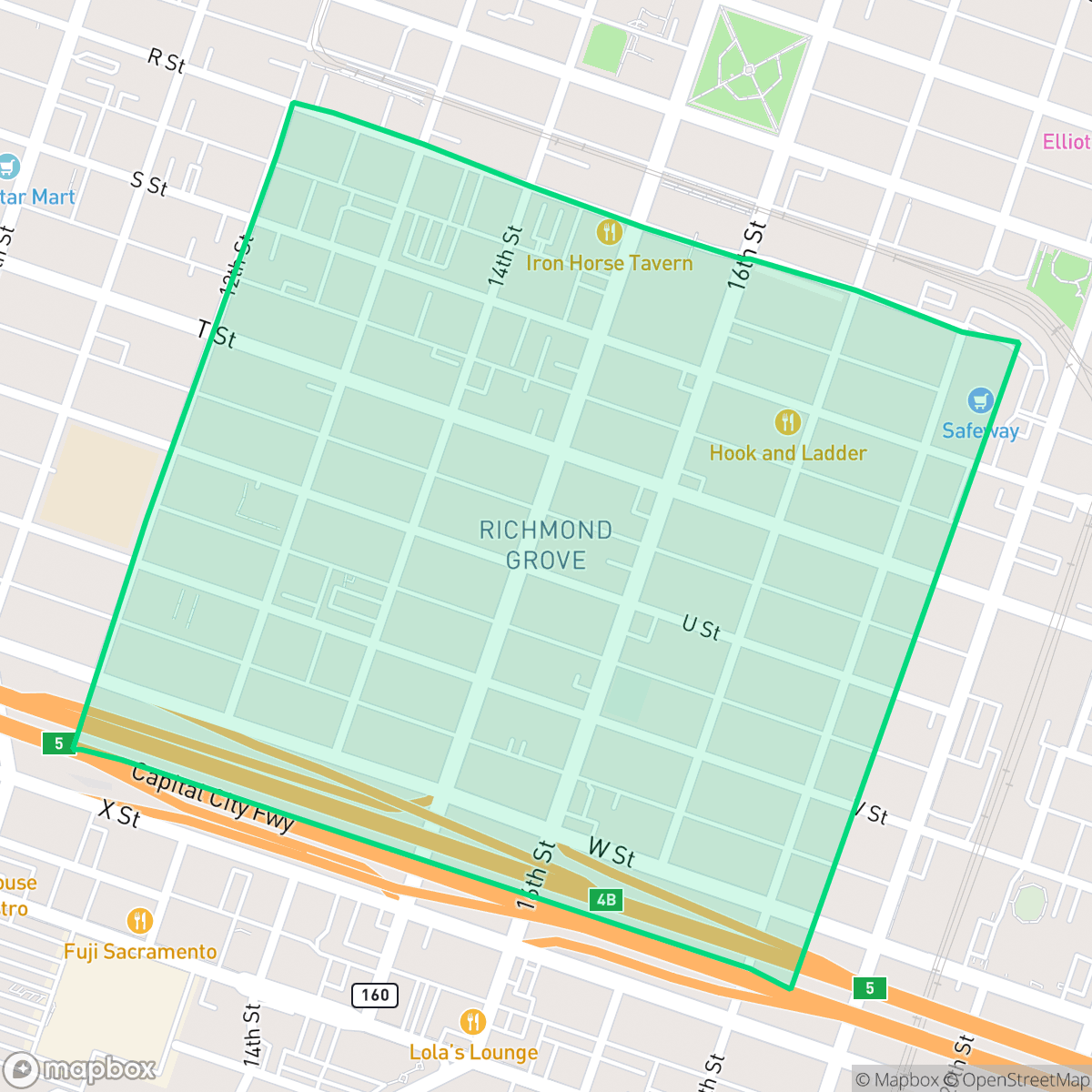
About Richmond Grove
Located in Sacramento, California, the Richmond Grove neighborhood developed as a primarily residential area from the 1860s through the mid-20th century. Unlike many surrounding neighborhoods, Richmond Grove historically lacked racial covenants, making it a vital haven for Black, Japanese, and Chinese residents, particularly after World War II and the redevelopment of Sacramento’s West End. Architecturally, the neighborhood features a dense collection of historic homes, with nearly half of its contributing structures built in the Craftsman style, alongside Queen Anne, Streamline Moderne, and Midcentury Modern designs. Key local landmarks reflect this diverse cultural evolution, including the Northern California Koyasan Temple—originally built as an Italian Christian church in the 1930s before transitioning to a Shingon Buddhist temple—and the former Negro Woman's Civic Improvement Club on T Street, which opened in 1942 as a boarding home for Black women.
This area serves as a dense, urban residential hub where historic Craftsman, Queen Anne, and Midcentury Modern homes sit alongside modern commercial amenities. With a perfect walkability score according to iHuus data, the neighborhood allows residents to easily access popular local spots like Camellia Coffee Roasters and Binchoyaki. The streets are lined with trees, creating a pleasant environment for pedestrians and dog owners who frequent the nearby public parks. While the location offers high accessibility and a lively atmosphere, prospective residents should consider the acoustic environment. The neighborhood faces persistent road traffic noise, which impacts the overall quietness of the area. It is well-suited for those who prioritize urban convenience and cultural character over absolute silence, as well as individuals who value being within walking distance of diverse dining and social venues.
Neighborhood Scores Across 15 Qualities
Residential spacing varies between close-proximity urban structures and more spread-out homes. According to iHuus data, this level of density provides slightly less buffer between neighbors than the Sacramento average.
Pedestrian movement is easy due to a dense street grid, continuous sidewalks, and ample crossings. This area offers superior walkability compared to the Sacramento average, supported by a high tree canopy and direct paths.
Residential views consist of tidy single-family homes and apartment complexes with modest yards. This visual landscape is slightly below the Sacramento average for aesthetic variety.
Wide, tree-lined streets with grass verges and proximity to a large public park provide ample space for pet owners. According to iHuus data, these features make the area slightly more pet-friendly than the Sacramento average.
Residential streets and green spaces exist in roughly equal measure here. This area is less densely urbanized than the Sacramento average, offering a mix of housing, commercial blocks, and larger infrastructure elements according to iHuus data.
Frequent social activity and a notable concentration of local dining hubs make this area significantly more vibrant than the Sacramento average. Residents can find a diverse mix of high-energy urban pockets and active suburban streets near various parks and commercial centers.
Frequent noise from nearby airport runways and heavy rail infrastructure makes this area significantly louder than the Sacramento average. Residents should expect persistent acoustic disruptions throughout the day.
Air quality remains consistently high with infrequent instances of poor air readings, performing significantly better than the Sacramento average according to iHuus data.
Primarily residential in character, this area avoids heavy industry although a railway corridor and electrical substation are present in the southern portion. According to iHuus data, the concentration of industrial activity is roughly in line with the Sacramento average.
Health insurance enrollment rates in this area are lower than the Sacramento average, according to iHuus data.
Voting patterns and census indicators in this area reflect a very strong liberal leaning, which is slightly more pronounced than the Sacramento average according to iHuus data.
Residents live alongside a balanced mix of young adults, families, and older individuals. This demographic spread is largely consistent with the broader Sacramento area, according to iHuus data.
Residual flood risk exists within the 500-year floodplain, though safety levels remain notably higher than the Sacramento city average according to iHuus data.
Address-Level Insights for Richmond Grove


iHuus Neighborhood Intelligence Insights
Get address-level neighborhood insights for Richmond Grove
- Street-level scores — see how individual blocks compare, not just neighborhood averages
- Micro-zone boundaries — identify quiet pockets, flood boundaries, and walkable clusters before you visit
- 15 dimensions in full — walkability, noise, air quality, school quality, insurance coverage, population age profile, urban/rural index, and more
- Boundary risk alerts — know if your address sits near a block boundary where scores drop, the kind of detail no listing will ever mention
- School insights — individual school ratings and insights, not just district-level data
- Compare before you commit — side-by-side data across neighborhoods, down to block precision
No credit card required
Compare with Any Neighborhood
| Dimension | Richmond Grove | Airport |
|---|---|---|
| 🚶 Walkabilityavg 8.5 | ||
| 🔊 Acoustic Comfortavg 3.22 | ||
| 🤫 Privacy Indexavg 5.34 | ||
| 🎨 Visual Appealavg 6.3 | ||
| 🐕 Dog Friendlinessavg 6.98 | ||
| 🗺️ Urban-Rural Indexavg 6.57 | ||
| ✨ Neighborhood Vibeavg 4.66 | ||
| 🏥 Health Insurance Coverageavg 7.4 | ||
| 🌿 Air Qualityavg 6.12 | ||
| 🏭 Industrial Proximityavg 8.32 | ||
| 🌊 Flood Safetyavg 6.04 | ||
| 🗳️ Ideological Leanavg 9.49 | ||
| 👥 Population Age Profileavg 4.75 | ||
| 🔥 Fire Safetyavg 0 | ||
| 🏫 School Quality |
Richmond Grove Rankings
School Districts Serving Richmond Grove
School Insights for Richmond Grove
Below average outcomes; significant attendance and academic challenges.
School Insights
See what's really behind every school rating near Richmond Grove
- Individual school ratings — each school's own score with outcome context, not just a district average
- Enrollment & class size data — student-to-teacher ratio and how it compares to the state average
- Full demographics breakdown — ethnicity and gender composition for every school in the enrollment zone
- Every school in the district — all schools within the enrollment boundary ranked by rating, not just the closest one
- Grade levels & benchmarks — elementary through high school, with below/above state-average flags
No credit card required