Richards, Sacramento
Updated · 1,980 residents
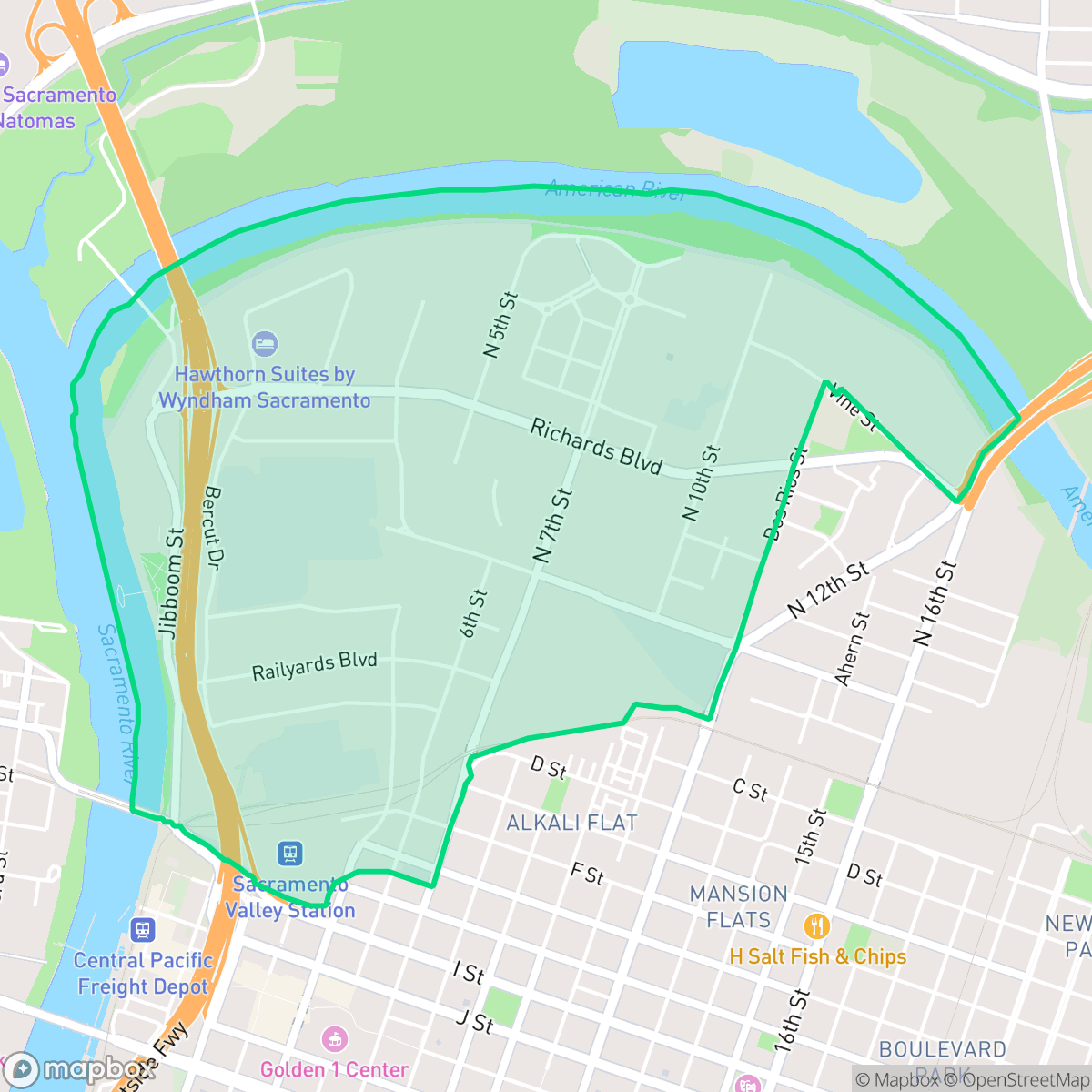
Richards is a transitioning industrial district in Sacramento defined by its proximity to major logistics hubs and the American River. While the area benefits from good air quality, residents experience significant noise from road traffic and a landscape dominated by large-scale commercial infrastructure.
Key Highlights
About Richards
Once an isolated industrial hub bounded by the American and Sacramento rivers, the Richards neighborhood—now often called the River District—historically served as Sacramento’s premier distribution center. Its industrial legacy was anchored by the Bercut-Richards Packing Company, once California's largest independently owned cannery, and the historic Blue Diamond Growers facility. Residential development began after World War II with the construction of the 22-acre Dos Rios public housing project (later Twin Rivers, now Mirasol Village). Following its annexation to Sacramento in the late 1950s and the subsequent decline of rail shipping, the area transitioned through the Richards Boulevard Redevelopment Area. Today, the neighborhood is undergoing a major mixed-use transformation, highlighted by the revitalization of an abandoned historic power station into the SMUD Museum of Science and Curiosity (MOSAC).
The neighborhood functions as a dense mix of heavy industrial zones, logistics warehouses, and emerging residential apartment blocks. Its current character is shaped by a landscape of large-footprint commercial operations, including scrap metal facilities and wastewater infrastructure, which contributes to a lower visual appeal score. Despite its industrial roots, the area maintains a strategic location near the confluence of the American and Sacramento rivers, serving as a key node for city distribution and light industrial activity.
Living in this area involves specific trade-offs, particularly regarding noise levels and pedestrian accessibility. According to iHuus data, the neighborhood is better suited for those who prioritize proximity to major thoroughfares over a quiet, walkable suburban environment. Prospective residents should also be aware of the complex educational landscape, as the area is served by multiple school districts currently navigating significant fiscal and operational challenges. While the area offers high air quality, the presence of industrial sites and high traffic noise makes it a distinct choice compared to the city's more residential, pedestrian-oriented neighborhoods.
Neighborhood Scores Across 15 Qualities
Structures are closely spaced with minimal separation between homes, making this area significantly less private than the Sacramento average according to iHuus data.
Pedestrian access is easy due to a consistent grid system, reliable sidewalks, and safe crossings. This level of walkability is slightly above the Sacramento average, particularly near the downtown core and arena zones.
Standard residential rooftops and dense apartment blocks define the area, which offers less visual variety than the Sacramento average. According to iHuus data, the landscape is characterized by tidy yards and modern urban structures like solar panels and large arena rooftops.
Walking routes for pets are primarily limited to street verges and the nearby riverfront strip, which offers fewer park options than the Sacramento average. Most areas consist of paved surfaces and multi-lane highways, according to iHuus data.
Industrial warehouses and residential blocks provide a suburban feel that is notably less dense than the Sacramento average. According to iHuus data, the area features a balance of paved industrial footprints and riparian green space.
Local social hubs and diverse dining options provide a higher level of activity than the Sacramento average. While some areas remain quiet near industrial zones, many blocks feature a noticeable concentration of lively eateries and public spaces.
Frequent sounds from nearby railroad tracks and major freeways characterize the area. This level of acoustic disturbance is higher than the Sacramento average, according to iHuus data.
Air quality in this area remains mostly clean with only rare instances of elevated readings. According to iHuus data, the atmosphere is significantly clearer than the Sacramento city average.
Large logistics warehouses, rail corridors, and a wastewater treatment plant contribute to a notable industrial presence that is more pronounced than the Sacramento average. While much of the area remains residential, residents may encounter increased truck traffic and noise from nearby utility and transport hubs according to iHuus data.
Health insurance access is significantly lower than the Sacramento average. Residents may face higher challenges accessing covered medical services according to iHuus data.
Voting patterns and census indicators reflect a very liberal political leaning that is even more pronounced than the Sacramento average.
Residents live alongside a balanced mix of young adults, families, and older populations. According to iHuus data, this demographic distribution is very similar to the overall Sacramento average.
Residual flood risks exist within this area due to its location in a 500 year floodplain, though safety levels remain higher than the Sacramento average according to iHuus data.
Address-Level Insights for Richards


iHuus Neighborhood Intelligence Insights
Get address-level neighborhood insights for Richards
- Street-level scores — see how individual blocks compare, not just neighborhood averages
- Micro-zone boundaries — identify quiet pockets, flood boundaries, and walkable clusters before you visit
- 15 dimensions in full — walkability, noise, air quality, school quality, insurance coverage, population age profile, urban/rural index, and more
- Boundary risk alerts — know if your address sits near a block boundary where scores drop, the kind of detail no listing will ever mention
- School insights — individual school ratings and insights, not just district-level data
- Compare before you commit — side-by-side data across neighborhoods, down to block precision
No credit card required
Compare with Any Neighborhood
| Dimension | Richards | Airport |
|---|---|---|
| 🚶 Walkabilityavg 8.5 | ||
| 🔊 Acoustic Comfortavg 3.22 | ||
| 🤫 Privacy Indexavg 5.34 | ||
| 🎨 Visual Appealavg 6.3 | ||
| 🐕 Dog Friendlinessavg 6.98 | ||
| 🗺️ Urban-Rural Indexavg 6.57 | ||
| ✨ Neighborhood Vibeavg 4.66 | ||
| 🏥 Health Insurance Coverageavg 7.4 | ||
| 🌿 Air Qualityavg 6.12 | ||
| 🏭 Industrial Proximityavg 8.32 | ||
| 🌊 Flood Safetyavg 6.04 | ||
| 🗳️ Ideological Leanavg 9.49 | ||
| 👥 Population Age Profileavg 4.75 | ||
| 🔥 Fire Safetyavg 0 | ||
| 🏫 School Quality |
Richards Rankings
School Districts Serving Richards
School Insights for Richards
Below average outcomes; significant attendance and academic challenges.
School Insights
See what's really behind every school rating near Richards
- Individual school ratings — each school's own score with outcome context, not just a district average
- Enrollment & class size data — student-to-teacher ratio and how it compares to the state average
- Full demographics breakdown — ethnicity and gender composition for every school in the enrollment zone
- Every school in the district — all schools within the enrollment boundary ranked by rating, not just the closest one
- Grade levels & benchmarks — elementary through high school, with below/above state-average flags
No credit card required