Pocket, Sacramento
Updated · 27,511 residents
The Pocket is a serene, river-adjacent neighborhood in Sacramento defined by its winding suburban streets, consistent sidewalk networks, and abundant green space. Known for its high walkability and quiet, residential atmosphere, the area offers a blend of established tract housing and scenic canal-side paths that cater to outdoor-focused residents.
Key Highlights
About Pocket
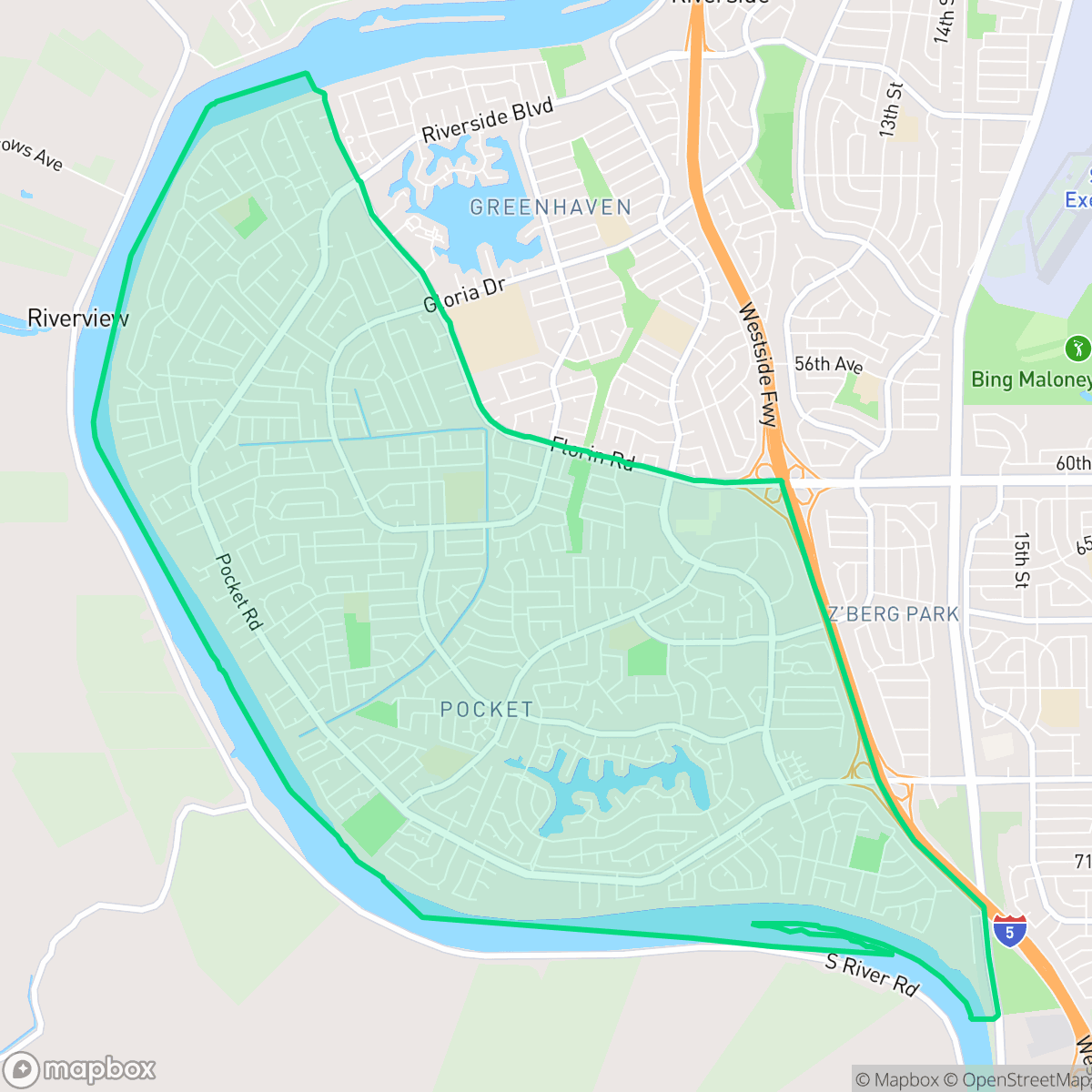
Named for its location within a large meandering bend of the Sacramento River, the Pocket neighborhood was originally a low-lying riparian forest. Following the California Gold Rush, Portuguese immigrants from the Azores Islands settled the area. They constructed levees to reclaim the swampy terrain, transforming it into a highly productive agricultural region known as "Little Portugal" or the "Lisbon District". Early industrial activity included the Sacramento Brickyard Co., established in 1854, which supplied bricks for the State Capitol; its former clay pit is now Lake Greenhaven. Annexed by Sacramento in 1959, the area transitioned from farming to a planned suburban community under the Pocket Area General Development Plan. Local heritage is preserved in landmarks like the 1873 Dutra House and the Portuguese Community Park.
The neighborhood functions as a dense suburban enclave with a strong connection to the Sacramento River. Its layout features wide green verges and interconnected canal pathways, making it highly accessible for pedestrians and dog owners. While the area maintains a quiet, low-density feel, it provides a stable residential environment with a mix of single-family homes, many of which feature private pools and well-maintained landscaping. The lack of industrial activity contributes to a consistent, peaceful atmosphere throughout the residential blocks.
This community is ideal for families and professionals seeking a calm, safe environment with minimal industrial presence. While the area is highly walkable, it lacks a dense commercial core, meaning residents often rely on short drives for diverse dining and retail needs. Prospective residents should note the variability in local school performance, as the neighborhood is served by a district that contains both top-rated elementary schools and institutions facing significant administrative and academic challenges.
Neighborhood Scores Across 15 Qualities
Homes in this area feature a mix of detached houses and townhomes with varying levels of separation. This density is slightly higher than the Sacramento average, providing a standard suburban layout with moderate buffers between neighbors according to iHuus data.
Continuous sidewalks and dedicated canal crossings ensure safe movement throughout the area. This level of accessibility for pedestrians and cyclists is notably higher than the Sacramento average.
Large homes with manicured landscaping and frequent private pools characterize much of this area. According to iHuus data, the visual environment is notably more polished than the Sacramento average.
Abundant greenbelts, riverside trails, and wide grassy verges provide ample space for pets away from traffic. According to iHuus data, these connected parklands and canal corridors make this area more dog friendly than the Sacramento average.
Residential layouts range from dense suburban developments to a transition zone near large agricultural fields. This landscape is slightly more rural than the Sacramento average, featuring a mix of single-family homes and significant tree canopy according to iHuus data.
A mix of quiet, green residential blocks and lively social hubs provides a more active atmosphere than the Sacramento average. While many areas offer scenic views near the water, some parts of the neighborhood remain car-dependent with limited local business variety.
Steady traffic noise from nearby busy streets is common here; however, acoustic levels remain more stable than the Sacramento city average.
Air quality levels are generally acceptable, though sensitive groups may experience occasional concern during certain periods. This neighborhood maintains a level of air quality that is roughly in line with the Sacramento city average, according to iHuus data.
Industrial hazards and large warehouses are absent from this area, making it significantly cleaner of heavy industry than the Sacramento average. Residents live in a landscape of purely residential and light commercial uses, though some proximity to utility infrastructure and the nearby freeway is present.
Health insurance accessibility is notably higher than the Sacramento average, according to iHuus data. Most residents in this area have access to comprehensive medical coverage.
Voting patterns and census indicators reflect a deeply liberal political leaning, consistent with the broader Sacramento area.
Residents live alongside a balanced mix of young adults, families, and seniors. This demographic spread is slightly more varied than the average found across Sacramento, according to iHuus data.
Flood risk in this area is higher than the Sacramento average due to its location within a 500-year floodplain. According to iHuus data, some residual risk remains despite being situated in a generally stable zone.
Address-Level Insights for Pocket


iHuus Neighborhood Intelligence Insights
Get address-level neighborhood insights for Pocket
- Street-level scores — see how individual blocks compare, not just neighborhood averages
- Micro-zone boundaries — identify quiet pockets, flood boundaries, and walkable clusters before you visit
- 15 dimensions in full — walkability, noise, air quality, school quality, insurance coverage, population age profile, urban/rural index, and more
- Boundary risk alerts — know if your address sits near a block boundary where scores drop, the kind of detail no listing will ever mention
- School insights — individual school ratings and insights, not just district-level data
- Compare before you commit — side-by-side data across neighborhoods, down to block precision
No credit card required
Compare with Any Neighborhood
| Dimension | Airport | |
|---|---|---|
| 🚶 Walkabilityavg 8.5 | ||
| 🔊 Acoustic Comfortavg 3.22 | ||
| 🤫 Privacy Indexavg 5.34 | ||
| 🎨 Visual Appealavg 6.3 | ||
| 🐕 Dog Friendlinessavg 6.98 | ||
| 🗺️ Urban-Rural Indexavg 6.57 | ||
| ✨ Neighborhood Vibeavg 4.66 | ||
| 🏥 Health Insurance Coverageavg 7.4 | ||
| 🌿 Air Qualityavg 6.12 | ||
| 🏭 Industrial Proximityavg 8.32 | ||
| 🌊 Flood Safetyavg 6.04 | ||
| 🗳️ Ideological Leanavg 9.49 | ||
| 👥 Population Age Profileavg 4.75 | ||
| 🔥 Fire Safetyavg 0 | ||
| 🏫 School Quality |
Pocket Rankings
School Districts Serving Pocket
School Insights for Pocket
Below average outcomes; significant attendance and academic challenges.
School Insights
See what's really behind every school rating near Pocket
- Individual school ratings — each school's own score with outcome context, not just a district average
- Enrollment & class size data — student-to-teacher ratio and how it compares to the state average
- Full demographics breakdown — ethnicity and gender composition for every school in the enrollment zone
- Every school in the district — all schools within the enrollment boundary ranked by rating, not just the closest one
- Grade levels & benchmarks — elementary through high school, with below/above state-average flags
No credit card required