Old North Sacramento, Sacramento
Updated · 5,274 residents
Old North Sacramento is a historic district defined by its walkable grid, modest bungalow architecture, and a vibrant commercial corridor along Del Paso Boulevard. While the area offers convenient access to local dining and social hubs, residents should expect moderate road noise and a dense suburban environment.
Key Highlights
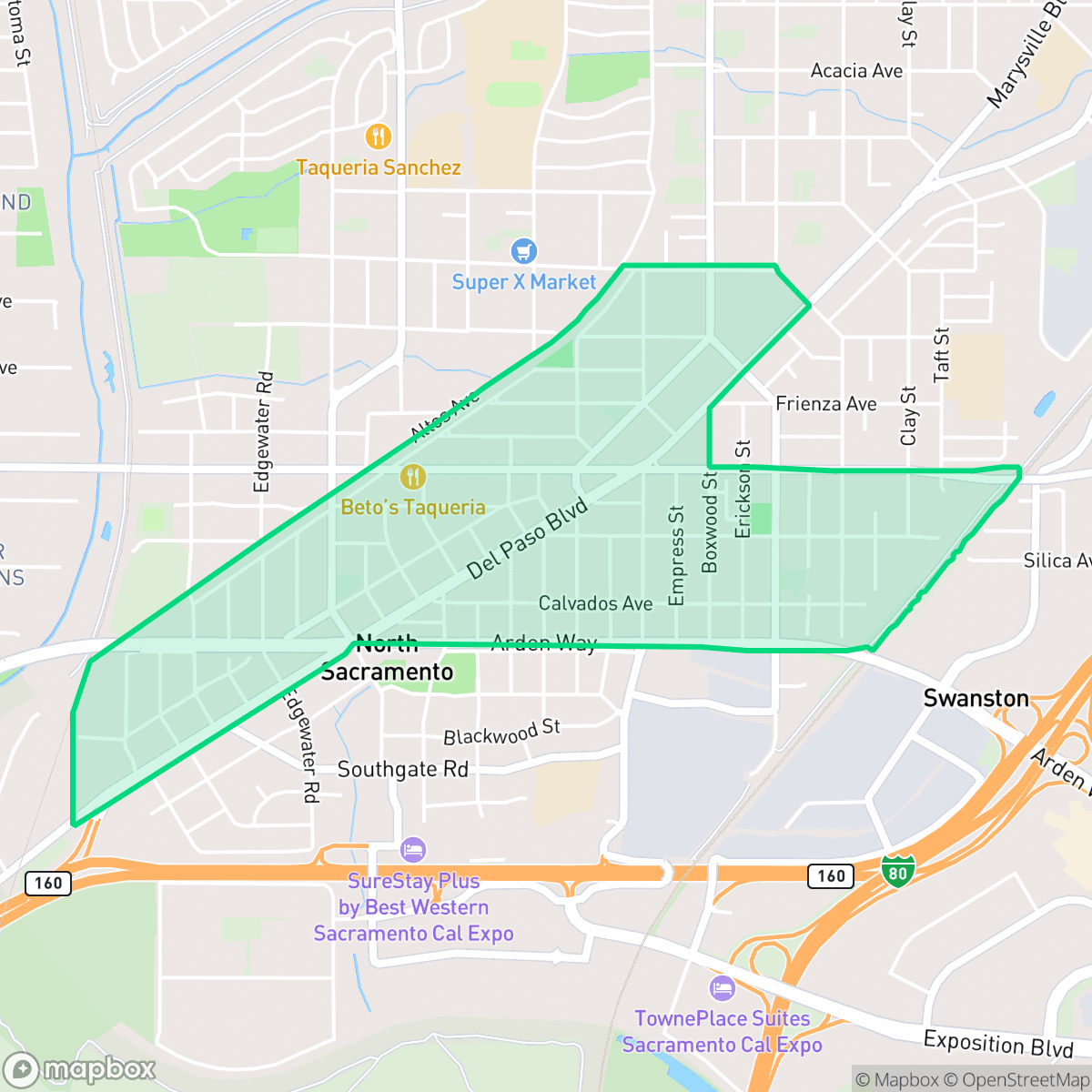
About Old North Sacramento
Old North Sacramento was originally part of Rancho Del Paso, a 19th-century land grant famous for James Ben Ali Haggin’s champion horse-breeding farm. Subdivided in the early 1900s by the North Sacramento Land Company, the area grew rapidly after a streetcar line was built in 1915, leading to its incorporation as the City of North Sacramento in 1924. Its main commercial corridor, Del Paso Boulevard, thrived as part of the historic Lincoln Highway (U.S. Route 40). A unique local law allowing fresh meat sales after 6:00 PM—banned in neighboring Sacramento—became a major talking point before the city was narrowly annexed by Sacramento in 1964. The construction of the North Sacramento Freeway bypassed the boulevard, sparking decades of economic disinvestment. Today, the neighborhood is recognized for its historic bungalows, mid-century homes, and its emerging Uptown arts district.
The neighborhood functions as a dense, mixed-use community where residential blocks of single-family homes sit alongside light industrial warehouses and active commercial strips. Its well-connected street grid allows for high walkability, providing residents with easy access to various local eateries and community spaces. While the aesthetic is characterized by modest tract housing and limited private outdoor space, the area benefits from a favorable flood safety profile and a central location that keeps essential services within reach.
Prospective residents should consider the trade-offs of living in a high-traffic environment, as road noise remains a consistent factor throughout the area. Families with school-aged children may find the local school district, Twin Rivers Unified, to be in a period of significant transition, which impacts academic consistency and resource availability. Overall, the neighborhood is best suited for individuals who prioritize walkability and proximity to urban amenities over quiet seclusion or expansive private yards.
Neighborhood Scores Across 15 Qualities
Homes are positioned with moderate spacing and minimal vegetation buffers between neighbors. This level of density provides slightly more separation between structures than is typical for the Sacramento average.
A well-defined grid with sidewalks and crosswalks connects residential areas to commercial strips, though some sidewalks can be narrow or interrupted. Pedestrian accessibility is slightly below the Sacramento average due to high-traffic arterial roads.
Standard tract housing with uniform rooflines and small yards defines the local landscape. According to iHuus data, the area offers less visual variety and fewer luxury amenities than the Sacramento average.
Access to dog walking space varies across the area, as some residential streets lack wide grassy verges. While certain sections offer large public parks and green space, the overall amenities are below the Sacramento average according to iHuus data.
Open land and scattered homes provide a slightly more rural feel than the Sacramento average. The area features a diverse landscape of single-family residential grids interspersed with large industrial warehouses and significant transportation infrastructure.
Lively pockets containing diverse dining and social hubs coexist with quieter, industrial-suburban blocks. This area offers a higher level of activity and amenity access than the Sacramento average.
Frequent noise from nearby railroad tracks and major freeways defines the acoustic environment. According to iHuus data, levels of disturbance in this area are slightly higher than the Sacramento average.
Air quality fluctuates between acceptable and unhealthy levels, presenting occasional concerns for sensitive groups. This quality is roughly in line with the Sacramento city average, according to iHuus data.
Residential life is largely undisturbed by heavy industry, though some light commercial warehouses and a rail corridor exist on the eastern edge. This level of industrial proximity is notably lower than the Sacramento average.
Health insurance coverage among residents is notably lower than the Sacramento average, according to iHuus data.
Voting patterns and census indicators show a deeply liberal political leaning, which is consistent with the broader Sacramento area according to iHuus data.
Residents live alongside a balanced mix of young adults, families, and older individuals. This demographic spread is very similar to the broader Sacramento area, according to iHuus data.
Residual flood risk exists within the 500-year floodplain, though safety levels remain notably higher than the Sacramento city average according to iHuus data.
Address-Level Insights for Old North Sacramento


iHuus Neighborhood Intelligence Insights
Get address-level neighborhood insights for Old North Sacramento
- Street-level scores — see how individual blocks compare, not just neighborhood averages
- Micro-zone boundaries — identify quiet pockets, flood boundaries, and walkable clusters before you visit
- 15 dimensions in full — walkability, noise, air quality, school quality, insurance coverage, population age profile, urban/rural index, and more
- Boundary risk alerts — know if your address sits near a block boundary where scores drop, the kind of detail no listing will ever mention
- School insights — individual school ratings and insights, not just district-level data
- Compare before you commit — side-by-side data across neighborhoods, down to block precision
No credit card required
Compare with Any Neighborhood
| Dimension | Old North Sacramento | Airport |
|---|---|---|
| 🚶 Walkabilityavg 8.5 | ||
| 🔊 Acoustic Comfortavg 3.22 | ||
| 🤫 Privacy Indexavg 5.34 | ||
| 🎨 Visual Appealavg 6.3 | ||
| 🐕 Dog Friendlinessavg 6.98 | ||
| 🗺️ Urban-Rural Indexavg 6.57 | ||
| ✨ Neighborhood Vibeavg 4.66 | ||
| 🏥 Health Insurance Coverageavg 7.4 | ||
| 🌿 Air Qualityavg 6.12 | ||
| 🏭 Industrial Proximityavg 8.32 | ||
| 🌊 Flood Safetyavg 6.04 | ||
| 🗳️ Ideological Leanavg 9.49 | ||
| 👥 Population Age Profileavg 4.75 | ||
| 🔥 Fire Safetyavg 0 | ||
| 🏫 School Quality |
Old North Sacramento Rankings
School Districts Serving Old North Sacramento
School Insights for Old North Sacramento
Below average outcomes; significant attendance and academic challenges.
School Insights
See what's really behind every school rating near Old North Sacramento
- Individual school ratings — each school's own score with outcome context, not just a district average
- Enrollment & class size data — student-to-teacher ratio and how it compares to the state average
- Full demographics breakdown — ethnicity and gender composition for every school in the enrollment zone
- Every school in the district — all schools within the enrollment boundary ranked by rating, not just the closest one
- Grade levels & benchmarks — elementary through high school, with below/above state-average flags
No credit card required