North Oak Park, Sacramento
Updated · 4,307 residents
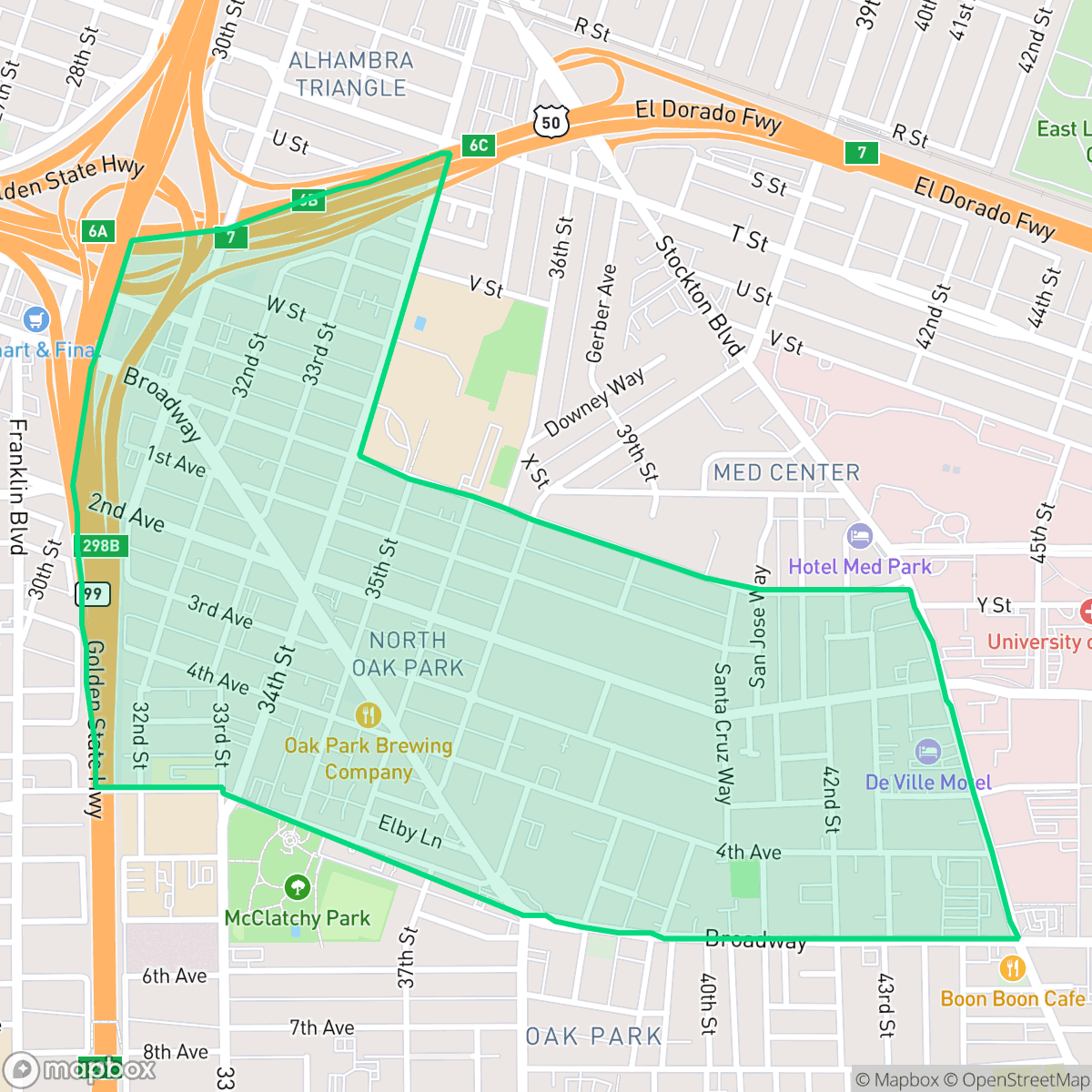
North Oak Park is a dense, walkable neighborhood defined by its consistent grid layout and proximity to local coffee shops and bakeries. Residents experience a classic suburban atmosphere with closely spaced homes, though the area is notably impacted by consistent road traffic noise.
Key Highlights
About North Oak Park
Subdivided in 1887 by Edwin K. Alsip as Sacramento’s first streetcar suburb, North Oak Park developed as a vibrant commercial and cultural hub. The neighborhood is anchored by the historic Broadway corridor (formerly Sacramento Avenue), which evolved into a bustling "second downtown" lined with 1910s and 1920s brick commercial buildings. At its heart lies McClatchy Park, which served as the terminus for early electric streetcars and hosted the popular Joyland amusement park until a fire in 1920. In the mid-20th century, the area became a center for Sacramento's African American community. Today, North Oak Park’s distinct character is preserved through landmarks like the historic Guild Theater and the "40 Acres" cultural complex, which celebrates local Black history and literature.
The neighborhood functions as a dense, walkable environment where residents can easily access local services such as Naked Coffee Roasting and Faria Bakery. The area maintains a steady rhythm of daily life, blending residential streets with institutional buildings and active commercial corridors. With a grid system that supports consistent pedestrian movement, the community remains well-connected to its local schools and small businesses without the presence of heavy industrial activity.
Living in this part of Sacramento involves specific trade-offs, particularly regarding privacy and acoustic comfort. Homes are typically situated on smaller lots with narrow side-yard setbacks, resulting in a high density that limits individual privacy. Additionally, according to iHuus data, the area experiences elevated noise levels averaging 63 decibels due to road traffic. Prospective residents should also be aware that the local school district is currently navigating significant fiscal instability and administrative challenges, which may impact educational services in the region.
Neighborhood Scores Across 15 Qualities
Homes are situated in relatively close proximity with narrow side-yard setbacks. This density is slightly higher than the Sacramento average, offering a layout where neighbors are more closely packed than in more suburban areas.
A consistent grid pattern with extensive sidewalk networks and pedestrian bridges provides excellent connectivity for residents. This ease of navigation for pedestrians is slightly above the Sacramento average, according to iHuus data.
Standard tract housing dominates the landscape, characterized by uniform rooflines and modest yards. This visual density and architectural consistency are roughly in line with the Sacramento average, according to iHuus data.
Extensive green verges and large public parks with ball fields offer reliable access to shaded walking paths. According to iHuus data, the availability of these continuous green spaces is slightly below the Sacramento city average.
Residential streets consist of a mix of single-family homes and multi-story structures, creating a suburban environment that is similar to the Sacramento average. According to iHuus data, the area features various commercial strips and institutional buildings rather than significant open farmland.
A predictable mix of residential streets, green spaces, and local services provides a balanced energy that is slightly more active than the Sacramento average. While many social spots and eateries are accessible, the density of walkable businesses remains moderate across the area.
Frequent acoustic disturbances from nearby railroad tracks and heavy freeway traffic are common here. This level of noise is notably higher than the Sacramento average, according to iHuus data.
Air quality in this area fluctuates between acceptable and unhealthy levels, mirroring the general conditions found across Sacramento. Sensitive groups should remain aware of occasional days with increased pollution levels according to iHuus data.
Industrial presence is minimal, as the area consists almost entirely of residential and light commercial land uses. According to iHuus data, this neighborhood lacks the warehouses, heavy industry, or pollution hazards found more frequently in other parts of Sacramento.
Health insurance coverage among residents is relatively high, though slightly below the Sacramento city average according to iHuus data.
Voting patterns and census indicators reflect a highly liberal political leaning that is even more pronounced than the Sacramento average.
A balanced distribution of young adults, families, and older residents characterizes the area, mirroring the demographic spread found across Sacramento.
Residual flood risk exists within the area, though safety levels are notably higher than the Sacramento city average according to iHuus data.
Address-Level Insights for North Oak Park


iHuus Neighborhood Intelligence Insights
Get address-level neighborhood insights for North Oak Park
- Street-level scores — see how individual blocks compare, not just neighborhood averages
- Micro-zone boundaries — identify quiet pockets, flood boundaries, and walkable clusters before you visit
- 15 dimensions in full — walkability, noise, air quality, school quality, insurance coverage, population age profile, urban/rural index, and more
- Boundary risk alerts — know if your address sits near a block boundary where scores drop, the kind of detail no listing will ever mention
- School insights — individual school ratings and insights, not just district-level data
- Compare before you commit — side-by-side data across neighborhoods, down to block precision
No credit card required
Compare with Any Neighborhood
| Dimension | North Oak Park | Airport |
|---|---|---|
| 🚶 Walkabilityavg 8.5 | ||
| 🔊 Acoustic Comfortavg 3.22 | ||
| 🤫 Privacy Indexavg 5.34 | ||
| 🎨 Visual Appealavg 6.3 | ||
| 🐕 Dog Friendlinessavg 6.98 | ||
| 🗺️ Urban-Rural Indexavg 6.57 | ||
| ✨ Neighborhood Vibeavg 4.66 | ||
| 🏥 Health Insurance Coverageavg 7.4 | ||
| 🌿 Air Qualityavg 6.12 | ||
| 🏭 Industrial Proximityavg 8.32 | ||
| 🌊 Flood Safetyavg 6.04 | ||
| 🗳️ Ideological Leanavg 9.49 | ||
| 👥 Population Age Profileavg 4.75 | ||
| 🔥 Fire Safetyavg 0 | ||
| 🏫 School Quality |
North Oak Park Rankings
School Districts Serving North Oak Park
School Insights for North Oak Park
Below average outcomes; significant attendance and academic challenges.
School Insights
See what's really behind every school rating near North Oak Park
- Individual school ratings — each school's own score with outcome context, not just a district average
- Enrollment & class size data — student-to-teacher ratio and how it compares to the state average
- Full demographics breakdown — ethnicity and gender composition for every school in the enrollment zone
- Every school in the district — all schools within the enrollment boundary ranked by rating, not just the closest one
- Grade levels & benchmarks — elementary through high school, with below/above state-average flags
No credit card required